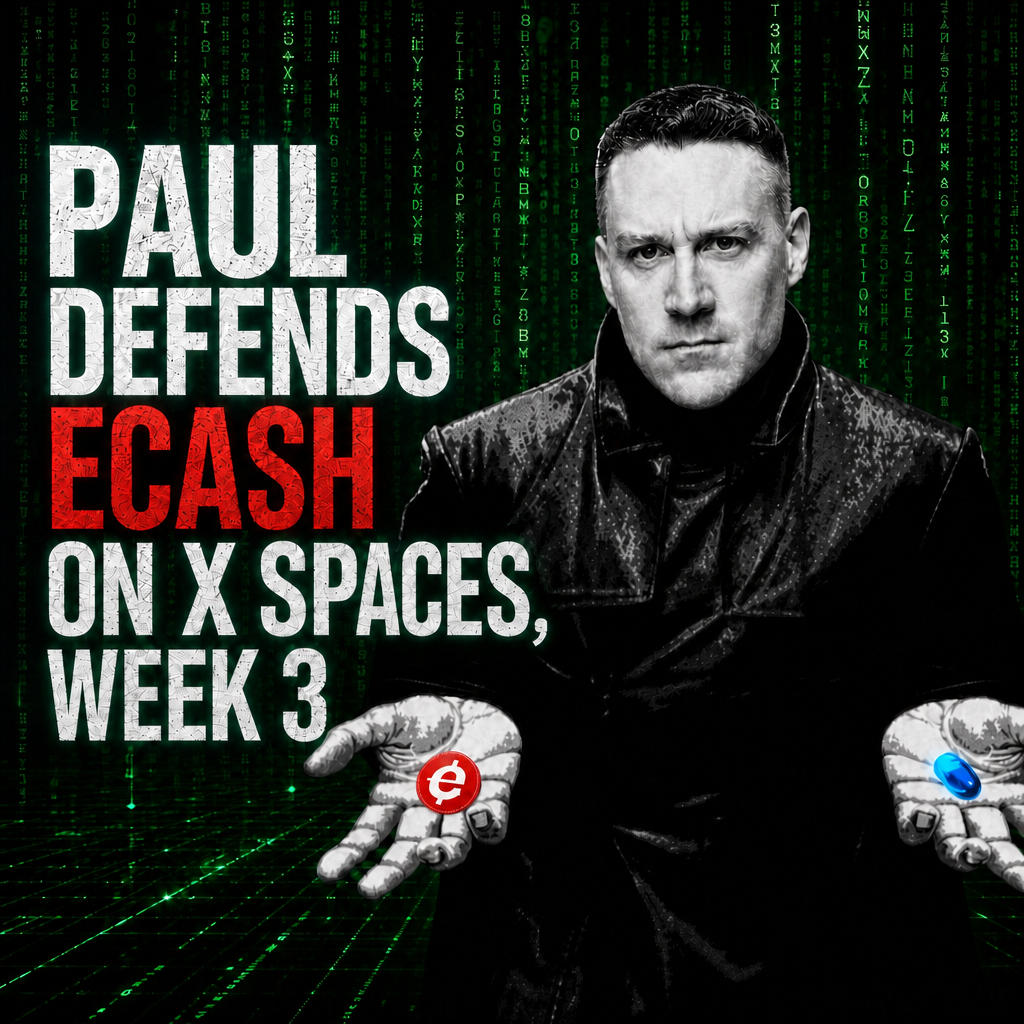
Inside Paul Sztorc's May 20th Spaces on X: When Critics Sergio Demian Lerner & Mr. HODL Joined
There is a kind of conversation that almost never happens in cryptocurrency anymore. The format goes like this: a project founder opens a public microphone, invites anyone to join, and then sits on the line for over two hours while critics (actual critics, not friendly questioners) take their turn at the mic. No moderation favoring the host. No muting when things get uncomfortable. No screening of who gets to speak.
On Wednesday, May 20th, 2026, that conversation happened. Paul Sztorc held his weekly open Twitter Spaces, and two of the project's most prominent critics walked into the room: Mr. Hodl, the longtime Bitcoin maximalist who has spent months questioning the Ecash fork on social media, and Sergio Demian Lerner, the cryptographer behind Rootstock and one of the most technically respected voices in Bitcoin sidechain research. What followed was not a flame war. It was something rarer and more valuable: three serious people, with real disagreements, finding the parts of the problem they actually agreed on.
This essay walks through what happened, why it mattered, and what the broader cast of participants contributed to one of the most substantive Ecash conversations to date.
The opening: governance, BIP 300, and why developers can't agree
Before either critic joined, Sztorc spent the opening of the Space answering a listener question about Ecash's future governance structure. His answer cut to what he sees as the core thesis of the project:
"BIP 300 is the governance solution… when it's on, people will be able to add or remove different L2, and L2 will be able to compete for users. So there will be some governance, but the only governance, so to speak, is which L2 the miners should support. And that almost takes care of itself completely, because the miners can easily support many different L2s with minimal involvement from them, and they collect transaction fee revenue from all of them."
This framing — that drivechains are the governance answer, not a feature requiring governance — turned out to be the philosophical anchor for nearly every disagreement that followed. The critics weren't really arguing about technical parameters. They were arguing about whether this framing is correct.
Jake, a regular participant who opened the technical discussion, made a point that would echo throughout the session: BitVM, the technology many Bitcoin developers are now pivoting toward, is itself a worse version of what BIP 300 already offers. Even BitVM's creator, Robin Linus, has publicly said BIP 300 should be activated. Sztorc agreed, framing it as a cultural rather than technical failure:
"We've had this phenomenon in Bitcoin where we have a bad criterion and then it redirects everyone's brainpower into something that we don't need. And then since monkey see monkey do, since people copy each other, it creates this mass psychosis on everyone."
Mr. Hodl arrives: the hashing algorithm question
When Mr. Hodl joined, he didn't open with hostility. He opened with a real engineering question: why use SHA-256 and merely lower the initial difficulty, rather than choosing a different hashing algorithm or merge-mining with Bitcoin itself?
Sztorc's answer was revealing because it showed his framing of Ecash's relationship to Bitcoin's miner ecosystem:
"If you switched hashing algorithms, then if Ecash gets really, really big, then all the SHA-256 miners will lose a ton of money. And I don't really want that to happen. I don't want them to be thinking about — after it's proven to be a big success — activating BIP 300 on BTC. I'd rather just have them click over."
Mr. Hodl pressed hard on the practical implications: with a low initial difficulty and a world full of existing ASICs, what stops a large miner from immediately dominating the chain and causing 51% problems? How do exchanges decide on a confirmation count? How does any of this bootstrap?
The exchange was tense but productive. Sztorc acknowledged the concern openly:
"I absolutely, 100% agree that at first you won't know. You'll be kind of flying dark, and you don't know what the real equilibrium difficulty should be. So very, very early on, when you first launch the project, that will be like a chaotic moment."
He then proposed three concrete mitigations he had been considering: a three-month temporary manual difficulty checkpoint that auto-deactivates, tighter difficulty adjustment guardrails during the bootstrap period, and pre-launch futures markets to provide price discovery. None of these are commitments yet, but the openness to discussing them publicly — without dismissing the critic — was the point.
Mr. Hodl's tone shifted noticeably as the conversation progressed. By the end of his segment he was saying:
"I'm a big fan of you because, again, like I really think that — I wish more people would fork Bitcoin's UTXO set instead of, you know, printing their own money. Like, I'm not a fan. The reason I really hated altcoins was because I didn't think people should just print their own money."
This is the part that almost never happens in Bitcoin Twitter discourse: a critic admitting that the method of the project, forking the UTXO set rather than premining a new token, is exactly the right approach... even while disagreeing with the specifics. Mr. Hodl pushed back on naming, on the exchange listing strategy, on the difficulty bootstrap mechanics. But on the fundamental ethics, he and Sztorc were aligned.
Sergio Demian Lerner: the most substantive technical critique to date
Then Sergio joined. For listeners who didn't know who he was, Sztorc introduced him simply: "We got the great Sergio." The deference was earned. Sergio is the architect of Rootstock, holds patents in cryptographic protocols, and has written some of the foundational research on Bitcoin sidechains.
His critique was sharp, technical, and impossible to dismiss. He challenged Sztorc's framing of the fork itself:
"You claim this fork is an airdrop, but it's not. It's something I would call a fork drop. Because basically you are not fixing a snapshot of the UTXO. You are just — those UTXOs are changing all the time. So basically, it's not like you take a snapshot and then you give the money to those owners. And you don't implement full replay protection on both sides, like changing the signature scheme or a single bit somewhere so that there is no possibility of transactional replay. And that makes it very, very hard for users and for sidechains, for anyone to claim your tokens without putting their own private keys in danger."
He then walked through the specific impact on Rootstock. Because Rootstock's private keys are held in HSMs that no individual controls, there is no way for the Rootstock community to "split" the BTC held by the peg in time for the August fork. This creates an attack surface he described with characteristic precision:
"Anyone can take in Bitcoins that have already been split, and then take out Bitcoins that are not yet split and cashed out. And I've done some math to see how much money will be there to grab. Depending on the value of this new token, it can be a couple of million dollars."
In other words: a sophisticated attacker can drain the Ecash entitlement of every BTC held in the Rootstock peg, while users who use Rootstock as designed receive nothing. Sergio wasn't speculating. He had run the numbers.
What made this exchange remarkable was Sztorc's response. He didn't deflect. He didn't insult Rootstock. He engaged technically and admitted the limits of his framing:
"A lot of that makes some sense to me, but not all of it… I do wonder about the philosophy of it all. Yeah, it is interesting that, like, you could just take a — you could just say, 'import this UTXO set,' and how would that really be different?"
The two of them then collaboratively explored solutions in real time. Sergio proposed a snapshot model with a three-to-six-month claim window. Sztorc proposed a "super replay protection" model that could be aware of sidechain UTXOs. Neither came to a final answer, but the conversation modeled what good-faith protocol design actually looks like — two engineers, with deep disagreements about philosophy, trying to find the design that hurts the fewest users.
Sergio closed his segment with a sentence that should be quoted whenever someone claims Ecash's critics are unreachable:
"I want to thank you, Paul, for having the opportunity to say the problems that it could bring to our community. I hope you could address them. Thanks."
This is what disagreement looks like when both sides are operating in good faith. Sergio is not endorsing Ecash. He is naming specific harms and asking that they be addressed. Sztorc is not capitulating. He is acknowledging the concerns are legitimate and committing to think harder. Both walked away with their disagreements intact and their mutual respect strengthened.
Other voices that shaped the room
Several other participants made contributions worth highlighting:
Jake opened the technical thread with the observation that the entire Bitcoin development culture has pivoted toward BitVM and similar workarounds explicitly designed to avoid activating drivechains, even though their own creator endorses BIP 300. His framing — that the developers prefer "make-work programs" to permanent solutions — became a recurring theme of the Space.
Auto-incentive asked a question about UTXO consolidation limits that opened up the broader discussion of how drivechains naturally solve block size pressure by letting different L2s have different blockspace economies — "blockchains that have different block sizes of all different shapes and sizes." This is one of the cleanest explanations of the drivechain value proposition recorded in the Space.
Crypto Voyager asked whether sidechains can communicate with each other, which led into the deepest portion of the conversation about full nodes, SPV, free-riding, and the data availability problem. His questions were sometimes confrontational, but they forced Sztorc to articulate something rarely stated this clearly: the full-node validation cost is a separate economic dimension from transaction fees, one that the BSV-style "miners will handle it" framing simply ignores.
Decentralized D Vortex provided the necessary moment of comic relief, calling out the room with a meme and noting that this is exactly why Sztorc forking the chain is the right move — to end the endless debate by simply shipping working software. As he put it:
"Paul is forking so he doesn't have to argue with you fucking retards anymore, so he can just prove it works. And then you guys could come in hindsight 2020 bullshit for the next ten years. That's the point."
Crude, but structurally correct. After ten years of arguing, demonstration beats debate.
Justin closed the Space with a question about the data availability problem that led Sztorc to give one of his clearest explanations of why full nodes matter and why "everyone can SPV" is not a workable long-term equilibrium.
What this Space proved
There is a temptation in the Ecash discourse to frame critics as either ignorant or malicious. The May 20th Spaces proved neither framing is accurate. Mr. Hodl came in with real engineering concerns about chain bootstrapping. Sergio came in with the strongest technical critique of the replay protection design to date. Neither was performing. Neither was trolling. Both wanted the project to succeed in a way they could support.
What they got in return was a founder who:
Took every question without screening
Acknowledged when critics were correct (Sergio on the Rootstock attack surface, Mr. Hodl on the bootstrap difficulty)
Proposed concrete mitigations rather than handwaving
Did not call anyone names, even when crude language was directed at him
Stayed for over two hours past the announced end time
This is the format Sztorc has committed to weekly. Anyone can join. Anyone can question. No one is muted. And as he said on a previous show:
"I would always accept any podcast invitation, no matter how hostile."
The May 20th Spaces was the proof of that commitment. Two of the most prominent critics in the space walked into a room where Sztorc held the mic, and they left with more respect for the project than they came in with... not because they agreed with everything, but because the conversation was real. Sergio's concerns about replay protection and Rootstock liquidity are now part of the design conversation, openly, on record. Mr. Hodl's questions about exchange listings and bootstrap chaos are now things the project has publicly committed to thinking through.
This is what the Bitcoin community used to look like, before the discourse degenerated into Reddit dunks and podcast cliques. It is what serious technical disagreement actually sounds like when both sides are operating in good faith. And it is, structurally, the strongest argument that everyone in that room — critics included — actually wants Paul to succeed.
The Ecash project still has hard problems to solve. The replay protection design needs work. The launch difficulty bootstrap needs a plan. The naming question will keep getting raised. But what the May 20th Spaces demonstrated is that the project has something most cryptocurrency launches never have: a founder willing to sit in a room with his loudest critics and treat their objections as gifts. That is rare. It is also, on the evidence of this conversation, working.