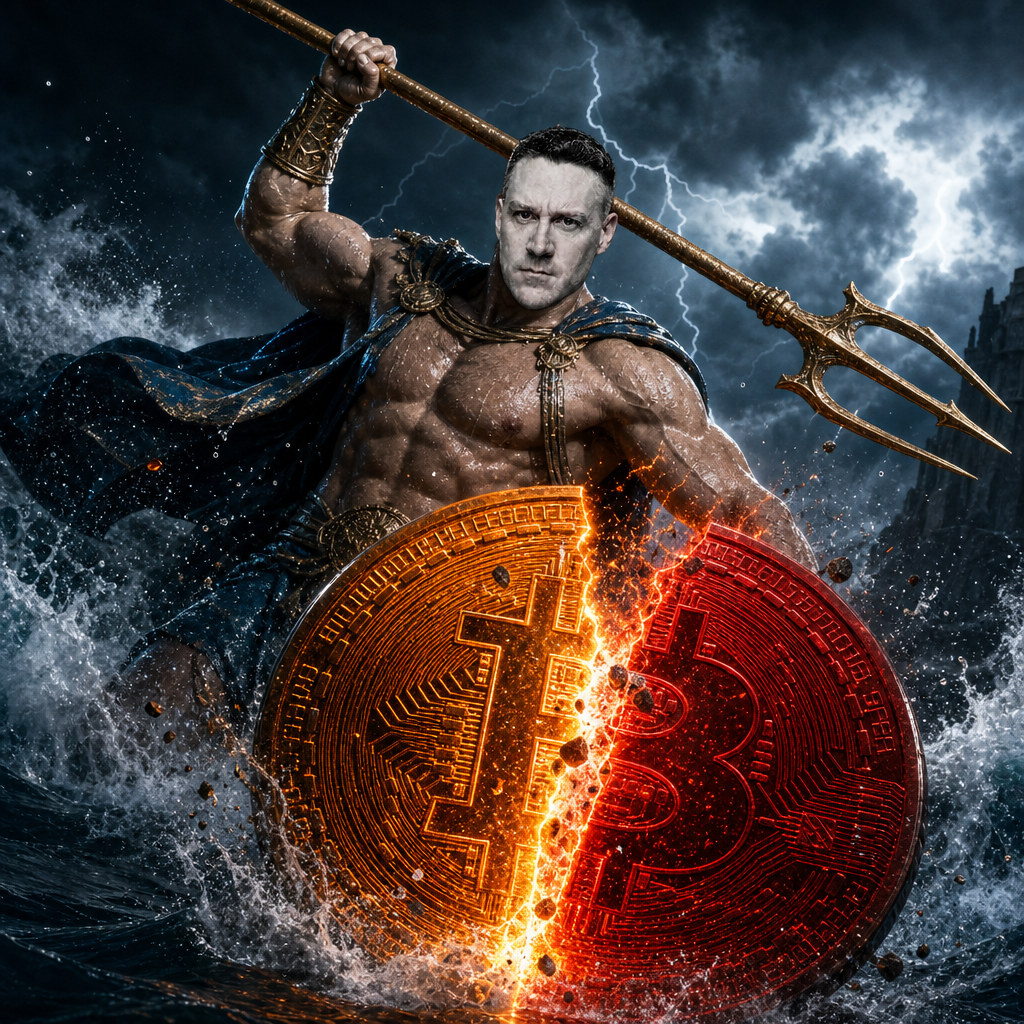
Are Hard Forks Inflating the 21 Million Coin Supply?
There is a critique of the Ecash fork that frequently surfaces in conversation. It's rooted in Adam Back's observation of altcoins and goes like this:
If Ecash forks Bitcoin and gives every BTC holder an equivalent ECX balance, doesn't that mean there are now 42 million coins in circulation? Hasn't the 21 million supply cap been violated? Isn't this just inflation by another name?
The critique sounds devastating on first hearing. It also happens to be wrong — not in a technicality way, but in a fundamental misunderstanding of what a hard fork actually does to supply. The 21 million cap is not violated. It is temporarily duplicated, and that duplication resolves itself the same way it always has: the market picks a winner, and the loser's coins drift toward zero value and economic irrelevance.
This essay walks through why the inflation is temporary, why Ecash has a real (if small) chance of being the version of Bitcoin that wins, and why complacency (the comfortable assumption that nothing can ever displace BTC) is a far more dangerous position than most holders realize.
What a hard fork actually does to supply
When a chain hard-forks, every existing UTXO is duplicated onto the new chain. The nominal coin count doubles. Anyone who held 1 BTC at the snapshot block now holds 1 BTC and 1 ECX. On paper, the supply cap has been broken.
But "supply" in the economic sense is not a count of database rows. Supply is the number of units that the market treats as the same monetary good. Two chains with identical histories and incompatible futures are not one currency at double the supply. They are two competing currencies, each with its own supply cap of 21 million, competing for the same monetary niche.
This has happened many times. Bitcoin Cash forked from Bitcoin in 2017. Bitcoin SV forked from Bitcoin Cash in 2018. Ethereum split from Ethereum Classic in 2016. In every case, the nominal supply doubled at the moment of the fork. In every case, the market eventually picked a winner. And in every case, the loser's chain is now worth a small fraction of the winner's — not because the supply cap was enforced by code, but because economic reality enforced it through price.
BCH today trades at roughly 0.5% of BTC's market cap. BSV trades at roughly 0.1%. ETC trades at roughly 0.4% of ETH. The "inflation" was temporary. The market did exactly what theory predicts: it consolidated value onto the chain that the broader ecosystem judged most credible, and the rest faded into the long tail.
Why the winner takes almost everything
Money is a coordination good. Its value comes from network effects — from the fact that other people will accept it, hold it, price things in it, and build infrastructure around it. This creates a winner-take-most dynamic that economists call monetary network effects, and it is the reason there is one dominant reserve currency per era, not a balanced portfolio of forty roughly-equal currencies.
When a hard fork happens, the market is forced to answer a question: which chain is the "real" continuation of the project? The answer is determined by some mixture of:
- Which chain attracts more hashrate
- Which chain attracts more developer activity
- Which chain attracts more exchange liquidity
- Which chain attracts more user attention and merchant adoption
- Which chain has the more compelling roadmap going forward
These factors reinforce each other. More hashrate signals security, which attracts more holders, which attracts more exchanges, which attracts more developers, which produces a better product, which attracts more hashrate. The feedback loop is brutal and fast. Within months — sometimes within weeks — one chain is clearly the winner and the other is clearly the loser, and the market caps reflect it.
The 21 million cap is preserved in the only way that economically matters: the chain that the market converges on retains its 21 million as the monetary supply, and the other chain's coins become a low-value curiosity that no one prices the global economy in.
Why Ecash has a real chance
Most forks fail because they do not offer anything the original chain does not already offer. BCH was bigger blocks. BSV was even bigger blocks. ETC was "no rollback." None of these features were compelling enough to overcome BTC's or ETH's network effects. The market correctly identified them as marginal variations on the existing product and consolidated value back onto the original.
Ecash is different in two specific ways that matter.
First: openness to innovation. The single biggest pathology of Bitcoin development over the past decade has been the ossification of the protocol. Useful upgrades — BIP 300 (drivechains), covenants, simple sidechain mechanisms — have languished for years not because they are technically flawed but because the social process for activating them has effectively stopped working. Ecash starts from the position that this is a problem worth solving by forking, and that the resulting chain can ship the upgrades Bitcoin has been unable to. If even one of these upgrades turns out to be transformative (drivechains in particular have the potential to be), Ecash inherits the upside.
Second: a credible answer to the miner fee problem. Bitcoin's long-term security model depends on transaction fees eventually replacing the block subsidy. That replacement is not happening on the current trajectory. Mempool fees are low, miner revenue is increasingly dependent on the subsidy, and there is no clear path to a fee market large enough to secure the chain at current price levels after the subsidy decays. Ecash's drivechain architecture creates a structural answer: every sidechain that runs on top of Ecash pays its transaction fees to Ecash miners. This means SHA-256 miners have a positive economic reason to point hashrate at Ecash rather than treat it as a threat. The chain that pays miners more wins miners. The chain that wins miners wins security. The chain that wins security wins users.
Neither of these is a guarantee. Both are reasons to take the small probability seriously.
The complacency trap
The most common response to all of this is some version of: "Bitcoin has won. The fork can't possibly succeed. I don't need to think about it."
This is the same reasoning that was used against Bitcoin itself in the early days, against Ethereum in 2015, against every disruptive monetary technology that subsequently became dominant. The reasoning is not stupid — incumbents usually do win — but it is asymmetric in a way that matters for how you should allocate attention.
Consider the payoff structure. If you pay attention to Ecash and it fails, you have lost some reading time and possibly a small position. If you ignore Ecash and it succeeds, you have lost the opportunity to claim coins you were entitled to as a BTC holder, and you are holding the wrong chain at the wrong time during the most consequential monetary realignment of the decade. The downside of attention is small. The downside of complacency is large.
This is true even if you assign Ecash only a 5% chance of becoming the dominant chain. Five percent of "the next Bitcoin" is not a small expected value. It is enough to justify reading the documentation, claiming your fork allocation, and watching how the post-fork market behaves. You do not have to believe Ecash will win. You have to believe the probability is non-zero, and that the cost of being wrong while ignoring it exceeds the cost of being wrong while paying attention.
The Bitcoin community has been here before. In 2017, the same crowd that now confidently dismisses Ecash was confidently dismissing the idea that Bitcoin's transaction fees would matter or that Layer 2 solutions would be necessary. Many of those same voices then spent the following years pivoting to support exactly the technologies they had previously dismissed. Pattern-matching that history onto the present moment is not paranoid. It is the rational response to a community whose track record on identifying credible technical threats is mixed at best.
What this essay is not arguing
It is worth being explicit about what is not being claimed here.
This essay is not arguing that Ecash will definitely win. It probably will not. Most forks fail, and there is a strong base rate against this one.
This essay is not arguing that BTC holders should sell their BTC. The two are not mutually exclusive — every BTC holder will automatically receive an equivalent ECX balance, so paying attention to Ecash is fully compatible with holding BTC.
This essay is not arguing that the 21 million cap has been broken in a way that should make you doubt Bitcoin. The cap holds. It always holds, through every fork, because the market enforces it economically even when the code does not enforce it numerically.
What this essay is arguing is narrower and more defensible: forks create temporary supply duplications that resolve through market selection; the resolution can in principle favor either chain; Ecash has structural reasons to be a more credible challenger than the forks that came before it; and the asymmetric cost structure of attention vs. complacency means that even a small probability of Ecash success is worth caring about.
Conclusion
The 21 million coin supply is not a number enforced by software. It is a property of whichever chain the market converges on as "real Bitcoin." Every hard fork temporarily duplicates the nominal supply and then resolves through monetary network effects into a winner whose 21 million is the supply that matters and a loser whose 21 million is a footnote.
Ecash is, on the evidence, the most credible challenger Bitcoin has faced. Not because its founder is louder or its marketing is slicker, but because it ships the upgrades Bitcoin has been unable to ship and offers SHA-256 miners a structural reason to defect. The probability that it wins is small. The probability that it matters is not.
Pay attention. Claim what you are entitled to. Watch the market resolve the duplication the way it always does. And do not mistake the comfortable feeling of betting on the incumbent for actual knowledge of how this resolves.
The future of money is being written right now, and the most expensive position you can hold is the one where you stopped reading.