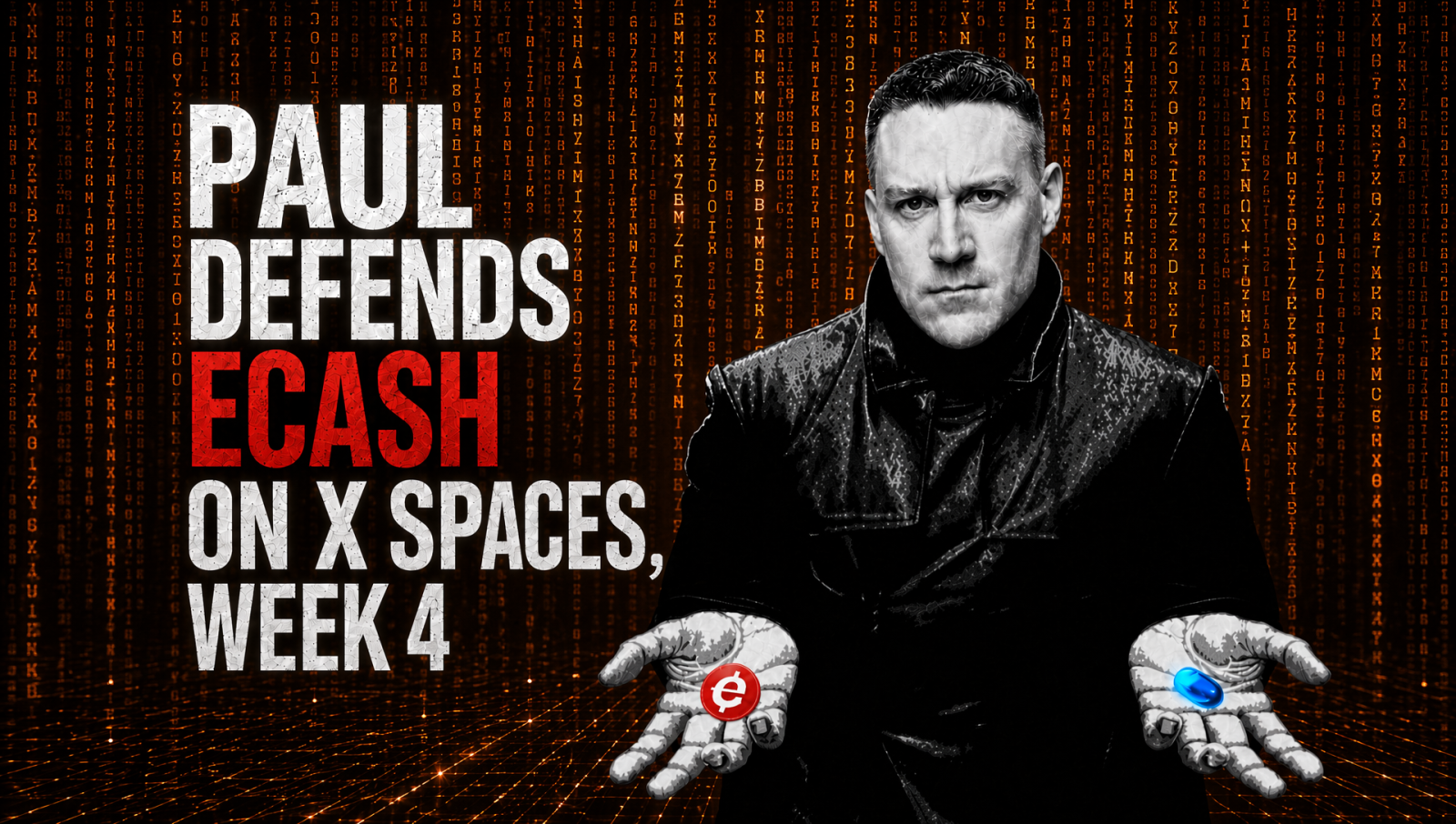
Paul Sztorc's May 27 Twitter Space: Bug Bounties, Pool Software, and the Cultural Death Spiral of BTC
For roughly 90 minutes on Wednesday, May 27, 2026, Paul Sztorc once again opened the floor on Twitter Spaces, walking through a checklist of announcements before fielding questions on Lightning, governance, miner passivity, and the long arc of Ecash. What emerged was less a technical update than a snapshot of where the project stands today: a coin preparing for launch, a community sorting itself out, and a founder increasingly convinced that BTC's biggest problem is not code but culture.
A $100,000 Bug Bounty for the Summer
Sztorc opened with the headline announcement: a summer-long bug bounty totaling $100,000, structured as five rounds of $20,000 each over roughly two-week intervals. Prizes go to first, second, and third place per round, weighted toward bugs that are severe, found in core packages, and not yet reported by anyone else.
He emphasized that the pot is expandable. "If there are lots of bugs found, we will massively increase the reward," he said, noting that the whole point is to surface as many issues as possible before launch rather than to ration prize money. Participants should submit bugs as soon as they find them; details and the prize table are on the drivechain.info blog.
Simple Pool: An Open-Source Mining Pool Stack
The second major announcement was "Simple Pool," which Sztorc was careful to describe as "wet concrete": brand new, partially implemented, but publicly visible. The project's premise is straightforward: there is no good reason that the software running major mining pools should be closed-source.
He pushed back on a recurring misreading from critics. Simple Pool is not meant to replace Foundry or any other branded pool operator. Those brands earn their fees through reputation and reliability, and that economic role is unaffected. What Simple Pool aims to do is provide an open, auditable codebase that any pool (including the big ones) could adopt for the actual mechanics of selecting transactions and constructing blocks.
Sztorc tied this to broader problems he sees in Bitcoin's mempool and relay layer. Because relay today is done "in a kind of communist way" (for free, out of goodwill) the network has developed the awkward bifurcation between standardness rules and validity rules, which he called "a huge distraction, a waste of everyone's time." A revenue-maximizing, transparent pool stack, paired with companion software that lets miners route hashrate to the most profitable pool without thinking about it, would push the system back toward economic rationality. He explicitly framed this as "the opposite of what Luke is trying to do with Bitcoin Knots": non-judgmental and aggressively profit-seeking rather than censorious.
The Ecash Brand and Solana Token Plan
Sztorc reiterated the positioning of the Ecash brand: useful, true information will be published on the official channels, but he is comfortable with some strategic ambiguity. "We need a lot of stupid people to bet against, so we don't necessarily want it to be too obvious how good of an idea this is," he said. He also pushed back, mildly, on community framings that lean too hard on the "take Satoshi's coins" narrative, suggesting that being slightly misunderstood is, for now, a feature.
On the parallel Solana token experiment, he confirmed he has shared a small spreadsheet with about five people laying out a plan to let participants redeem the Solana token for real Ecash. The mechanism, as he described it, treats Solana creator fees as functionally a purchase of Ecash, with logistics around redemption being the main challenge. He said anyone he shared the spreadsheet with has permission to repost it, and indicated he would share it with the newly created verified Solana-Ecash Twitter account that Iron mentioned on the call.
Iron, running that new account, framed the project as "second-chance Bitcoin": an opportunity for retail participants who missed 2011 to get something analogous to buying BTC at $30.
Lightning: From Critique to Settled Issue
The longest stretch of the Space, prompted by Marcus, returned to Lightning. Sztorc's position has hardened. He now treats Lightning as a "totally settled issue" in private conversations with knowledgeable developers, and views the public defense of it as primarily cultural rather than technical.
His central analogy was Theranos. He retold the story of Tyler Schultz watching patients have their blood drawn into a Theranos device, only for staff to whisk the sample away during a lab tour and run it on standard Siemens equipment, then present the results as Theranos's. When Tyler tried to blow the whistle, family members like his grandfather George Schultz dismissed him: "I've seen the machine work. They tested my blood with it." Sztorc argued Lightning operates similarly: most of the heavy lifting that makes the user experience tolerable happens off the protocol, in custodial services, while the Lightning brand takes credit.
He drew a sharp line between bidirectional payment channels (which predate Lightning and which he considers genuinely useful) and the Lightning Network's signature claim: that a graph of payment channels can route arbitrary payments at scale. The latter, he argued, has been quietly abandoned even by experts. He cited Burak, the creator of Ark, as someone who explicitly built Ark because Lightning didn't work.
Marcus pressed back, arguing Lightning still has value for instant pre-confirmations and cross-chain settlement, and that some centralization (LSPs, Phoenix-style wallets) is acceptable so long as unilateral exit is preserved. Sztorc agreed unilateral exit matters but pointed out it cannot be enforced at scale without enough block space — exactly the constraint Lightning advocates dismiss when convenient.
On instant confirmations specifically, Sztorc said he has compiled a private document of zero-conf and pre-confirmation designs and is considering publishing it as an open contest. He sketched several existing categories: double-signing proofs that let miners slash bonds, merchant-side workflows where zero-conf is already nearly secure (Amazon-style orders where non-payment simply cancels the order), in-person purchases backed by video and law enforcement as a deterrent, and gift-card workflows like Bitrefill where one slow on-chain settlement enables many subsequent fast payments.
His broader argument: once instant settlement exists through any of these paths, the rationale for Lightning's complexity collapses. "Won't you just drop Lightning at that point?"
Cross-Chain Swaps and Coinshift
Marcus also pushed on cross-chain functionality: the ability to pay any invoice from any chain through one wallet. Sztorc pointed to Coinshift, a sidechain design where the L2 node runs full nodes of multiple L1s as dependencies, allowing it to be aware of every transaction across those chains and enable atomic-swap-like behavior.
He acknowledged a real weakness Marcus raised: chains like Monero hard-fork on roughly six-month cycles, which would force Coinshift to either hard-fork in sync or fragment. Sztorc conceded this is a meaningful problem and that Coinshift is best understood as a fallback rather than a primary scaling mechanism. He suggested market-based exchanges (now embedded in many wallet apps) handle most of this demand already, even if they introduce custodial trust.
Why Bitcoin SV People Should Be Drivechain People
In a brief but pointed aside, Sztorc argued that the Bitcoin SV philosophy (unlimited on-chain data, optional downloading, miners absorbing costs) is structurally similar to drivechain, except that BSV has no immune response when an experiment becomes too expensive. Drivechain, by contrast, lets expensive L2s die off while the rest of the network continues. "The whole Bitcoin SV mistake is the idea that there's nothing bad about increasing the block size at all, which is false." He expects some BSV supporters will eventually recognize that drivechain delivers what they actually wanted.
Ethereum, EthSide, and Categorical Control
Asked whether an Ethereum-style sidechain ("EthSide") will ship at launch, Sztorc admitted he built a working version around 2023 but lost interest. He thinks most actual Ethereum usage (stablecoins, basic transfers) would be better handled by purpose-built drivechains like Thunder or BitAssets. He's open to including it if there's real demand but described the prospect as "uninspiring."
Marcus made an interesting counterpoint: even an inefficient EVM sidechain is valuable as a testing ground for new drivechain designs. You could prototype a novel L2 inside EthSide before going through the social process of getting miners to activate a dedicated drivechain slot.
Sztorc connected this to an old essay of his on "sidechain privatization" or "categorical control" — the argument that purpose-built chains beat general-purpose chains because they can maintain efficient, topic-specific state rather than carrying every contract's data forever. He admitted the predicted frustration with general-purpose smart-contract chains hasn't really materialized, but suspects it eventually will.
Governance, Miner Passivity, and the Foundry Story
The conversation's most revealing thread concerned why miners are so passive. Marcus pointed out that BTC miners could already activate BIP 300/301 if they wanted to: they simply haven't.
Sztorc's explanation was historical and cultural. Soft forks were originally non-controversial: code changes that did nothing until 51% of miners upgraded. SegWit broke that pattern, but not because SegWit itself was contentious... it was "held hostage" by the block size war. Taproot was a quieter echo. Since then, almost nothing has happened.
He then told what he called a representative story about Foundry. According to sources he considers reliable, Foundry knew an epic-sat ordinal was approaching in their expected block range and emailed members proposing to isolate and sell it, distributing proceeds to participants. Members pushed back (they didn't want to be associated with the ordinals controversy) and Foundry backed off. ViaBTC then mined the epic sat and sold the single satoshi for roughly 13 BTC.
His lesson: in a culture poisoned by mistrust and mythology, even economically rational moves by pools become socially impossible. Pools end up with "no opinion on anything." He argued this is fixable in a fresh chain launched specifically around merge-mined L2s, where pools would directly see L2 fee revenue and have clear incentives to evaluate, add, and occasionally retire drivechain slots.
He also drew a contrast on governance dynamics. In Bitcoin Core, a rejected proposal becomes "shameful" to its author and embarrassing to Core if it later succeeds. In a multi-L2 environment, a rejected idea can simply move to a neighboring L2 or spawn a new one: defusing the political stakes entirely.
The End-Game Argument
Marcus offered a pessimistic forecast: Ecash will launch, the price will drop, eventually find users, and become "another altcoin," with BTC remaining king as a kind of digital gold standard surrounded by centralized services.
Sztorc countered with a geometric-growth argument. Suppose BTC's transaction fee revenue stays roughly flat while Ecash's grows even 10% per year across all its L2s. Like the "penny doubling every day for a month" thought experiment, this compounds dramatically. Eventually the rival chain's fee revenue per block grows so fast within each two-week period that BTC's difficulty adjustment can't keep up, and hashrate migrates wholesale.
He acknowledged BTC could in theory respond by activating drivechains or similar designs... but argued the cultural dysfunction he describes makes that response unlikely. The smart, technically curious people are leaving; the remaining culture is increasingly unable to discuss its own problems honestly. He compared this to the late Roman Empire: persistence and prior dominance are not, by themselves, evidence of permanence.
He was explicit about the framing on price: both a high launch price and a low one help the project in different ways. A high price validates. A low price invites accumulation by people who think they can supply the one or two missing pieces (a wallet, a better explanation, infrastructure) and capture the upside. Either way, the early dynamic involves separation... culling holders who aren't engaged from those who become genuine stakeholders.
"If You Win, You Also Lose"
A late exchange with Sad Scholar drew out an underappreciated point about why competing chains matter beyond mere experimentation. Sad Scholar advocated for chains-as-playgrounds, where real liquidity lets developers test ideas with real stakes.
Sztorc agreed in principle but added a sharp wrinkle. In a world where BTC can simply copy any successful innovation, a rival chain that "wins" by demonstrating a better design still loses, because BTC absorbs the idea and the rival's coin goes to zero. "If you lose, you lose. If you win, you also lose." The only configuration in which the experiment is real, he argued, is one where the rival can actually replace BTC. This is why he keeps framing Ecash explicitly as a succession candidate rather than a complement.
Format Changes and Top Haters
Sztorc floated two organizational questions for next week: whether to migrate the format (possibly to Clubhouse), and which "top hater" might actually be worth inviting on for a real conversation. He suggested Peter Todd as one possibility, joked about training an AI bot to argue in his style, and asked the audience to suggest worthwhile critics.
The Evolution of Ecash
Stepping back from any single topic, what this Space documents is a noticeable shift in how Sztorc is positioning the project. A few years ago his arguments were largely technical: drivechains as a sidechain mechanism, BIP 300/301 as soft fork plumbing, scaling as a coordination problem. Today the technical case is treated as essentially closed: the bug bounty, Simple Pool, and a settled implementation roadmap are presented as cleanup rather than research.
What's evolved is the framing. Ecash is no longer pitched primarily as "Bitcoin with drivechains." It's pitched as a successor specifically engineered around the cultural failure modes Sztorc sees in BTC: passive miners who don't understand their own incentives, a developer culture that cannot acknowledge problems, a community where Lightning's gap between marketing and reality has become representative of a broader inability to tell the truth about the protocol.
The bug bounty, the open-source pool, the merge-mined L2s with miner-aligned revenue, the willingness to deliberately let the price be low at launch to surface real stakeholders, the Solana-token redemption experiment, even the brand strategy of being slightly misunderstood: it all fit a thesis that the next Bitcoin will be won less by superior cryptography than by a healthier epistemic environment around the cryptography that already exists.
Whether that thesis is correct is, as Marcus put it near the end of the call, something only time will tell.