Paul Sztorc's June 3 Twitter Space: Rusty Russell Quits, the $5m Round Closes, and What Is a Fair Launch?
For roughly two and a half hours on Wednesday, June 3, 2026, Paul Sztorc held court on Twitter Spaces, working through a checklist of weekly items before the conversation veered into what became the longest, most pointed exchange of the call: a debate with a self-identified critic over whether the Ecash airdrop to BTC holders is a good idea at all.
Along the way, the group touched on Rusty Russell's departure from Lightning, the closure of the $5 million funding round, the ongoing bug bounty, Michael Saylor's selling, the August hard fork, and a deep dive into BIP 300 mechanics, prediction markets, and inter-drivechain composability.
Listen to the X Space recording
Rusty Russell Leaves Lightning
Sztorc opened with what he framed as the symbolic story of the week: Rusty Russell, one of the most experienced and (by Sztorc's account) most personally decent developers in the Bitcoin space, is leaving Lightning and Bitcoin to return to Linux work. Russell headed up Blockstream's c-lightning project and, during the block size war, was one of the few senior figures who actively tried to tone down the rudeness rather than capitalize on it.
For Sztorc this is one more data point in what he called "the ongoing death of Lightning." His framing: while figures like Michael Saylor flood timelines with promises that everyone will get rich, the people who actually built Lightning are quietly walking away, vindicating the longtime critics (he name-checked Fiatjaf and himself) who said years ago that it would not pan out.
The $5 Million Round Is Closed
Item two: the $5 million funding round is officially finished. Sztorc noted it was mostly subscribed before the Las Vegas conference in April and has since filled out completely. He planned to announce it formally by tweet the following morning. He treated the closure as external validation that, regardless of the volume of online hostility, there is genuine appetite for the project.
Bug Bounty Update
The USD 100,000 bug bounty (five rounds of USD 20,000) is roughly a week in and going well enough that Sztorc said the prize pool will likely be increased. Severity is weighted heavily; finding more severe bugs in core packages dramatically raises a participant's odds. Details remain on the drivechain.info blog and ecash.com.
Michael Saylor, Selling, and SaylorTracker
Sztorc spent a few minutes on Michael Saylor's recent selling, pointing listeners to saylortracker.com and citing what he claimed was a roughly 10 percent underwater position across Saylor's average buys.
He also relayed a piece of speculation he found amusing: that Saylor sold around USD 400 million of MicroStrategy stock for cash in order to personally accumulate Bitcoin (…which, Sztorc joked, would imply Saylor understands Bitcoin perfectly well; he simply prefers that other people hold the MSTR bag while he walks away with the real coins).
The Solana Meme Token Plan
An early caller pushed Sztorc to launch his own meme coin. He declined, but reiterated the existing arrangement: at ecash.com/sol-token, creator fees from a Solana-side token are treated as if the payer is purchasing real Ecash, with only the top five holders eligible to redeem (capped at five swaps each, totaling 25 interactions).
When pressed on why the limits exist, his answer was bluntly logistical: anything more becomes an administrative nightmare. He also noted that with the USD 5 million round now closed, the Solana token route is "probably the cheapest way" left to gain exposure.
Wayne Chain Nostalgia
A welcome guest appearance came from the creator of Wayne Chain, Wayne Vaughan. The 2016 satirical project featured "time traveling transactions," zero block times, and unlimited block sizes (complete with a guitar solo in its Bitcoin Uncensored commercial).
Wayne recounted how investors at Blockchain Capital initially questioned the stunt; over time it became one of the most effective sales tools he had, with people at IBM and elsewhere telling him the joke was exactly why they took him seriously.
Sztorc seized on the cultural point: Wayne Chain worked as satire because it lampooned an era in which competing chains were one-upping each other on block time and block size with no acknowledgment of cost. He drew a straight line from that era's mistakes to today's "treasury company" era, conceding that he himself is not entirely sure what to make of the current moment (…is it the opposite of 2016, or somehow the same?).
The Bitcoin Film Fest Ecash Poster
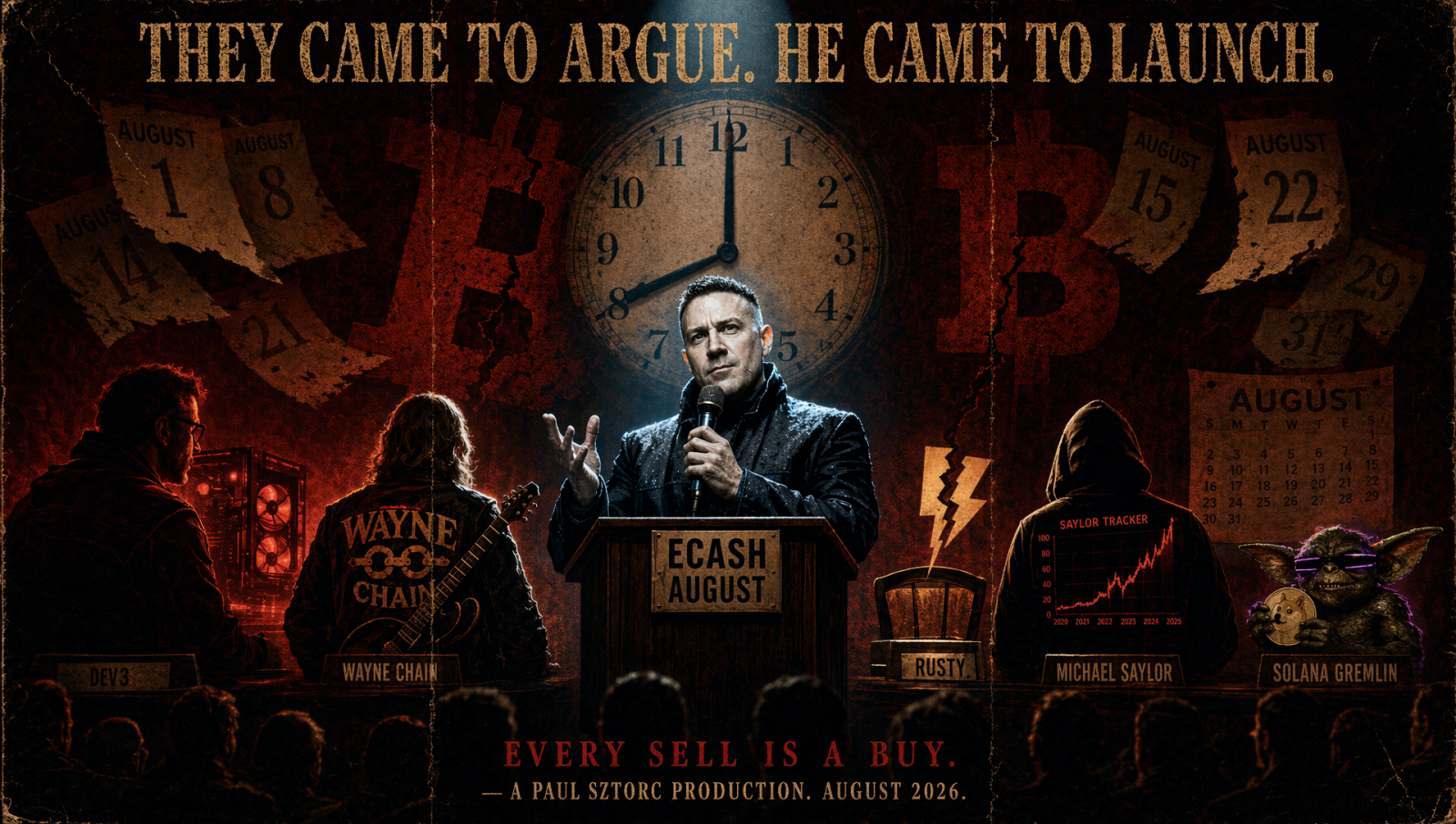
Vlad mentioned that this week's Bitcoin Film Fest in Warsaw (next door to Monerokon) will feature a slasher-movie-style poster promoting the August hard fork, designed to catch the eyes of attendees on their way into the theater.
The Long Debate: Airdrop Versus Fair Launch
The defining stretch of the call began when "Dev3" (who Sztorc had apparently placed on a "haters" list) came up to challenge the distribution model. His core objection: airdropping new coins to the existing BTC rich list (MicroStrategy, BlackRock, large funds) hands an enormous opening allocation to entities who are, in many cases, diametrically opposed to the project. Why not a true fair launch from genesis, with zero allocation aside from the already-completed strategic raise?
Sztorc's response unfolded over more than half an hour. The core points:
Most of the BTC rich list (he estimated something like 95 percent) is not Michael Saylor. Many large holders are quiet, sophisticated, and add real value to whatever project they engage with.
A pure fair launch creates a situation where a "genius inventor also has to be independently wealthy and altruistic" to bear the multi-year cost of bringing the project into the world. He called that arrangement "barbaric" and argued capitalism works better when capital and talent can cooperate from day one.
The airdrop is designed to force engagement. People who currently dismiss drivechains in tweets will, once real money is at stake, actually have to think through whether they believe their own arguments. Even haters with skin in the game become, at minimum, sellers who want the price to be high when they exit (…which, in his framing, makes them de facto shills).
He repeatedly pushed Dev3 for a concrete example of an airdrop he considered comparable. Dev3 named Monad and MegaETH; Sztorc countered that those distributions were not transparent, were aimed at speculative crypto-natives rather than a defined community, and are not really in the same category as a one-for-one BTC fork.
Citing the 2017 Bitcoin Cash fork, he noted that a year after the split, the UTXO sets had diverged by less than 50 percent. Most real holders neither sold nor bought; they just quietly kept both. Those are the holders he wants to court.
JK (a different caller) jumped in to broker the disagreement, arguing that distribution itself (spread out across many wallets rather than concentrated) is one of the most underrated metrics in crypto launches, and that Sztorc and Dev3 are simply talking past each other because they came up in different eras of the industry. Sztorc largely conceded the framing while sticking to his view: he would rather have one engaged large holder than 20,000 indifferent ones, and he wants people to sell, because every sale is a buy and brings new attention.
The exchange got barbed at points (Dev3 was accused of "special pleading" given his early-mining background; Dev3 in turn ribbed Sztorc for having previously fair-launched a proof-of-work coin himself), but it remained substantive. Sztorc closed the segment by accepting that the chart may look ugly for weeks or months, while rejecting JK's prediction of a four-to-five-year Bitcoin Cash style decline.
His own probability estimate for the project: roughly 10 percent chance of succeeding, but if it does succeed, the payoff is potentially 10,000x.
Why the L1 Doesn't Need to Change Much
A recurring theme: Sztorc wants almost all innovation captured in drivechain L2s rather than at the L1. The Ecash L1 is essentially Bitcoin Core. This is deliberate; it protects the chain from the kind of perpetual political campaigns (BIP 110, SegWit2x, XT) that, in his telling, have hollowed out BTC's ability to make decisions.
JK pointed out the awkwardness this creates: the project is simultaneously criticized as too big a change from BTC and as not changing enough. Sztorc accepted the tension and framed it as proof the design is splitting the difference correctly.
Alkanes, OP_CAT, and Bitcoin Core Plus
A long technical segment followed with a caller asking about specific software directions. Highlights:
Sztorc revived the idea of "Bitcoin Core Plus" (a fork of an older Core release that ships with OP_CAT, OP_CTV, and other proposed opcodes). He thinks bright Bitcoin hackers like Jeremy Rubin would find a drivechain home far more productive than years of campaigning for soft forks that "Bitcoin culture is so screwed up" it will never activate.
JK introduced the room to Alkanes, a WebAssembly-based system on Bitcoin from Subfrost that allows EVM-style contracts via an indexer. He suggested something like it on a drivechain could go a long way toward bringing real on-chain DeFi-style behavior into the ecosystem.
Marcus floated the idea of an Elements-based drivechain (importing Blockstream Elements' confidential transactions, asset issuance, and OP_CAT support). Another caller said they were already working on something similar, and Sztorc encouraged them to coordinate, predicting the project would become popular fast because no comparable home for that work currently exists.
Composability and Coinshift
On cross-drivechain communication, Sztorc pointed once again to Coinshift as the existing answer; a separate L2 that maintains awareness of multiple L1s and L2s simultaneously, allowing atomic-swap-like behavior across them. He acknowledged it isn't a perfect solution (especially for chains that hard fork frequently), but framed it as the realistic path versus IBC-style standards.
JK pushed the broader point: in 2017 and 2018, the promise was that UTXO-based atomic swaps would replace exchanges. Instead, the industry collapsed back into reliance on centralized exchanges and stablecoin issuers. Better cross-chain swap infrastructure would, he argued, restructure the whole incentive landscape away from that centralization.
The Economics of Drivechain Security
Dev3 (now in a more collaborative mode) pressed Sztorc on why BIP 300 uses miner voting on withdrawals rather than a cryptographic proof. Sztorc's reframing was the most pointed defense of the design he has offered recently:
If miners love the L2 (because it generates merge-mining revenue), the human-voting model works perfectly and is simpler.
If miners hate the L2, even cryptographic bridges fail, because miners can censor deposits and withdrawals at the L1 level regardless.
A bug in a cryptographic system gets immediately exploited. A bug in a system everyone wants to keep working tends to get quietly patched.
He cited the recent Zcash Orchard inflation bug as a live example, noting that Ecash's Zside uses the same Orchard crate and the team will need to look into it.
His closing framing: if no one is paying transaction fees and the L2 isn't contributing to the L1 exchange rate, perhaps it shouldn't exist at all. BIP 300 is built assuming the L2s that survive are ones miners want around, which is "a very healthy design" under those assumptions and "garbage" under the opposite ones.
Bit Names, Truthcoin, and the Logarithmic Market Scoring Rule
Toward the end of the call, Sztorc went on a tangent about Bit Names (his proposed naming drivechain), explaining that the strategy for "taking on ICANN and winning" involves preserving existing google.com style property rights while adding a parallel sovereign namespace (.bit, .anarchy) that lives entirely on-chain.
He also enthused at length about Robin Hanson's logarithmic market scoring rule, which underpins Truthcoin's prediction markets. He admitted that when he first tried to learn it from Hanson's 2002 paper he found it nearly impenetrable, which is why he eventually built a heavily annotated Excel spreadsheet (available on bitcoinhivemind.com) that he believes is still the single best resource for understanding the mechanism. He cautioned the room never to rename a project mid-flight, citing his own painful experience moving from Truthcoin to Bitcoin Hivemind to Truthcoin DC.
The Evolution Visible in This Call
Compared to the May 27 Space, this one was less a manifesto and more a working session. The major announcements (the round closing, Rusty Russell leaving, the bug bounty running hot) were dispatched quickly.
The bulk of the call was spent doing two things the project has rarely done as openly before: defending the airdrop mechanic to a substantive critic for over thirty minutes, and walking through the technical and economic case for BIP 300's miner-voting design without retreating to slogans.
The cultural framing remained consistent with last week: BTC is in a "cultural death spiral," unable to talk about its own problems, and Ecash is a lifeboat. But the operational tone has shifted. The project now sounds like one that expects to launch on schedule in August, has its capital, has its bug bounty, has its allies (Marcus on Elements, the new contributor on a parallel elements-style L2, JK pushing on ordinals-aware wallets), and is mostly answering questions rather than recruiting believers.
If there was one through-line, it was Sztorc's repeated insistence that he wants people to sell at launch, that volatility is fine, that even the haters become participants once they own coins, and that the worst possible outcome is not a bad chart but an indifferent one.