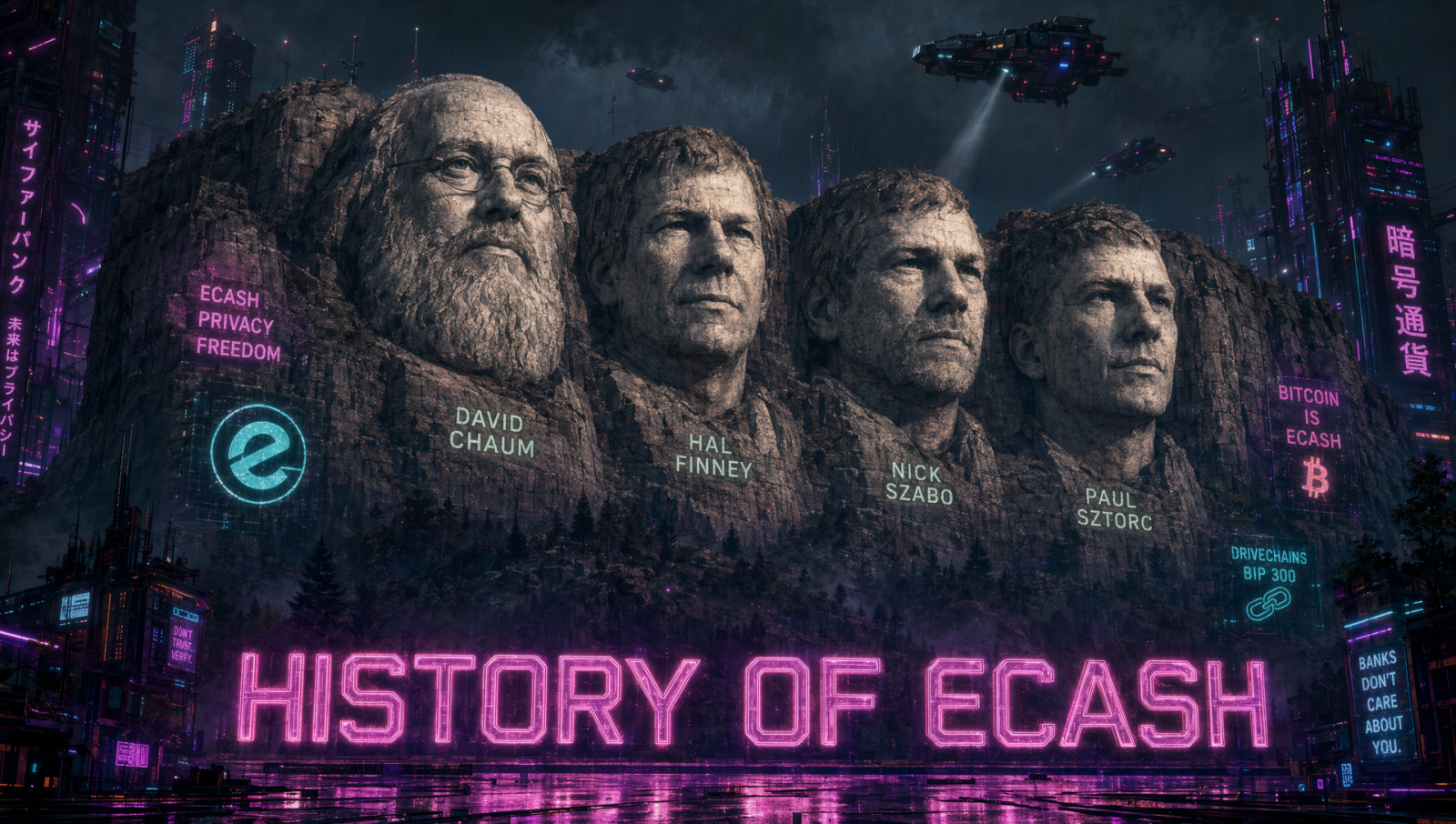
A Brief History of Ecash: From Chaum to Sztorc
The word "ecash" is older than Bitcoin. Older than the cypherpunk mailing list. Older than the World Wide Web, in fact. It belongs to a forty-year intellectual tradition of trying to build electronic money that respects human dignity. Understanding that tradition makes clear why Paul Sztorc chose the name... and why no one can take it from him, or from anyone else who wants to build in this lineage.
This is the history.
1983: David Chaum invents the field
In 1983, a cryptographer named David Chaum published a paper titled "Blind Signatures for Untraceable Payments." It was the founding document of what became known as ecash. Chaum's insight was that cryptography could give digital money the same privacy property as physical cash: the payer and the payee could transact without a third party knowing who paid whom.
This was radical. The financial system Chaum was working against had already begun its slide toward total surveillance. Credit card networks were aggregating purchase histories. Banks were digitizing transaction records. Chaum saw, decades before anyone else, that a fully electronic economy would be a fully surveilled economy unless cryptographers built an alternative.
In 1990, Chaum founded a company called DigiCash to commercialize his ideas. Its product was literally called "ecash." It was the first electronic payment system that preserved payer anonymity through blind signatures. Microsoft offered Chaum $100 million to bundle ecash with Windows 95. He turned it down. DigiCash went bankrupt in 1998.
But the word "ecash" had entered the lexicon. From the early 1990s onward, every cryptographer working on digital money knew what ecash meant: privacy-preserving electronic money, descended from Chaum's blind signature scheme.
1992 – 2008: The cypherpunk inheritance
The cypherpunk mailing list, founded in 1992, treated ecash as a shared project. Tim May's "Crypto Anarchist Manifesto" referenced it. Adam Back's Hashcash, Wei Dai's b-money, Nick Szabo's Bit Gold — every major precursor to Bitcoin sat in the lineage of Chaum's ecash, even when the specific designs diverged.
By the early 2000s, dozens of attempts had been made to build a successor to DigiCash. Most failed for the same reason DigiCash did: they required a central issuer, which created a single point of failure, a regulatory target, and a trust assumption that defeated the whole point. The cypherpunks understood the problem clearly. What they did not yet have was a solution.
October 2008: Satoshi's whitepaper, originally titled "ecash"
In October 2008, an anonymous developer using the name Satoshi Nakamoto circulated a draft paper on the cryptography mailing list. The published version was titled "Bitcoin: A Peer-to-Peer Electronic Cash System."
But an early draft that circulated privately was filed under a different name: ecash.pdf. This is documented in correspondence preserved from that period. Satoshi was working in the Chaumian tradition, and the filename reflected it. The final title kept the phrase "electronic cash": a direct nod to Chaum's terminology — and added "peer-to-peer" to signal what made Bitcoin different.
Bitcoin was, explicitly, Satoshi's attempt to solve the problem that had defeated DigiCash: how to build ecash without a central issuer. The blockchain was the mechanism. Proof-of-work was the consensus rule. But the goal (electronic cash, in the Chaumian sense) was older than the design.
Bitcoin is not separate from the ecash tradition. Bitcoin is ecash, in the lineage that runs from Chaum through the cypherpunks to Satoshi. Every essay arguing that Bitcoin should remain "just digital gold" is arguing against the original framing of the whitepaper itself.
2009 – 2020: Bitcoin forgets its name
Once Bitcoin launched, the word "ecash" fell out of fashion. The community gravitated toward "cryptocurrency," "digital gold," "magic internet money," and eventually "sound money." This was not accidental. As Bitcoin attracted investors more interested in monetary policy than in cypherpunk politics, the original framing became inconvenient. "Electronic cash" implied transactions. "Digital gold" implied holding.
The shift had consequences. By 2017, the community was at war with itself over whether Bitcoin was a payment network or a savings vehicle. The largeblocker faction, who saw themselves as defending Satoshi's original vision, eventually forked off as Bitcoin Cash. The smallblocker faction won the social war on the main chain.
In 2018, Amaury Séchet, the lead developer of Bitcoin ABC and one of the architects of the Bitcoin Cash fork, eventually led another fork (this time of Bitcoin Cash itself) to a project called eCash (ticker: XEC). The Avalanche-based consensus layer it added is controversial, but the choice of name was not. Séchet was reaching for the same word Satoshi had reached for: ecash, the Chaumian tradition, the original framing of what Bitcoin was supposed to be.
The XEC project remains active, with its own community, its own technical roadmap, and its own claim on the name. That claim does not conflict with anyone else's, because the word "ecash" was never anyone's to begin with.
2022 – present: Cashu and the Chaumian revival
In 2022, a developer named calle released Cashu, an implementation of Chaumian ecash protocols designed to run alongside Lightning. Cashu mints issue blinded tokens redeemable for sats. Users can transact privately using cryptography that descends directly from Chaum's 1983 paper.
Cashu uses the word "ecash" explicitly. So does Fedimint, a federated Chaumian system. Both projects, in their documentation, describe themselves as building "Chaumian ecash": the same tradition Chaum founded, the same tradition Satoshi extended, the same tradition Sztorc now claims for the Bitcoin renaissance.
This is not a coincidence. It is the natural state of a word that has belonged to the cypherpunk commons for forty years. Every serious project trying to build privacy-preserving electronic money eventually reaches for the same term, because no other term carries the same intellectual weight.
2025: Sztorc buys ecash.com
In 2025, Paul Sztorc purchased the domain ecash.com and announced that his Bitcoin hard fork project would carry the name. The purchase was not symbolic. It was practical. The domain was available; the name was apt; the lineage was clear.
Sztorc's reasoning, as he has stated it, runs along three lines:
First, the name accurately describes the project's goal. Ecash is a fork that activates drivechains, enabling Bitcoin to host the kind of execution environments (including privacy sidechains, smart contract sidechains, and prediction market sidechains) that the Chaumian tradition has always wanted to build. Drivechains are not a deviation from the ecash tradition. They are its long-delayed fulfillment.
Second, the name reclaims the original framing. Bitcoin was, in Satoshi's draft, ecash.pdf. The renaissance project re-asserts that framing against the "digital gold only" reading of Bitcoin that has dominated the last decade. Calling the fork "Ecash" is a deliberate echo of the whitepaper's original title and an implicit argument about what Bitcoin was supposed to be.
Third, the name honors the lineage without claiming exclusivity. Sztorc has been explicit that his project does not deprecate Cashu, does not conflict with XEC, does not delegitimize Fedimint. The word "ecash" is large enough to contain all of them. What Sztorc owns is a domain and a project. He does not own the word, and he has never claimed to.
Why the word cannot be trademarked
This is the part that matters most.
In a normal commercial context, a company would trademark a product name and aggressively defend it. "Ecash" cannot be trademarked, because the term has been in continuous public use for forty years, by dozens of independent projects, in academic papers, in commercial products, in open-source codebases, and in the original Bitcoin whitepaper draft.
A trademark requires distinctiveness: a sense in which the public associates the word uniquely with one source. The word "ecash" fails this test catastrophically. It is a generic term in the cypherpunk space. It describes a category, not a brand. You cannot trademark "ecash" any more than you can trademark "encryption" or "blockchain" or "open source."
This is good. It is, in fact, the correct state of affairs for a cypherpunk movement. The whole point of cypherpunk culture is that the protocols belong to everyone, that the ideas are commons, that no central authority (corporate, governmental, or otherwise) gets to gatekeep what counts as legitimate. A community where the word "ecash" could be owned by one project would be a community that had already lost.
Sztorc's project is called Ecash. Cashu calls itself ecash. XEC calls itself eCash. Fedimint builds Chaumian ecash. None of these conflict, because the word names a tradition, not a product. The market will sort them out. The best implementations will win adoption. The worst will be quietly forgotten. That is how cypherpunk movements have always operated, and it is how Bitcoin itself emerged from the long history of failed digital cash projects that preceded it.
Drivechains as ecash's missing piece
Here is the synthesis. The ecash tradition has always wanted three things:
- Electronic money that preserves privacy
- Money issued without a trusted central authority
- Money that supports rich economic activity, not just simple transfers
Bitcoin solved problem two. Lightning made progress on problem one for a narrow use case. But problem three (rich economic activity without a central authority) has remained unsolved on the Bitcoin main chain for fifteen years. The community's answer has been "go build it on an altcoin," which is the same as saying "the ecash tradition stops at Bitcoin's L1."
Drivechains are the missing piece. They let the ecash tradition extend to privacy sidechains, contract sidechains, and prediction market sidechains, all denominated in BTC, all secured by Bitcoin's miners, all without launching new monetary assets that fragment the cypherpunk movement into a thousand competing tokens.
This is why the project is named Ecash and not, say, Bitcoin++. The name asserts a claim about lineage. Drivechains are not a deviation from the path that runs from Chaum through Satoshi through Cashu. They are the path's continuation. Calling the project Ecash makes that explicit.
What this means in practice
If you encounter Ecash, Cashu, XEC, Fedimint, or any other project using the word "ecash," you are looking at a node in a forty-year-old intellectual tradition. None of them are imposters. None of them are stealing anyone else's name. They are all working in the same lineage, with different technical approaches, competing in a free market of ideas exactly as cypherpunk values prescribe.
Sztorc's Ecash is distinguished by its specific technical bet: that drivechains, as specified in BIP-300 and BIP-301, are the right architecture for letting Bitcoin host the experimentation that the broader cryptocurrency ecosystem has shown it demands. Whether that bet pays off will be determined by adoption, not by branding.
But the name is right. The history says it is right. The whitepaper draft titled ecash.pdf says it is right. The forty-year tradition from Chaum to Cashu says it is right. And in a cypherpunk movement where no one owns the words and the market decides the winners, that is exactly the kind of legitimacy that matters.