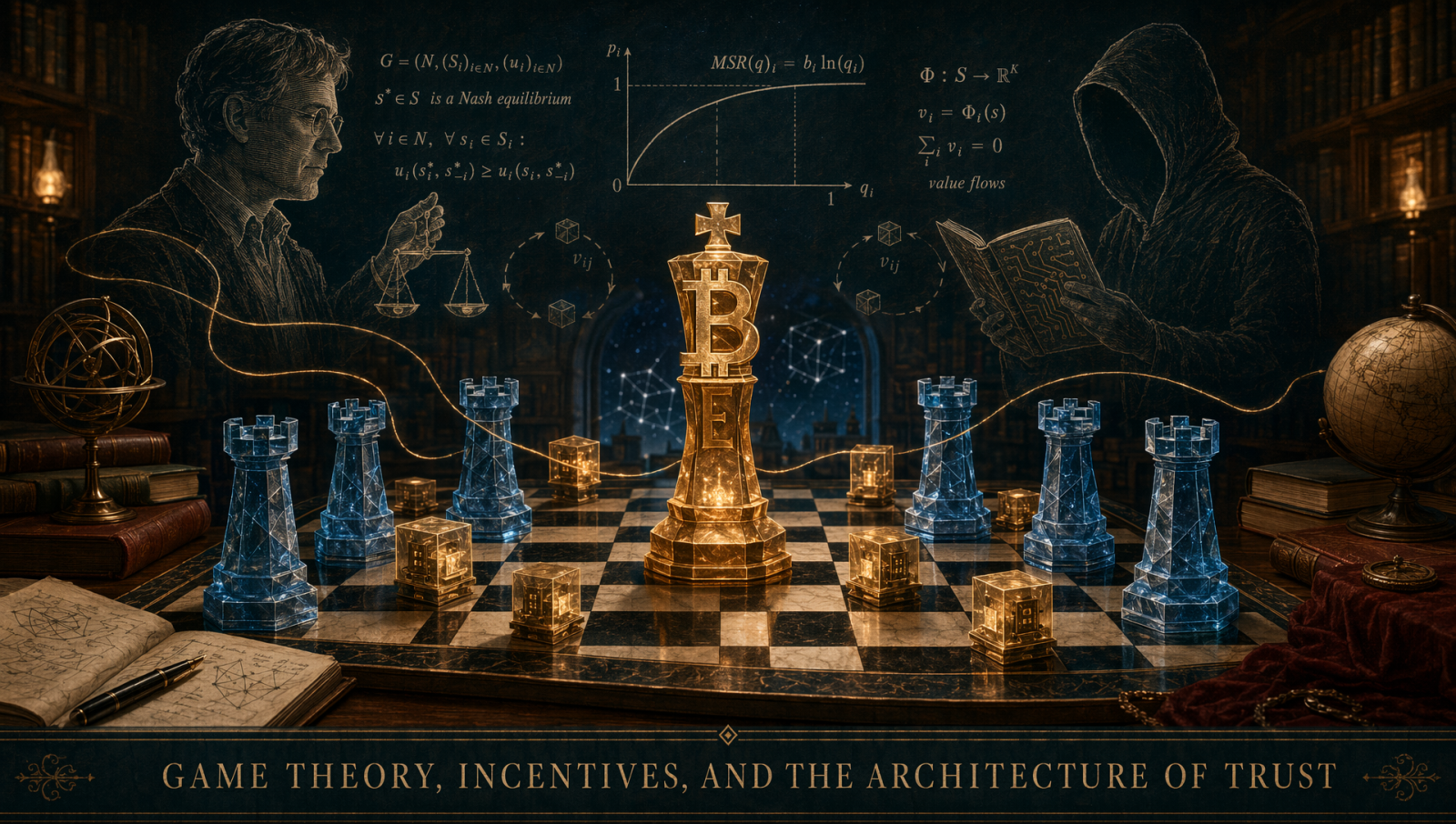
Drivechains, Game Theory, and Robin Hanson's Influence on Ecash
When Satoshi Nakamoto released Bitcoin in 2009, the breakthrough was not cryptographic. Hash functions, digital signatures, and Merkle trees all predated Bitcoin by decades. The breakthrough was game-theoretic: a system in which thousands of mutually distrustful, self-interested actors would, by following their own incentives, produce an outcome that benefited the whole network. Miners do not secure Bitcoin because they are altruistic. They secure it because securing it is more profitable than attacking it.
This is the lineage Paul Sztorc claims for Ecash and its drivechain architecture, and it is also where his intellectual debt to economist Robin Hanson becomes most visible.
The Game-Theoretic Core of Drivechains
Drivechains, as specified in BIP 300 and BIP 301, allow sidechains to attach to a Bitcoin-like base layer through merged mining. Coins move from L1 to an L2 via deposits, and back via withdrawals that miners vote on across a long acknowledgment window (roughly three months). There is no SNARK, no validity proof, no light-client bridge cryptographically verifying the L2's state on the L1.
To many engineers trained in the zero-knowledge tradition, this looks like a bug. Sztorc treats it as the entire point.
His argument, repeated in nearly every recent Twitter Space, runs roughly as follows. A drivechain that miners want to keep alive (because it produces fee revenue they capture through merged mining) will be defended by those miners. A drivechain that miners hate cannot be saved by any cryptographic gadget, because miners can censor deposits and withdrawals at the L1 layer regardless of what proof system the L2 uses. The cryptography, in other words, is downstream of the incentives. Once you accept that, you might as well design the system so that the incentives do the work directly.
This is a textbook Nash equilibrium argument. Each miner, acting in their own narrow financial interest, will:
-
Merge-mine drivechains that generate fees, because it costs them nothing extra in energy
-
Honor withdrawals from drivechains they merge-mine, because dishonoring them collapses the L2's value (and therefore their future fee stream)
-
Ignore or vote down drivechains that nobody uses, pruning the system of dead weight
The outcome, in aggregate, is that surviving drivechains are precisely the ones the market wants to survive. No committee decides. No foundation grants. No core developer holds a veto.
Why Hanson Matters Here
Robin Hanson is best known in crypto-adjacent circles for two things: prediction markets and futarchy. Both are mechanisms for getting better collective outcomes by aligning private incentives with truth-telling or value-creation, rather than by relying on the good faith of central planners.
Hanson's foundational claim, going back to his 1990s work on "idea futures," is that markets aggregate information better than committees because participants put money on the line. A trader who is wrong loses; a trader who is right profits. Over time, prices converge on something close to the best available estimate of the truth, not because anyone is trying to be honest, but because dishonesty (or sloppiness) is expensive.
Futarchy extends this to governance. Rather than voting on policies, a futarchic system votes on values (what outcomes do we want?) and then uses prediction markets to decide on policies (which proposal is most likely to produce those outcomes?). The market does the hard analytical work; the voters only need to know what they want.
Sztorc's intellectual relationship with Hanson is direct and acknowledged. His earliest serious crypto project, Truthcoin (later Bitcoin Hivemind, now Truthcoin DC), is an attempt to build a decentralized prediction market using a novel Nash-equilibrium-based reporting mechanism. Sztorc spent years annotating Hanson's logarithmic market scoring rule paper into a teaching spreadsheet (still available on bitcoinhivemind.com) because, by his own admission, the original paper was nearly impenetrable to him on first reading. The Amoveo project's interview series places Sztorc and Hanson side by side as the two primary thinkers on prediction markets in the cryptocurrency space.
The connection to drivechains is not incidental. Both Hanson's prediction markets and Sztorc's drivechain voting model share the same underlying premise: that you do not need to verify truth cryptographically if you can structure incentives such that the cheapest path for self-interested actors is to converge on truth anyway. Miner voting on drivechain withdrawals is, in a sense, a degenerate prediction market with a single binary question repeated every block ("should this withdrawal go through?"). The miners are the traders. Their stake is their ongoing fee revenue. The equilibrium is honest behavior.
The Cryptographic Alternative and Its Hidden Costs
The competing vision (the one dominant in Ethereum-influenced design circles) is to replace game-theoretic trust with cryptographic proof. Zero-knowledge rollups, validity proofs, zkBridges, recursive SNARKs: the promise is that you can verify the entire state of an L2 on an L1 without trusting anyone, by checking a small cryptographic proof.
This is genuinely impressive technology. zk-SNARKs and zk-STARKs have moved from theoretical curiosities to production systems in less than a decade, and projects like Mina, Zcash, and the various Ethereum L2 rollups have demonstrated that significant computational work can be compressed into proofs that any light client can verify.
But Sztorc's critique, sharpened over years of Bitcoin Core debates, is that the cryptographic approach has costs that its advocates systematically under-count:
The first cost is fragility. A bug in a cryptographic system gets exploited the moment it is discovered. The recent Zcash Orchard inflation bug is the live example Sztorc cited on the June 3 call: a flaw in the proving system can, in principle, allow attackers to mint coins from thin air. Z-Side, the Zcash-style privacy drivechain in development for Ecash, uses the same Orchard crate and inherits the same risk. By contrast, a bug in a system that everyone wants to keep working tends to get quietly patched, because the participants have aligned incentives to fix rather than exploit.
The second cost is technocratic capture. Cryptographic systems are complex. Reviewing them requires specialized expertise that, in practice, lives in a small number of academic and industrial labs. When the security of a system depends on the correctness of a SNARK circuit, the people who can audit that circuit become a de facto governance class. Bitcoin Core's decade-long refusal to merge BIP 300 (despite no serious technical objection ever surviving sustained scrutiny) is, in Sztorc's framing, exactly this dynamic playing out: a small group of cryptographically literate developers acting as gatekeepers for a system that was originally designed to need no gatekeepers.
The third cost is the trusted setup problem. Many SNARK systems require a one-time ceremony in which secret randomness must be generated and then destroyed. If the secret leaks, the entire system is compromised. The ceremony itself reintroduces exactly the kind of centralized point of failure that the cryptography was supposed to eliminate.
The fourth cost, and the one most aligned with Hanson's worldview, is the misalignment between cryptographic verification and human decision-making. A SNARK proves that a computation was performed correctly according to a specification. It cannot prove that the specification was a good idea. When the specification has bugs, or when the parameters need to change, the cryptographic apparatus must be torn down and rebuilt, often through some form of centralized governance. The miner-voting model, by contrast, degrades gracefully: if circumstances change, miners simply update their voting behavior, and the system adapts without anyone having to coordinate a hard fork.
The Free-Market Case Against Constant Consensus Patching
There is a deeper philosophical point underneath all of this, one that connects Hanson's economics to Sztorc's engineering choices.
Hanson's career-long argument is that centralized expert systems consistently under-perform decentralized market systems on problems involving distributed information. Experts have biases, blind spots, and political incentives. Markets have prices, which aggregate information from everyone with a stake. This is true for weather forecasting, for sports betting, for stock prices, and (Hanson argues) for governance, science funding, and policy decisions.
Applied to blockchain design, the argument becomes: every time you patch a consensus bug by adding a new cryptographic constraint, you are betting that a small group of experts has correctly anticipated all the ways the system might be attacked or might need to evolve.
Every patch shrinks the design space, hardens the assumptions, and increases the dependence on the patchers themselves. Over time, the system becomes less a self-regulating economic mechanism and more a technocratic artifact maintained by a priesthood.
Drivechains take the opposite bet. They assume that miners, holders, and L2 operators acting in their own narrow interests will, in aggregate, produce better outcomes than any committee could design.
When something goes wrong, the participants adjust their behavior. When something works, they pile in. The system selects for L2s that produce real value (measured in fees) and prunes L2s that do not. There is no central party deciding which experiments are worthy.
This is, structurally, the same bet Satoshi made in 2008. Bitcoin does not solve the double-spend problem through cryptographic elegance alone; SHA-256 and ECDSA were available for years before Bitcoin existed. Bitcoin solves it by making honest mining more profitable than attacking, and letting greed do the rest. Drivechains extend the same logic from the base layer to the L2 layer.
Where This Leaves Ecash
Ecash's August 2026 hard fork is, in this light, less a technical experiment than a philosophical wager. The wager is that Bitcoin's long stagnation (the refusal to activate drivechains, the cultural ossification around the base layer, the proliferation of cryptographic Band-Aids in adjacent ecosystems) reflects a drift away from Satoshi's original incentive-design insight and toward a technocratic mode of development that the original design was meant to prevent.
By shipping seven drivechains at launch (a privacy chain, a prediction market, a DEX, a quantum-resistant chain, a naming chain, a high scalability chain, and others) and by funding the launch through a controversial reallocation of dormant coins to early backers, Sztorc is forcing the question. If the market wants these L2s, miners will defend them, fees will flow, and the system will demonstrate that game-theoretic security scales. If the market does not want them, they will die quietly, and the experiment will have cost the participants only what they were willing to risk.
Either outcome is, in a Hansonian sense, informative. The prices (of the new chain, of the reassigned coins, of fees on the various drivechains) will tell the world what people actually believe, as distinct from what they say on Twitter. Sztorc has been saying for years that he wants people to sell, because every sale is a buy, and every trade is a vote with real money behind it. That is not just rhetoric. It is the most direct possible application of Hanson's lifetime of work on prediction markets to the problem of bootstrapping a new monetary system.
Whether the wager pays off will not be known for years. But the design itself, miner-voted withdrawals, drivechain composability through Coinshift, prediction markets via Truthcoin DC, and an explicit refusal to gatekeep which L2s deserve to exist, is a coherent application of game theory in the tradition that runs from Nash through Hanson to Satoshi and now to Sztorc.
It is, in other words, the most ideologically consistent attempt to build on Satoshi's original insight that has been made in years. Whether the market agrees is, fittingly, a question only the market can answer.