Paul Sztorc's June 24 Twitter Space: The ECX Mobile App, Saylor's Unraveling & a Builder's Challenge
The June 24 Twitter Space landed on a Wednesday, with Paul Sztorc announcing at the top that next week's session would happen on Tuesday (June 30th). The conversation ran over two hours and covered a wide spread of territory, from a new mobile wallet to the cultural meltdown around Michael Saylor to a genuinely pointed disagreement about whether the Ecash drivechains will actually be buildable on launch day.
Joined by Vlad Costea, Hunter Beast, Robin Linus, a builder named Adam McBride, a skeptic going by Coin Bazaar, and a few colorful late arrivals, this was one of the more grounded and operationally focused calls of the run-up to the August fork. Here is what was discussed.
Bug Hunt Two Wraps and a New Mobile App Arrives
Sztorc opened with housekeeping. The second bug bounty round just ended with 10 entrants, following 11 in the first round, all part of a 100,000 dollar program running through the summer. He praised the quality of the participants, saying the top finishers are skilled enough that it will be hard for newcomers to displace them. The best way to follow along remains the Telegram group at t.me/DcInsiders.
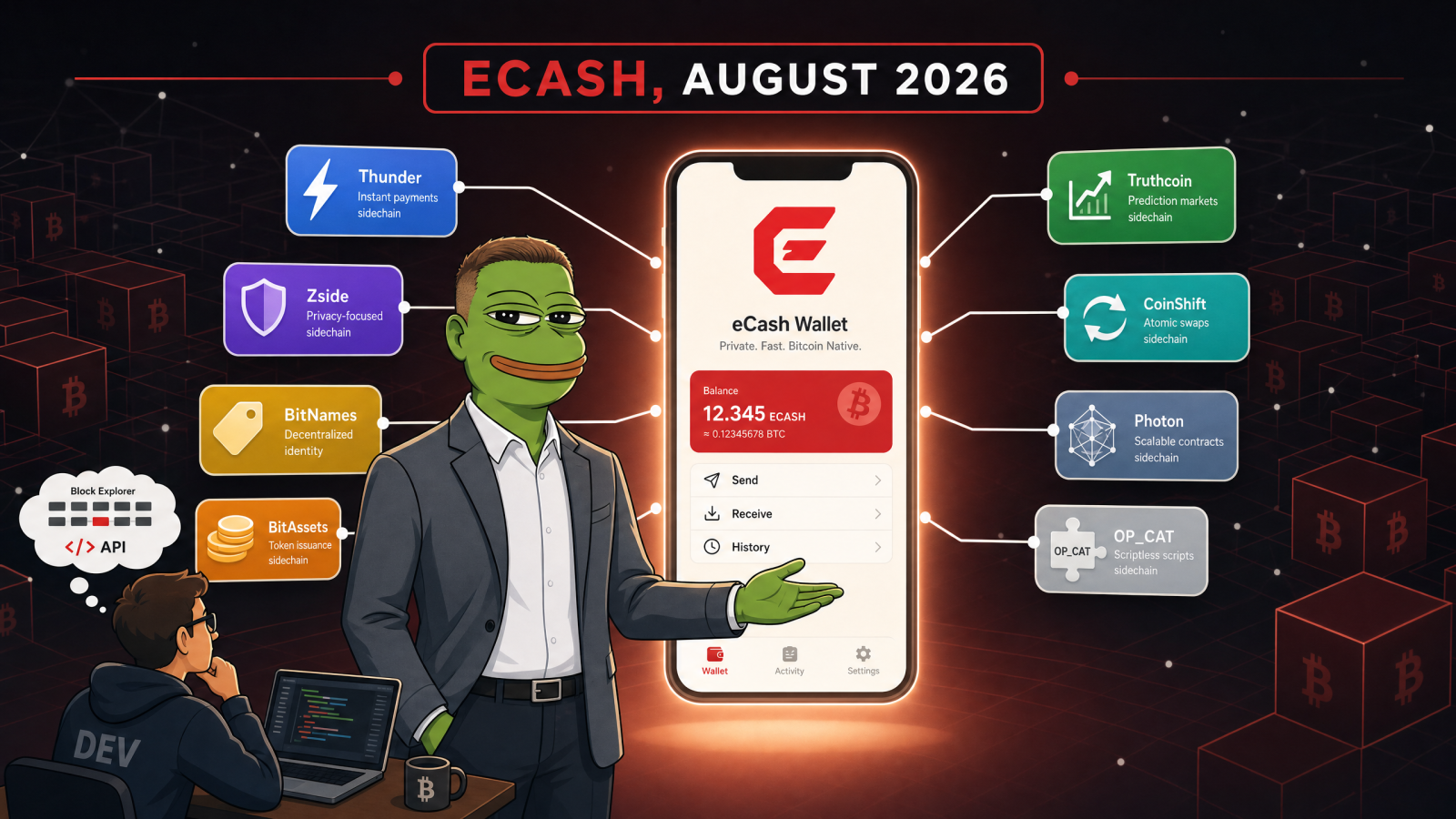
The bigger news was the arrival of a brand new eCash.com mobile app. Sztorc framed it as a major step up from the old Red Wallet, which only handled basic send and receive on L1. The app is in its earliest days, with Sztorc repeatedly noting it was only about 10 days old, and it currently targets L2L Signet. Much of the later half of the call circled back to what this app needs to become.
Deplatforming and the Case for BitNames
A recurring theme early on was the fragility of online accounts. Sztorc brought up several recent bans, including Cato the Elder 17, a friend of Hunter Beast, along with Nifty (Lisa Neigut) and a WhatsApp ban that hit someone simply for messaging a contact in Kenya. His point was that none of us hold a property right to our accounts, and that platforms can erase years of presence without warning or appeal. He found it especially strange that a banned account simply vanishes rather than getting a notice period.
This tied directly back to BitNames, the identity sidechain discussed in previous weeks. The vision remains that you own the name and the account becomes something you merely point to, making you impossible to fully deplatform. Sztorc and the group treated the recent bans as a live demonstration of why that model matters.
The Saylor Conspiracy Theory and the Comparative Advantage Argument
A large chunk of the call dealt with Michael Saylor and Strategy, formerly MicroStrategy. Vlad floated the theory, attributed to Cato the Elder, that Strategy may be tied to US intelligence and is being positioned as too big to fail, possibly even as the strategic Bitcoin reserve of the United States. The idea is that such rumors discourage short sellers who fear competing with the money printer. Sztorc was skeptical of the conspiracy framing but agreed the company looks financially stressed.
His sharper argument was economic. Drawing on Jim Chanos, Sztorc explained that a treasury company selling stock to buy Bitcoin on its own behalf is a bad deal for the buyer. If you believe in Bitcoin, you should buy Bitcoin, not paper that anyone can inflate. He invoked comparative advantage repeatedly. You invest in Elon because he can build a car better than you can. There is no comparative advantage in someone else simply holding Bitcoin for you, because they have the opposite incentive. He argued the entire treasury company wave, including copycats like Metaplanet and Nakamoto-style vehicles, is a textbook Austrian malinvestment story, a fake idea that tricked people into value-destroying behavior.
Sztorc went further, saying Saylor has crossed into fraud more than once with claims he must know are untrue, and that he constantly contradicts himself about whether Bitcoin is digital credit, money, or something else, sometimes within the same interview. A guest reinforced the point with the old line that if you do not know where the yield is coming from, you are the yield. Sztorc also referenced a Matt Odell whistleblowing episode, where an ETF company allegedly wanted to fund Bitcoin development before Saylor killed the deal, despite Strategy being marketed as a Bitcoin development company that, in the panel's view, develops nothing.
Coin Bazaar pushed back, trying to separate Saylor the individual Bitcoin believer from Strategy the entity. The panel resisted the split, noting that when Saylor endorses Bitcoin he is simultaneously endorsing his company, and that some of his statements are simply inaccurate about how the protocol works.
Free Samurai Gets a Real Strategy
Sztorc revealed that his long-promised Free Samurai plan now has funding behind it and will involve a second contest. The thrust is to make a pardon as easy as possible for the Trump administration to grant.
Paul wants to assemble a polished data room, essentially a structured PDF and document package, that lays out the voting situation, the facts of the case, the narratives, and the fundraising picture, so that a single staffer reviewing it for five minutes concludes it is a winning issue.
He floated the idea of a photo op, volunteering himself but suggesting bigger names might donate the moment, and argued the goal should be to get it done before the November midterm cycle makes the administration cautious. He apologized for not finishing the document in time, adding that he dislikes publishing serious material on summer weekends when nobody is paying attention.
The Case Against BIP 110 and Knots
Sztorc spent time dismantling the BIP 110 and Knots push, which he called silly. His technical objection is that the 110 limit does not actually prevent spam, since data can be encoded other ways, and that JPEG-style inscriptions can spam the chain less than a regular transaction because they avoid the sigop limit. He noted you could always run blocks-only mode or adjust your own mempool, so the proposal accomplishes little.
His deeper objection was philosophical. Past soft forks added features like CheckLockTimeVerify. BIP 110 subtracts a capability, which inverts the entire logic of why miners historically activated soft forks. He also pointed to the near total lack of support, less than one percent signaling, some of it apparently rented by paying for Stratum server signaling. He called the mandatory signaling slated for early August a bizarre chapter built on a misunderstanding of how SegWit activated.
Hunter Beast, Soft Forks, and the Marble Statue
Hunter Beast, author of the quantum-focused BIP 360, joined to steelman both BIP 110 and BIP 300, and to talk soft forks. This produced one of Sztorc's most lyrical passages. He described the soft fork as a towering work of genius, the fact that old and new nodes can coexist with no mandatory upgrade. He compared it to chiseling a statue from an unlimited block of marble using Satoshi's blank opcodes. You start with OP_NOP, which is anyone-can-spend, and chisel away invalid cases until a beautiful new feature remains. Once 51 percent of hash rate enforces it, the feature is as safe in practice as any other.
Sztorc explained his CUSF approach, the Core Untouched Soft Fork, available at bip300qcif.com, which leaves Bitcoin Core completely untouched and runs a second piece of software alongside it to enforce the new rule. He framed opposition to such opt-in, reversible, ignorable techniques as almost a social deduction game, where the people fighting a free and harmless tool reveal themselves as the bad actors. He blamed the block size war for destroying the cadence of routine soft forks, which once happened two or three times a year without controversy, and tied that ossification directly to the need for the Ecash hard fork.
Hunter Beast and a guest noted that figures like Saylor and Samson Mow now treat any Bitcoin upgrade as something to avoid unless something is outright broken, which the panel sees as setting Bitcoin up for trouble if the quantum threat materializes and large holders suddenly do care.
Why Fork At All
Coin Bazaar pressed the foundational question, asking what value the fork actually provides and pointing to Bitcoin Cash as a cautionary tale that forked, peaked, and faded.
Paul Sztorc pointed him to the written explanation on eCash.com but summarized it live. Bitcoin has done wonderfully, rising from 10 cents to roughly 100,000 dollars, but with very little additional effort and no new hardware requirements, the existing R&D since 2017 could deliver planetary scale, hundreds of billions in annual fees to miners, unlimited expressibility, quantum resistance, and Zcash-level privacy.
He distinguished Ecash sharply from Bitcoin Cash, which attempted a one-time hard fork to eight megabytes that was never going to fix governance or scaling because you would simply have to hard fork again. Ecash, by contrast, uses BIP 300 to open unlimited experimentation without repeatedly touching L1.
He framed the project as both an example of what Bitcoin should do and an insurance policy in case BTC is determined to, in his words, commit suicide.
The Builder's Challenge: Adam McBride on Missing Infrastructure
The most substantive technical disagreement came from Adam McBride, a builder who has actually tried to develop on the existing drivechains. His critique was direct and sustained.
There are now nine L2 chains, including Thunder, Zside, and a fan-built Elements chain, but in his experience you cannot meaningfully build on them because Layer Two Labs has not shipped APIs. The node RPC, he argued, is a firehose of raw, unindexed data that is useless for real applications. To build anything, he had to reverse engineer the nodes and construct his own API and his own indexer.
His running example was the block explorer. He built one for BitNames and Thunder and found it genuinely hard, and his point was that if the simplest possible tool takes that much effort, more complex applications will be out of reach for most builders.
He also flagged that the new mobile app only supports Signet, and that supporting the actual drivechains, especially a state-heavy one like BitNames where SPV does little, will require exactly the APIs that do not yet exist. His ask was that Layer Two Labs provide reasonable infrastructure for the initial drivechains, and that any private APIs built for the mobile app be made public for all builders.
Sztorc responded with his tower analogy. As you climb the tech stack, there is always a higher rung, and the feeling that something is missing never goes away, even after a hundred years.
He argued the right comparison is not against some ideal but against building on Lightning, which he called a total blowout in Ecash's favor. He maintained that you can run the full Thunder node today by clicking some buttons, and that APIs will emerge organically as usage grows.
McBride and a guest named Sad Scholar held their ground, making the case that shipping basic tooling like a block explorer early is precisely what bootstraps an ecosystem and makes it welcoming to builders. Sztorc eventually conceded the point was valid and said there probably will be a block explorer for the L2 chains before August, and promised that any APIs built for the mobile wallet would be made public.
He also offered a useful expectations check on launch readiness. Thunder and Zside should be production ready before the fork, BitNames sits in the middle of the pack and may not be fully finished until October or November, and the prediction market chain will take the most trial and error.
This exchange was a highlight because it was a real builder applying real pressure on a real gap, with Sztorc giving ground by the end. McBride also mentioned submitting a GitHub workflow PR so that others can install the Android APK directly from the repo rather than compiling it themselves on a Mac.
Matrix, Not Just Telegram
A practical thread ran through the call about contributors who refuse to use Telegram. Several people, including hunter beast and another builder, noted they had submitted bug findings as formal GitHub issues but were unsure they counted.
Paul Sztorc said Twitter or GitHub issues are fine, and the group landed on Matrix as an appealing solution, since a self-hosted Matrix instance can bridge Discord, Telegram, and IRC-style channels into one aggregated, censorship-resistant chat. Sztorc liked the idea and floated an eventual forum.ecash.com.
The Saylor Confiscation Bit and Vaults
A late arrival going by DecentralizedNow, or Degentralina, livened things up considerably with a recurring, mostly comedic push to confiscate Michael Saylor's airdropped Ecash. The argument was that giving roughly five percent of the supply to a distressed seller just feeds the order books and craters the price on day one.
Sztorc declined, leaning hard on property rights, and argued the mechanics would be a mess anyway since the true owner of Strategy's coins is a fluid abstraction of shareholders, convertible debt holders, and stretch holders rather than a single person. He drew a contrast with Satoshi's coins, which everyone knows will not move, and which represent a sacrifice made to launch the project.
The same exchange pivoted into a more serious endorsement of vaults. Sztorc said he wants user-friendly vaults on L1, ideally activated via a second CUSF-style Core Untouched Soft Fork so the base layer stays a clean copy of Bitcoin Core.
The motivation is wrench-attack deterrence, the ability to say you can only release a small percentage of funds at a time, which only works as a deterrent if it is advertised and widely adopted. Whether vaults belong on L1 remains an open tension with his commitment to L1 minimalism.
OP_CAT, Ordinals, and Launch Timing
On a question about whether the reduced L1 block size signals hostility to ordinals and runes, Sztorc said no. He argued ordinals are largely unaffected since the ordering simply advances per block, and that Ecash is in fact more welcoming to inscriptions and fun than Bitcoin Core or Knots, with BitAssets serving as a dedicated playground chain.
On OP_CAT, he confirmed it already exists on the fan-built Elements L2, which also added CTV, and said he would like OP_CAT and vaults on L1 eventually, but only through a non-invasive soft fork that preserves L1's resemblance to Bitcoin Core.
On timing, Sztorc was clear. Price will not drive a delay. The only reason to postpone would be something like a major exchange needing more time to list. If a delay happens, it will be a single delay of about two months, making the date either late August or late October, with no death-by-a-thousand-postponements.
He even argued a crashing BTC market would help the pitch, framing Ecash as the lifeboat. Vlad agreed, suggesting a Bitcoin identity crisis is the perfect backdrop for launching a UTXO fork.
The call closed with a lighthearted question about defending against a hostile takeover from a Calvin Ayre type figure wielding hash power and a fake Satoshi. Sztorc noted that a legally distinct Ecash Foundation exists separately from him, and that the project did not steal anything, it created something new and gave it away for free.
What This Call Revealed
If the earlier Spaces were about philosophy and vision, this one was about execution. The bug bounties are producing skilled entrants. A real mobile app exists and is being tested. And most importantly, real builders are now in the room applying real pressure about real gaps, with the API and tooling debate standing out as the moment where an outside developer pushed Sztorc into concrete commitments.
The Saylor segment captured the cultural mood, a sense that a long-protected figure is finally fair game for criticism, while the soft fork passages showed Sztorc at his most eloquent.
The open question heading into August is no longer whether the vision is coherent. It is whether the launch-day experience, especially the tooling that lets ordinary builders climb the tower, will be ready in time. Paul Sztorc says he thrives on high expectations. Over the next sixty days, the builders intend to hold him to them.