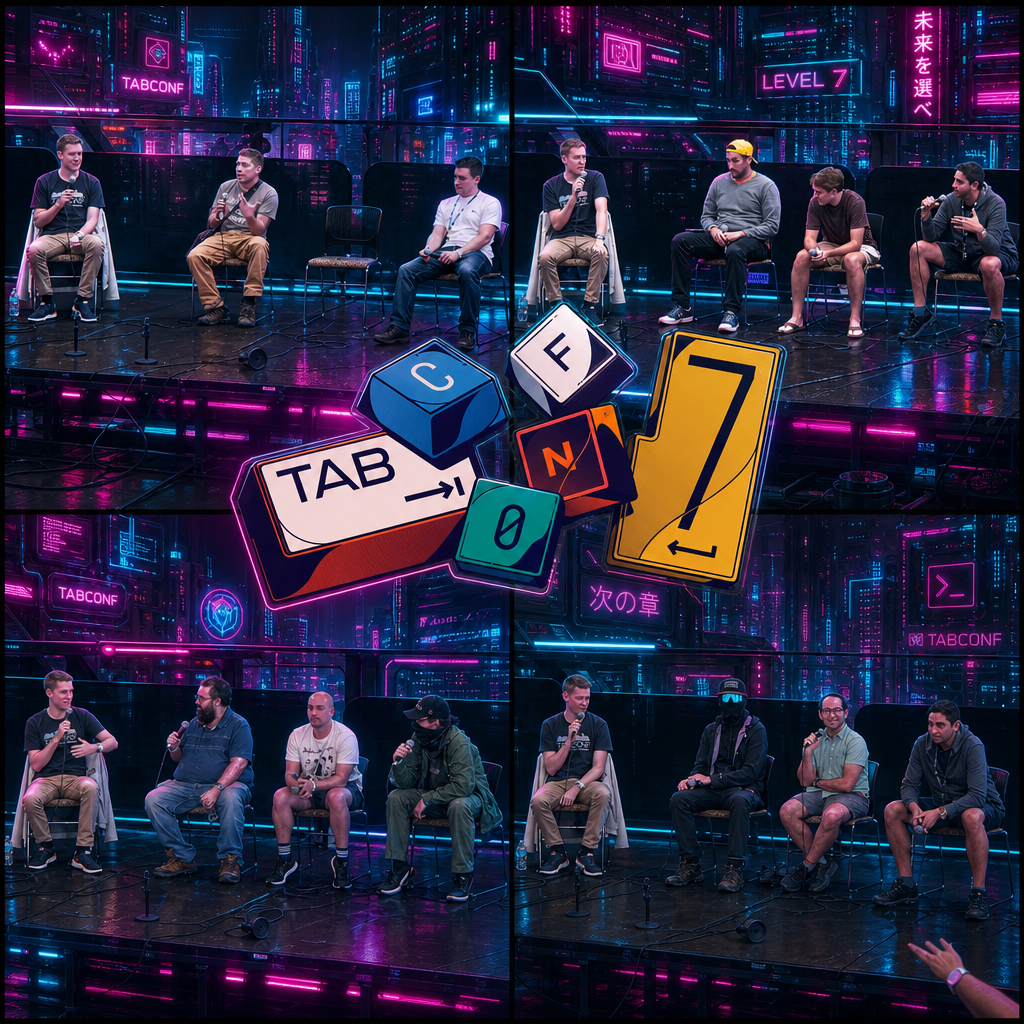
What Happened at TABConf 2025: The Day Lightning's Co-Creator Agreed with Paul Sztorc, The Skeptic
In late October 2025, in a conference room in Atlanta, the most consequential Bitcoin debate of the year took place... and almost nobody outside the room realized what they were watching while it happened.
Paul Sztorc, who has spent over a decade arguing that the Lightning Network is a dead end, was invited to TABConf to debate his position with a room full of Lightning developers. He almost did not go. He had booked the flight only a week earlier. Tadge Dryja, the co-author of the original Lightning Network paper and one of the most respected technical voices in Bitcoin, was sitting directly in front of him in the front row.
What followed was not a debate in the usual sense. It was something rarer: a public reckoning, where Sztorc made the case for his decade-long critique, and the audience of working Lightning developers, one after another, came up to the microphone and largely agreed with him.
This is what actually happened, transcript receipts included.
The opening: ten minutes to the case
Sztorc gave himself ten minutes to deliver the case and then opened the floor to questions for the rest of the hour. He wanted to "make himself very vulnerable" (his exact words) by giving three times more time to challenges than to his own argument.
His opening line set the tone:
"I just think this is a bad idea and it's a big waste of time. The channels idea is not workable. There's not enough block space for 1% of the Earth's population to really use Bitcoin via Lightning."
He walked through the structural problems in rapid fire: channels are difficult to operate and maintain, the UX is poor, they're unreliable, and crucially: "it matters who you open a channel with," which "steers us away from the cypherpunk world where everything is just like math, and steers us back towards this world of brands and you have trust and reputation."
He acknowledged Tadge Dryja directly, with grace: "I love Tadge. Tadge is great. I don't blame Tadge for this and neither should you. This isn't his fault. This is everyone's." But then he made an observation that lingered. He had checked the YouTube view count on the original 2015 Lightning Network presentation throughout that year (the year the blocksize war started, the year Lightning became the official scaling answer for Bitcoin) and the video never crossed 350 views. "The people who argue about Lightning, they actually haven't watched the video and they probably don't really know anything about Lightning."
This was Sztorc's framing throughout: most Lightning advocacy is not based on understanding Lightning. It is based on tribal loyalty inherited from the blocksize war.
The Blue Wallet anecdote
The moment Sztorc cited as personally radicalizing was a Bitcoin meetup in Mexico in February 2019. Hundreds of people, all excited about Blue Wallet. Sztorc downloaded it under peer pressure. Someone sent him eight satoshis instantly.
"I was kind of like, huh, it doesn't really make any sense because I didn't open a channel or like what's going on. So then I asked the room: is it custodial? And this was with a huge group, twenty-five people, only a small subset of this group of Lightning enthusiasts. But they had no idea what the question even meant. They didn't even know what the word custodial meant. And this led me to believe that many of the Lightning supporters are dupes. They don't realize what they are saying when they say that Lightning is great."
This is a story Sztorc has told many times before, in writing and on podcasts. Hearing it told live, in front of Lightning's actual developers, while Tadge Dryja listened from the front row, was different.
The HTLC catch-22
The technical core of Sztorc's argument hinged on the Hash Time-Locked Contract: the cryptographic primitive that lets payments route across multiple Lightning channels. His framing of the HTLC problem is one of the most cited from the talk:
"The HTLC idea also doesn't quite work because it expands the size: depends on how you count it, but basically two transactions you need in order to actually have the money and buy something with it. They increase the number of bytes that you must use. And this is a catch-22 because when the fee rate on the L1 blockchain is very high, the HTLC is so expensive that it's better off if you just don't use it at all and the Lightning Network part is useless. And then when the fee rates are low, you don't need to bother with the Lightning Network because the fee rates are low."
This is not a marginal concern. It is the core economic insight that explains why Lightning's promise: instant cheap payments for billions of users — collapses on contact with the actual fee dynamics of the Bitcoin L1.
He moved on to the cultural diagnosis: "Lightning derangement syndrome. Lightning doesn't work, and then if you tell the truth about it, then people get very defensive and then they just become very nasty. But as a result of this, Lightning gets out of criticism. A lot of people are just not comfortable saying things, or at least they weren't for many years. And as a result, we're all lying to ourselves."
The Waymo metaphor
The most memorable rhetorical moment of the talk came when Sztorc tried to explain what custodial Lightning actually is:
"Custodial Lightning. This is the stupidest idea in the universe. Imagine you get in a driverless Waymo, but there's a human driver in the front seat and he drives you to your destination with his hands and with his eyes. He's using the turn signal and everything. And then as you leave, the guy says: Waymo is the future of taxis because a computer can drive cheaper and safer than any human driver."
The room laughed. The metaphor landed because it was unanswerable. Custodial Lightning is, structurally, a centralized exchange that has adopted the Lightning brand. It has none of the cryptographic properties the original design was supposed to provide. Defending it as "Lightning" is the cypherpunk equivalent of saying a human-driven Waymo proves self-driving cars work.
The closing: two theories
Sztorc ended his opening with what he called the choice between two theories. The orthodox theory: channels work, they are the future of Bitcoin, engineers will solve the problems. Sztorc's theory: they do not work, it is no longer a good use of your time, engineers are playing pretentious games to win Open Sats grants.
"Orthodox view is like that I'm here to FUD Lightning and shill drivechains and I want more clout or something so that I can get BIP 300 activated. The truth is that Tid practically had to drag me here. I almost didn't come... booked the flight like last week. And Lightning is going to collapse because it doesn't work, and BIP 300 does not need code changes to Core and it will activate because of its effect on miner revenues and other things."
Then he opened the floor.
The procession of agreement
What happened next is the part that should have made headlines in Bitcoin media but largely did not.
The first person to the microphone introduced himself with the line: "Hey Paul, thanks. I mostly agree with you, which I'm shocked to say." Sztorc had predicted this. He had thought about putting up a tally counter on stage for how many speakers would open with that line.
The speaker pushed back gently: Lightning is a "massive success" in payment throughput within the network, even if it failed to scale to billions of users. Sztorc accepted the narrow point but reframed it: success in a niche role is not what Lightning was sold as, and the niche role does not justify a decade of community attention.
The next speaker disagreed more substantively, arguing that Lightning is what Bitcoin actually needs for scaling. Sztorc engaged with him directly, repeating the core math: not everyone can open a channel, the L1 byte costs are fundamental, and the premise of "we don't need to scale to 8 billion people" is exactly the defeat the conversation should not concede.
Then came a man making a point that was diplomatically devastating:
"I do agree it's not going to scale. I do believe that it will at some point only be a niche that some people will use for very specific purposes for very specific communities."
This was a working Bitcoin developer, on stage at a major Bitcoin conference, conceding the central point of Sztorc's critique. Lightning will not scale. It will end up as a niche tool. The disagreement was about whether that constitutes "failure" — but the technical claim Sztorc had been making for years was conceded almost in passing.
The hater who became a convert
One of the most striking exchanges came from a young man who walked up and introduced himself memorably:
"Hi Paul. When we first met, I introduced myself to you as your biggest hater."
Sztorc remembered the tweet — something about Lightning succeeding and Sztorc's ideas failing. But after meeting Sztorc, talking to him, and doing more research, the man had changed his mind. He used his time at the microphone to make the case for drivechains, citing Lightning's lack of a long-term security budget answer for Bitcoin as a decisive issue.
This is the pattern the rest of the panel revealed. People who had publicly attacked Sztorc had, on closer examination of the technical arguments, ended up on his side. The attacks were tribal. The reconsiderations were substantive.
The Lightning engineer who emailed
Then came one of the most quietly damning moments of the night. A speaker came up and said simply:
"Somebody asked me to watch one of your videos and critique everything that you had said because I happen to like Lightning. And I watched it, and everything you said was correct."
Sztorc replied that he gets this kind of message regularly. He mentioned a specific email he had received from an engineer working full-time at a Lightning company who, after reading Sztorc's 2022 essay, wrote to say that he finally understood for the first time how Lightning was supposed to work... and that it did not.
This is the deeper vindication. The people closest to the project, with the most reason to defend it, were reaching out privately to Sztorc to admit he was right. They could not say so publicly because their jobs depended on the narrative. But in private, and at moments like TABConf where the format gave them cover, the agreement was widespread.
The opposition: Shinobi's challenge
Not everyone agreed. The most coherent pushback came from Shinobi: the Bitcoin Magazine writer and Lightning maximalist who challenged Sztorc's central claim that Lightning would collapse. His argument was about network effects: Lightning is the established king, other L2s (Spark, Ark, Liquid, Fedimint) are designing themselves to interlink with Lightning, and that runaway snowball effect will reinforce Lightning's position rather than drag it down.
Sztorc disagreed sharply. His counter was that the interoperability story is itself an admission of the network effects argument running in his direction: every L2 trying to bolt itself onto Lightning is doing so because Lightning is the brand, not because Lightning is the technically superior choice. "All of that about interoperability is just a way of bolting on some attempt at a genuinely new idea onto Lightning brand because the Lightning brand is undefeated."
It was a real disagreement, and it remains the strongest counterargument to Sztorc's collapse thesis. But it was also notably the only sustained pushback in the entire panel.
The moment Tadge Dryja came up
The single most consequential moment of the night came at the end, when the moderator persuaded Tadge Dryja, who was sitting silently in the front row through the entire panel, to come on stage.
Sztorc asked him a direct question. His core technical argument was that Lightning channels consume L1 bytes, that this consumption fundamentally limits the design, and that any L2 which doesn't consume L1 bytes for every user state update will outcompete Lightning. Did Tadge fundamentally disagree?
Tadge's response was extraordinary, and worth quoting in full:
"This is not new. Like in the end of the Lightning Network paper, it's like, okay, yeah, like here's the back of the envelope. Like you'd need 300 megabyte blocks and then everyone could open a channel every year or something. So like yes, but the L1 bytes are very important."
The co-author of the original Lightning Network paper, on stage with Lightning's loudest critic, conceded the central technical point. The L1 byte problem is real. It is in the original paper. Lightning at global scale would require 300-megabyte blocks, which is exactly the outcome the smallblocker faction spent a decade fighting to prevent.
Tadge went on to defend Lightning's place in the ecosystem ("Lightning definitely still has a place") and to talk about other technologies he's working on (Utreexo, larger L1 capacity) that might complement it. But the core concession had already happened. He did not argue that Sztorc was wrong about the math. He argued that the math leaves Lightning a niche role, which is exactly what Sztorc had been arguing for years.
"But yeah, I guess my main thing is like yes, there's problems in Lightning, but like so many of these are like everywhere in Bitcoin and it is sort of like how are we making the progress we need to."
This is the sentence that ended the debate. Lightning's co-creator, in person, in public, did not refute the critique. He extended it. The problems are real. They are not solvable within Lightning's design. The broader question of how Bitcoin scales is open, and Lightning will not be its answer.
Why this was consequential
The TABConf panel was consequential not because it produced new technical arguments. Sztorc had been making the same arguments for years. The point that Lightning consumes L1 bytes was in the original 2015 paper. The point about custodial Lightning was obvious to anyone paying attention. The point about network effects was a standard part of Sztorc's pitch.
What was new was the public acknowledgment from inside the project. Tadge Dryja did not push back. The Lightning developers in the room did not push back. The "biggest haters" of Sztorc came up one after another to agree with him. The young man who had introduced himself as Sztorc's biggest hater was now advocating for drivechains. The Lightning engineer who emailed Sztorc privately after reading his 2022 essay was, by proxy, on the stage.
The Lightning community spent ten years gatekeeping criticism. The pattern Sztorc identified (that senior people privately agreed with him but could not say so publicly without losing speaking invitations, grant funding, or social capital) was, on that night in Atlanta, briefly suspended. People said what they actually thought. And what they actually thought, in overwhelming majority, was that Sztorc was right.
The vindication that mattered was not that Sztorc won an argument. It was that the people best positioned to refute him, given an unconstrained opportunity, declined to do so. They engaged with the critique on its merits and found themselves agreeing with most of it.
What this means for Ecash
The TABConf panel is the cleanest evidence that the cultural ground for Ecash has been prepared. The Lightning consensus that dominated Bitcoin for a decade is no longer a consensus. Inside the project, the people doing the actual work have quietly concluded that Lightning will not be the answer at scale. Outside the project, the constituency for an alternative is growing... and growing specifically among the technically literate, the people who would be earliest to adopt a drivechain ecosystem if one existed.
This is what Sztorc has been waiting for. The patience strategy described in the Sztorc Vindications — explaining the technical case repeatedly, over years, in slightly different words, until the Overton window shifted and it paid off at TABConf. The room was ready to hear the argument. Tadge was ready to concede the core technical point. The hater was ready to become the advocate.
The August 2026 fork happens against this backdrop. Ecash is not launching into a hostile audience that thinks Lightning is fine. It is launching into a Bitcoin community where the most technically credible voices have already conceded that Lightning will not be the universal scaling answer, and where the appetite for an alternative is at its highest point in a decade.
That is what Sztorc built at TABConf. Not by winning an argument, but by hosting one and trusting that the audience, when finally given the chance to think out loud, would reach the right conclusions.
The recording is public. Anyone who wants to verify the receipts can watch it on YouTube. The future of Bitcoin's L2 architecture was settled, in a room of about a hundred people, in the course of an hour. The rest is implementation.