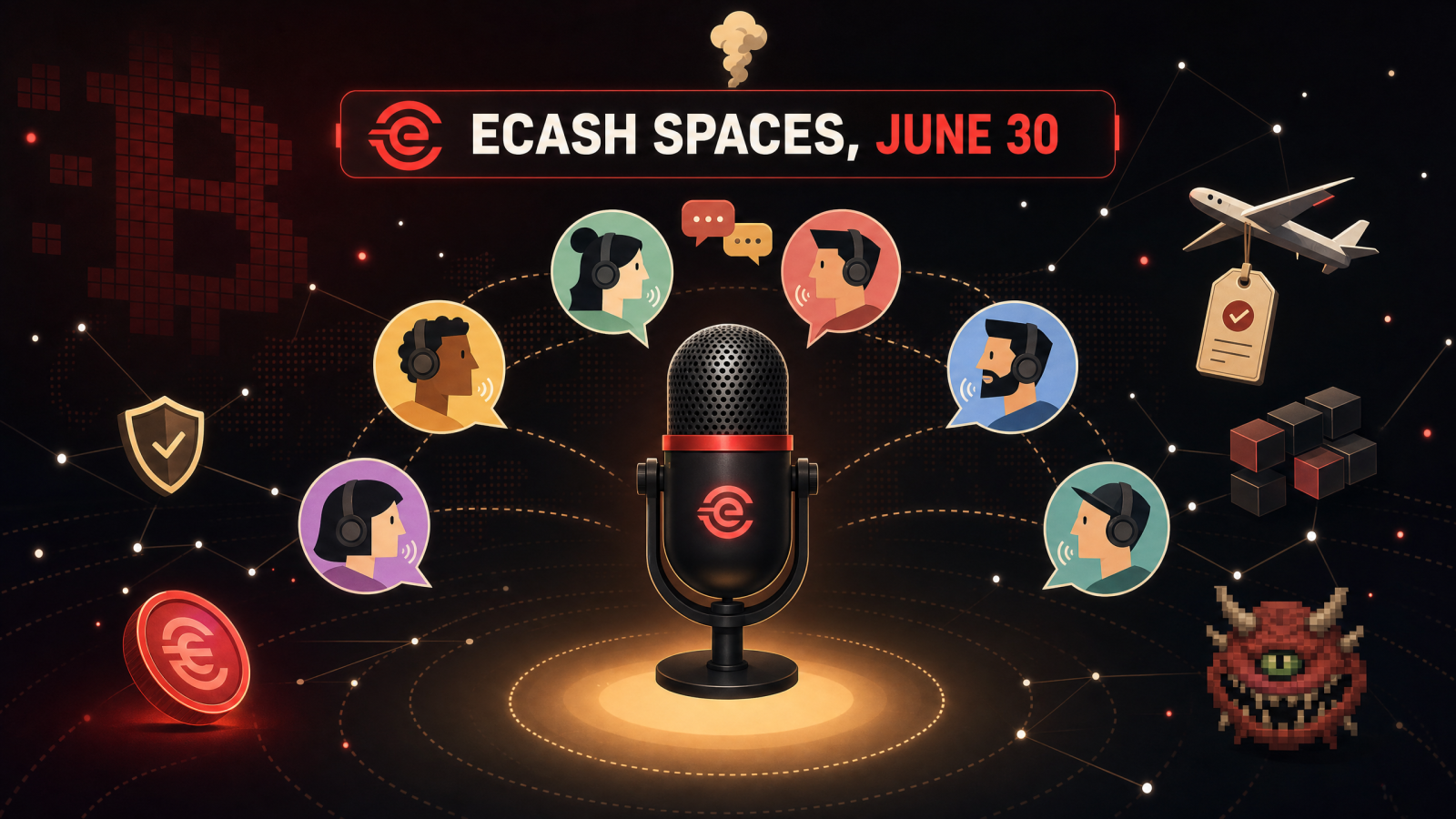
Paul Sztorc's June 30th Ecash Space: Comparative Advantage & Surviving the Launch
The final X Space of June ran a full two hours, and it followed the now-familiar rhythm: a slow, almost meandering solo open from Paul Sztorc, then a steady build into some of the sharpest technical exchanges of the entire launch run-up.
You can listen to the full recording on X or watch it on YouTube. Below is a map of what was discussed, who showed up, and the moments that made people laugh.
Housekeeping: The Wallet Is Out, the Samourai Is Late
Sztorc opened with two quick updates. The new mobile wallet and the eCash.com wallet are live, which he flagged as the week's most concrete shipping news. The Free Samourai document, on the other hand, slipped again.
He admitted it is essentially finished and that the delay was purely him wanting to "digest it a little," compounded by a lot of jogging in the sun that left him too tired to publish. He promised a 7am release the next day, "God willing," and apologized for dragging it out a week for no real reason.
Comparative Advantage and Another Shot at MicroStrategy
The first real theme was comparative advantage, tied to a week of retweets Sztorc aimed at MicroStrategy. His framing was clean: a real trade grows the pie for both sides. The baker who bakes at scale and the customer who buys instead of baking are both better off, two out of two.
His question for MicroStrategy is simple and unanswered in his view: what is the comparative advantage? If a company just buys Bitcoin that anyone could buy directly, and layers on lawyers and accountants, then it is not growing any pie. It is only re-slicing one, moving value between preferred holders, common stock, convertible debt, and the underlying assets, which means someone gains at someone else's expense.
He referenced a "wacky answer from Lynn Alden" to that comparative-advantage question, though he admitted he could not even remember what the answer was. It is worth noting for readers that Lyn Alden has generally been a long-term holder and cautious defender of the MicroStrategy trade, framing it as a company selling a security with structural demand that trades above net asset value, so Sztorc's dismissal is one side of a live disagreement rather than a settled matter.
A Statistics Tangent Nobody Requested
To fill time before guests arrived, Sztorc went on an entertaining detour about a Stanford PhD, "Fred K.," who allegedly ran a poll and misused confidence intervals and p-values to claim a 54-to-46 result rejected a coin-flip hypothesis.
Sztorc's objection was that with a large enough sample, even a 50.001 to 49.999 split becomes "significant," which misses the point entirely. He conceded that "no one's going to care about that," but offered it as proof that "we've got a lot of wacky people in Bitcoin," and that this particular one is "a leading light of 110."
Where the Name eCash Comes From
Hunter Beast, author of BIP 360, was the first guest and immediately asked the obvious question: why the name eCash, given how many things have carried it? Sztorc's answer was pragmatic. It is a short, two-syllable, easy-to-spell name, and remarkably, eCash.com plus a pile of related domains were actually available.
This kicked off one of the more genuinely interesting historical threads of the call. Hunter recounted being permanently blocked from writing Community Notes after correctly pointing out that "eCash" was coined by David Chaum in the 1980s, only to be reported by holders of a more recent shitcoin using the name.
Vlad Costea added rich context: there is Economist coverage of eCash from the late 80s or early 90s, and one of the earliest archived drafts of the Bitcoin white paper was reportedly titled ecash.pdf, before the "peer to peer electronic cash system" framing existed. The group drew a clean line between this Sztorc drivechain fork and the unrelated Avalanche-based eCash (XEC), a fork of a fork of Bitcoin Cash that bolts on proof-of-stake-style pre-consensus and, in Sztorc's telling, is propped up by a dev tax funding one person who bought "a bunch of Twitter bots."
Stablecoins: Just Become the New Tether
A guest asked whether drivechain has a strategy for stablecoins comparable to the BitNames-versus-ICANN plan. Paul Sztorc's view is that he barely needs one.
Tether is, in his words, close to the most profitable business model in the universe, so either they cooperate and keep printing money, or someone simply builds a drivechain USDT that is redeemable for real USDT, fully programmatic, with published reserves and yield on the backing. Either way he does not worry much about it.
The Difficulty Reset and the Open-Source Pool
A miner-focused guest (J25) pressed on two practical launch questions. First, why set difficulty to one? Sztorc clarified this was artistic license. The plan is to deliberately undershoot the difficulty, setting it well below the likely correct value, perhaps by a factor of 200, and let it ratchet up by the maximum 4x per retarget until it finds its level.
Second, on pools, he confirmed the Simple Pool is open source, anyone will be able to run one, and the goal is open-source pool software plus open-source node software so that leaving a pool and starting your own is trivial. He noted you really only need two pools for healthy competition, and that payouts should eventually flow over Thunder very quickly.
BitAssets vs Thunder, and a Blunt Complexity Critique
A recurring architecture question resurfaced: should sidechains be topic-specific or Swiss-army knives, and should Thunder and BitAssets merge? Paul Sztorc stayed genuinely open, saying it could go either way, and pointed to the upcoming public dry runs as the thing that will settle these debates empirically rather than theoretically.
The sharpest pushback of the call came from a skeptic who argued Sztorc is going to "ban most of your users via complexity" with all the talk of running node one, node two, and so on. Sztorc pushed back that everything sounds complex at first, "that's why Harry Potter is so successful," and that the actual user experience is just a window with a sidechains tab and a button, "less complicated than trying to play the Halo Master Chief collection." The exchange stayed pointed but good-natured.
The Technical Centerpiece: Why You Cannot Fake a Sidechain Header
The strongest technical segment was Sztorc walking through why lying about a withdrawal bundle is so hard. The key insight, which he admitted he had not fully appreciated its importance until pressed, is that the bundle hash is committed inside the sidechain headers.
His framework: L2 full nodes carry the burden of processing all the data and instantly reject any invalid block or bundle hash, even a single wrong byte. L1 observers only see the bundle hash and the work behind it. Because a fraudulent withdrawal only pays out after the full multi-month window of work, an attacker has to sustain an expensive lie the entire time, exposed to a community that can look closely at any moment. Faking a header effectively means outspending the entire fee flow of the sidechain, since the header occupies critical L1 real estate.
If a chain pulls in $10,000 of fees per block, you have to spend more than that to compete with the honest header. Sztorc reached for a Warcraft III analogy about invisible units and true sight, which he then worried was "too weird."
This section produced one of the day's best exit lines. A departing listener quipped, "Paul, it sounds like you've created a wonderful attack surface for the Federal Reserve, but thank you very much," and simply left.
The Bitcoin ASMR Moment
Right after the header discussion, Hunter Beast delivered the funniest and most affectionate beat of the Space. He told Paul he loves hearing him explain Bitcoin, praised his "soft, calm, confident demeanor," and said he would "pay good sats for like, almost ASMR Paul Sztorc explaining Bitcoin just for hours."
Sztorc took it in stride and pointed him to the roughly 36-hour YouTube playlist on drivechain.info. Hunter later added, during the hard fork discussion, "you're always welcome to grip my chain, Paul," which landed exactly as awkwardly and warmly as it reads.
The BIP-110 Steelman Debate
Hunter Beast then offered to steelman BIP-110, and to his credit he built the strongest version of the case: that tightening consensus can be a game-theoretic advantage, and that restricting the scriptPubKey helps mitigate quadratic signature verification attacks, also called poison block attacks. Sztorc engaged seriously but held firm. His core objections:
-
OP_RETURN data is the least computationally intensive, so JPEGs there actually reduce node burden compared to real transactions, which is exactly why users were historically encouraged to use it.
-
The 110 crowd wants to keep JPEGs off-chain and stop spam, but will achieve neither, since data can always be encoded elsewhere.
-
The quadratic hashing concern is real but old, partly motivated SegWit, and has rarely materialized as an actual attack because it does not accomplish much for the attacker.
Sztorc's memorable framing: it is like someone who needs to reach the post office before it closes, then parks the car and runs away from the building. The 110 proponents, in his view, are "so bad at getting what they want" that the craziness itself is the relevant fact. Hunter kept insisting OP_RETURN is a straw man and structured data is the real steelman, a distinction Sztorc acknowledged as more interesting than what Luke and others are actually arguing.
Later, guest J25 landed a clean jab: Luke has put his own arbitrary data on-chain in the form of Bible verses, and the Genesis block itself contains arbitrary data, so the purity argument collapses on contact.
Decentralized Storage, Filecoin, and Sia
A guest pitched a decentralized storage sidechain with replication markets letting node runners monetize spare capacity. Sztorc was receptive in principle and said it is a "phenomenal candidate for an L2 drivechain," since the drivechain handles the bridge, deposits, and withdrawals so the builder can focus on the novel part. The guest delivered a savage teardown of Filecoin as a Rube Goldberg machine, "Peewee Herman's breakfast machine of a blockchain," requiring GPUs, petabytes of HDDs, and terabytes of SSDs.
Paul Sztorc spoke fondly of David Vorick and Sia, praising the 12-word full-filesystem recovery idea. Notably, the guest said he would rather use a hard fork than BitVM, and Sztorc reminded everyone that BitVM's creator Robin Linus has repeatedly said BIP300 is better and that he only built BitVM as a workaround for its absence.
SegWit, the Hard Fork Pincer, and Copying Bitcoin Core
Mark Alpenblick asked what happens to SegWit under the reduced block size. Sztorc explained that nothing gets amputated; the whole "plane shrinks" proportionally, luggage and all. This led to his airplane analogy for SegWit, where the witness data is like checked baggage stored separately while pre-SegWit transactions carry everything on board. He later revealed the analogy's origin: he adapted it from a block size war graphic that used a bus and passengers leaving suitcases behind, swapping in "check a bag" because people actually understand that phrase.
He reiterated the guiding L1 philosophy: eCash's base layer is just Bitcoin Core with minimal, tight changes, so future maintenance is mostly copying upstream work. "What if you started up a hotel and you're like, oh, I'm going to also make my own copper for the wires." On the relationship between the fork and CUSF, he described a pincer movement: pursuing honorable soft-fork activation in BTC keeps the hard fork legitimate, while the hard fork forces people to actually take the soft fork path seriously. Both the thumb and the four fingers are needed for grip.
The CoinNews Governance Debate, Then a Live Demo
The longest guest exchange was with Shomari, who wants to launch a RISC-V sidechain and had dug through the BitWindow source to find that submitting a drivechain proposal hits a literal "TBD" comment in the code. He argued the M1 proposal mechanism is too permissioned, requiring a coinbase transaction, and proposed switching M1 to a regular fee-paying mempool transaction so anyone could propose trustlessly.
Sztorc walked through why he thinks that would not help: the proposal has to be ratified by miner coinbase signaling (M2) regardless, so the real gate is getting 51% of hashrate to want the chain, not the M1 mechanics. His answer to the discovery problem is CoinNews, a high-fee attention-grabbing message he likens to a Native American smoke signal, where everyone can see it and everyone can see that everyone else saw it. He noted, with some amusement, that the replies feature on CoinNews "weren't my idea" but he is staying open-minded.
The payoff came near the end. Shomari returned to announce he had submitted his proposal via CoinNews and it was already mined and showing up in the eCash wallet, then declared, "there's no excuse, Paul. I want to be in, let me in." Sztorc called it exactly how it should work.
Blind vs Normal Merge Mining
Marcus made a thoughtful case that normal merge mining, as used by Rootstock, might be better than blind merge mining because it gives miners a first-mover advantage to run node software and earn fees others miss, and avoids the L1 liquidity requirement. Sztorc found the point ironic, because blind merge mining was invented specifically to answer 2015-era complaints that miner competition on side activities would "damage mining incentives."
He now regrets taking those complaints seriously, calling many of the critics "Marxist weirdos" who complain both when something is competitive and when it is not. He maintained the two approaches are "mostly the same," while noting blind merge mining cleanly eliminates MEV through proposal-builder separation, and that the L1-to-L2 fee exchange rate self-adjusts.
Difficulty Adjustment and the Bitcoin Cash Cautionary Tale
Closing out, Shomari raised Bitcoin Cash's Emergency Difficulty Adjustment, which slashed difficulty after long blockless gaps and, in Sztorc's account, backfired badly. Miners began triggering it on purpose, waiting out the window for "open season" on easy blocks, and BCH had to scramble another hard fork that hurt its credibility. He even flagged, self-deprecatingly, that people are free to "clip the audio here" and replay it if eCash hits the same wall in late August.
His preferred approach is restraint plus preparation. Start difficulty deliberately low, let it climb, and if it overshoots, either rent hashrate (now cheap and easy) to push through to the next retarget, or ship a one-time software update that shifts difficulty down by 30%, rather than baking an ongoing EDA into consensus. His underlying logic is that a runaway-high difficulty can only really happen alongside a skyrocketing price, which is itself good news, so the genuinely bad zone is a narrow middle case worth working through manually.
A Few More Laughs Worth Keeping
Beyond the ASMR moment and the Federal Reserve exit line, the call had a steady undercurrent of humor: Liquid "has five users now, so that's up 500% from what they had before, which was zero," the recurring dream of running Doom on a BIP300 drivechain, and Sztorc cheerfully admitting he invents his elaborate analogies "as I go," except the ones he quietly borrowed from the block size war.
The throughline of the whole session was the same as recent weeks. The vision is settled; the conversation has moved to execution, tooling, and the messy practical questions of launch day. And increasingly, the guests are the ones driving it, whether by steelmanning opponents, tearing down Filecoin, or just mining their own proposal live to prove a point.