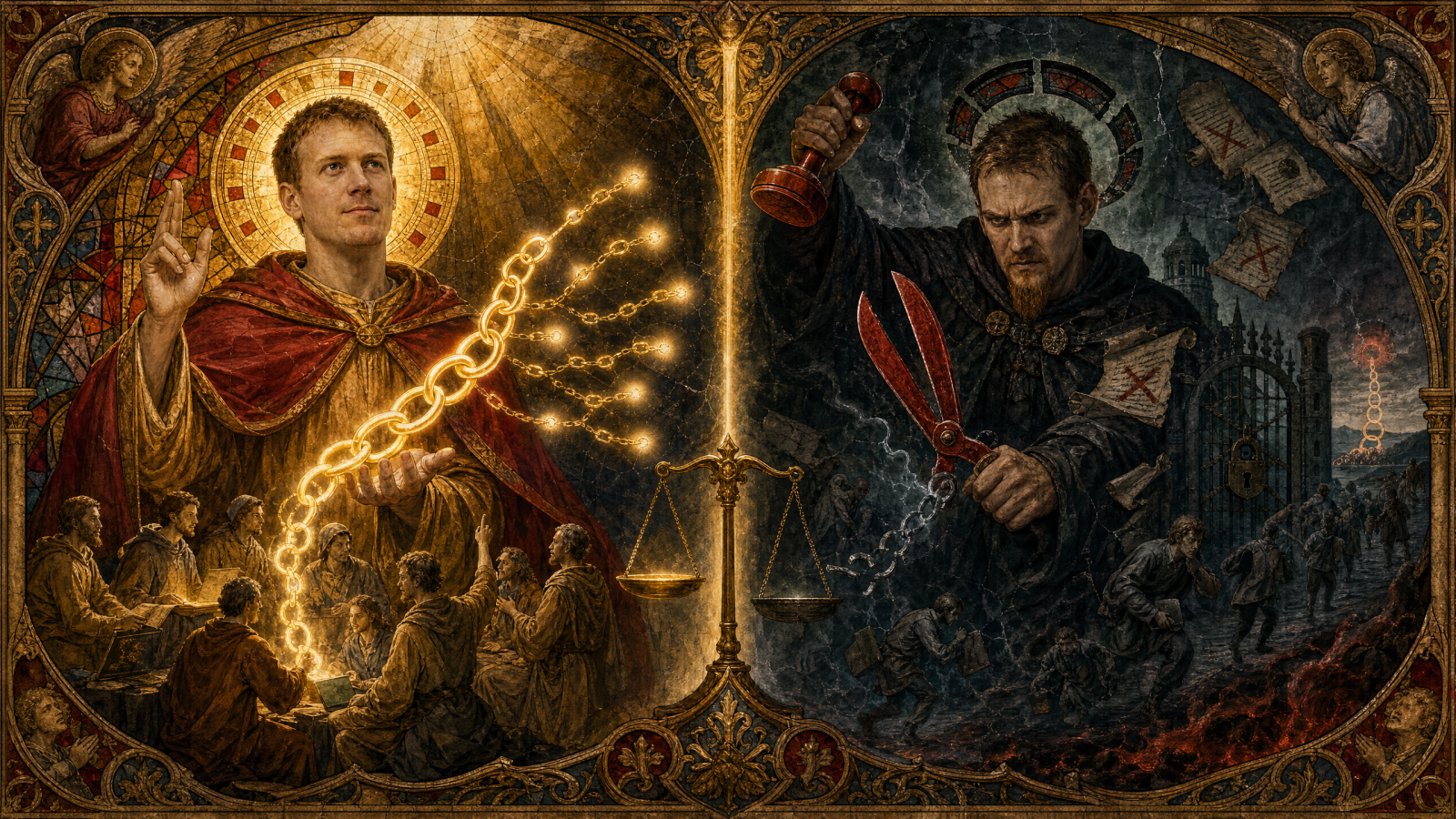
The OP_RETURN Distraction Industrial Complex: How Luke Dashjr Spent a Decade Sabotaging Bitcoin
In April 2025, Bitcoin Twitter erupted into a moral panic over OP_RETURN — a Bitcoin opcode most users had never heard of, doing something most users did not understand, in a debate that consumed thousands of developer hours and produced essentially no useful output. Senior figures made confident pronouncements that displayed no technical understanding. Influential accounts demanded the resignation of Bitcoin Core developers. Conferences pivoted entire panels to address the manufactured controversy. The debate raged through 2025 and into 2026, eating attention that should have flowed to substantive improvements.
Paul Sztorc had predicted exactly this dynamic. In his "Derangements" essay, he catalogued the way manufactured controversies systematically eat developer attention in Bitcoin, producing the appearance of activity while preventing actual progress. The OP_RETURN drama was the textbook example.
But the deeper story is not about 2025. It is about 2014, when a single developer named Luke Dashjr first established the precedent that would later be weaponized into a full-scale anti-development faction. The cost of that precedent has been incalculable. It produced the brain drain that drove a generation of developers to Ethereum, it gatekept legitimate use cases out of Bitcoin for over a decade, and it eventually metastasized into the Knots/Ocean Mining coalition that now functions as a permanent obstacle to anything Bitcoin Core tries to ship.
This is the story of how Bitcoin lost its developers, lost its momentum, and lost a decade of compounding innovation... and how the same patient figure who warned about it for years is now building the alternative that escapes the entire dysfunction.
The original vision: everything built on Bitcoin
To understand what was lost, you have to understand what Bitcoin maximalism originally meant.
In 2011, 2012, and 2013, "Bitcoin maximalism" was not a slur. It was a coherent thesis. The thesis was that Bitcoin would serve as the foundation layer for every interesting cryptocurrency use case: payments, identity, prediction markets, smart contracts, tokenization, naming systems, everything. The maximalist position was expansive, not restrictive. It said that Bitcoin's security, its monetary properties, and its network effects were so valuable that any new cryptographic application should naturally be built on top of Bitcoin rather than launching a separate chain.
This vision animated the early projects. Namecoin in 2011 was an attempt to build decentralized DNS on Bitcoin via merge-mining. Mastercoin in 2013 was an attempt to build a tokenization layer. Counterparty in early 2014 was the most ambitious: a full distributed exchange and token issuance platform that used Bitcoin transactions as its data layer.
Counterparty's mechanism is worth understanding because it exemplifies what early Bitcoin maximalism actually looked like in practice. The protocol embedded its data inside Bitcoin transactions using the OP_CHECKMULTISIG opcode: technically a "hack" because that opcode was intended for multisignature verification, not data storage. But the result was that Counterparty users got all the security guarantees of Bitcoin's hashrate, paid Bitcoin's miners for the blockspace they consumed, and inherited Bitcoin's network effects. A token issued on Counterparty was, in a meaningful sense, a Bitcoin token. The financial activity it represented happened on Bitcoin.
This was the maximalist vision firing on all cylinders. Bitcoin would not be a single-purpose monetary asset. It would be the substrate for every cryptocurrency application worth building. The community of developers attracted to this vision was large, enthusiastic, and growing rapidly.
Then March 2014 happened.
The 2014 OP_RETURN war
The story of what BitMEX Research later called the OP_RETURN Wars of 2014 has been almost entirely forgotten by contemporary Bitcoin discourse, which is a tragedy because the entire shape of the current dysfunction can be traced to that single month.
On March 20, 2014, Jeff Garzik) one of Bitcoin's most respected developers at the time) began posting on the Counterparty thread at Bitcointalk. His message was hostile and clear:
"You don't need to store data in the blockchain. That is purely intellectual laziness. Timestamping hash(data) is just as secure, while more efficient. Furthermore, a secondary chain can be provably pegged to bitcoin."
This framing (that data storage on Bitcoin was "abuse," that Counterparty was "lazy," that legitimate developers should build "secondary chains" instead) was the opening salvo of a campaign that would reshape Bitcoin culture permanently. Garzik continued:
"Given that the overwhelming majority — >90% — application for the bitcoin blockchain is currency use, using full nodes as dumb data storage terminals is simply abusing an all-volunteer network resource."
The Counterparty developers responded with patient confusion. They were paying fees. They were processing financial transactions (token trades are financial transactions). They were using a feature that the protocol explicitly supported. What exactly was the objection?
The objection, as it became clear over the following weeks, was cultural. A faction of Bitcoin developers had decided that Bitcoin should be used only for what they considered legitimate purposes: narrowly defined monetary transactions... and that everyone else should "build a secondary chain" if they wanted anything more interesting. This was not a technical argument. The technical argument did not exist. The objection was that Counterparty developers had not asked permission.
Then Luke Dashjr entered the conversation.
Luke Dashjr: the gatekeeper emerges
Luke Dashjr had been a Bitcoin developer since 2011 and operated a mining pool called Eligius. His response to the Counterparty situation established a pattern that would define his career for the next decade:
"The miners are supposed to filter out abuses."
This sentence is worth dwelling on. Notice the framing. Counterparty transactions are "abuses." Miners are obligated to "filter" them. The legitimacy of the underlying activity is not at issue: the determination has already been made, by Luke, that it is abuse. The only remaining question is how to suppress it.
Luke's mining pool, Eligius, began filtering out Counterparty transactions. When Counterparty developers modified their protocol to bypass the filter, Luke responded within hours:
"Great news! Filter added to block this crap in less than 5 minutes, and 1 line of code."
The Counterparty community was bewildered. They had been operating in good faith, paying fees, following protocol rules. Now a single developer with a mining pool had unilaterally decided their activity was illegitimate and was actively suppressing it. The replies on Bitcointalk ranged from confused to furious.
A user with the handle "porqupine" captured the broader concern:
"When was it decided that every node has consented to store X type data and not Y type data? Maybe I also did not consent to store transactions for laundered money, illicit drugs and weapons, human slavery — etc. You're basically negating protocol neutrality and deciding what the Protocol Should and Should Not be used to store, and More than that you aren't speaking in first person but using the pronoun Us, giving the impression that you are speaking for all miners or protocol users as a whole."
This was the right question. By what authority was Luke Dashjr deciding which Bitcoin transactions were legitimate and which were "abuse"? The answer, in 2014, was no authority at all. He had appointed himself.
PhantomPhreak, Counterparty's lead developer, articulated the deeper concern:
"Counterparty transactions are financial transactions. Every full node has consented to download and store the Bitcoin blockchain, no less. That is, transactions that accord to the Bitcoin protocol, which Counterparty transactions obviously do. Satoshi imbedded a political message in the Genesis Block, for Christ's sake. You have a much narrower view of the possible use cases for Bitcoin than do others."
The reference to Satoshi's Genesis Block message — "The Times 03/Jan/2009 Chancellor on brink of second bailout for banks" — is pointed. Satoshi himself embedded arbitrary data in Bitcoin transactions from the very first block. The protocol was designed to allow this. The "abuse" framing was historical revisionism, asserting a narrow vision of Bitcoin's purpose that had not actually been the consensus of its early developers.
But Luke Dashjr was not deterred by these arguments. He continued the gatekeeping. He continued the filtering. And critically, he was not punished or marginalized for his behavior. The Bitcoin community, in its infancy, allowed a single developer to function as a self-appointed legitimacy arbiter, suppressing entire categories of innovation that he personally disapproved of.
The brain drain begins
The consequences of the 2014 OP_RETURN war did not appear immediately. They appeared over the following decade, as developer after developer who had been excited about building on Bitcoin quietly migrated to Ethereum or other platforms that did not feature self-appointed gatekeepers.
Vitalik Buterin entered the 2014 debate to make exactly the right point:
"It's the protocol's fault the OP_RETURN battle is such an issue. In an ideal world, the concept of 'abuse' would not even exist; fees would be mandatory, and carefully structured to closely match the actual cost that a given transaction imposes on the network. If you can pay the fees for what you're doing then you should be able to do it, no questions asked."
This is the design philosophy Ethereum eventually adopted. Pay the fees, do what you want. No gatekeepers deciding what counts as "legitimate" use. The result was a protocol that attracted the developers Bitcoin was driving away. By 2016, Ethereum had a thriving developer ecosystem and Bitcoin had Lightning Network discussions. By 2020, the asymmetry was so pronounced that "Bitcoin maximalism" had completed its semantic inversion: it now meant the opposite of what it had meant in 2013. Where the original maximalism had been about building everything on Bitcoin, the new maximalism was about preventing anyone from building anything on Bitcoin.
BitMEX Research, in its retrospective on the OP_RETURN Wars, identifies the cultural cost precisely:
"The main driver for this was not necessarily fees or Ethereum's virtual machine and Ethereum's stronger technical capabilities. It is simply that many Bitcoiners and Bitcoin developers did not want Dapps on Bitcoin and they were not interested in these features. For better or for worse, some Bitcoiners deliberately pushed many of these Dapp developers away."
This is the brain drain Sztorc has been writing about for years. It is the brain drain Robin Linus described when he tweeted that "dozens of bright researchers and engineers" had left the Bitcoin community because of "more than a decade of pointless drama." It is the brain drain that explains why every interesting cryptocurrency use case from 2016 to 2025 was built somewhere other than Bitcoin.
The drain was not accidental. It was the result of specific decisions made by specific people, beginning in March 2014, with Luke Dashjr playing a starring role.
Luke Dashjr's deeper inconsistency
There is a particular irony in Luke Dashjr's career arc that has gone almost entirely uncommented on in the contemporary debate. Dashjr himself has, over the years, embedded religious messages and arbitrary data in Bitcoin transactions. He is on record advocating for various non-financial uses of the protocol when those uses aligned with his personal preferences. The "no arbitrary data" position he adopts when others want to use the chain is suspended when he wants to use it.
This is the deeper character of the gatekeeper role. The objection is never to data per se. The objection is to data Luke does not personally approve of. When Counterparty wanted to build tokenization, that was "abuse." When inscription users wanted to put images on the chain in 2023-2024, that was "abuse." When OP_RETURN users wanted to embed slightly larger data payloads in 2025, that was "abuse." But when Luke wanted to use the chain for purposes aligned with his personal beliefs, the same activities were not "abuse." They were legitimate.
This is not a coherent technical position. It is a coherent cultural position, in which Luke Dashjr functions as the legitimacy arbiter and the technical claims are post-hoc rationalizations.
The recent BIP 444 (later 110) discussions reveal this pattern with unusual clarity. Dashjr has spent the OP_RETURN debate framing himself as the defender of "Satoshi's original vision" of Bitcoin as money... except that the historical record shows Satoshi himself embedding arbitrary data in the Genesis Block, supporting BitDNS-style applications, and being broadly enthusiastic about expansive use cases for the protocol. The "original vision" Dashjr defends is not Satoshi's. It is Dashjr's.
This is the kind of historical revisionism that becomes possible when a community loses its memory and keeps poor track of its history. The 2014 debate was forgotten. The 2017 inscriptions debate was forgotten. The 2023 Ordinals debate was reframed as a novel crisis rather than the continuation of a decade-long pattern. By 2025, when OP_RETURN became the latest moral panic, almost nobody in the conversation remembered that the entire framework Dashjr was using had been invented by him eleven years earlier specifically to suppress Counterparty.
The Knots and Ocean Mining offensive
The 2025-2026 OP_RETURN drama is not just a continuation of the 2014 pattern. It is a weaponization of it. Luke Dashjr has spent the intervening years building institutional infrastructure that allows the gatekeeping role he pioneered in 2014 to be deployed at scale.
Bitcoin Knots is Dashjr's alternative Bitcoin Core implementation. The differences from Bitcoin Core are mostly small, but they include the systematic implementation of transaction filtering: the same techniques Dashjr pioneered with Eligius mining pool in 2014, now packaged as a full client. Users who run Bitcoin Knots are running software whose primary distinguishing feature is its willingness to censor transactions Dashjr personally disapproves of.
Ocean Mining is Dashjr's mining pool, founded in 2023. It implements similar filtering at the pool level. When Bitcoin transactions involve features Dashjr considers ”abuse” (inscriptions, Ordinals, OP_RETURN data over his preferred limit) Ocean Mining refuses to include them in blocks.
The combination of Knots and Ocean Mining gives Dashjr a complete vertical from user to miner that can be deployed against any feature he opposes. When the OP_RETURN debate erupted in April 2025, this infrastructure was the mobilization platform. Knots users were rallied. Ocean Mining was promoted as the "based" alternative to the supposedly compromised mainstream pools. Influential accounts who had aligned themselves with Dashjr's faction over the years coordinated to amplify the narrative.
The result was a months-long social media siege of the Bitcoin Core developers, who were portrayed as corrupt, captured, or insufficiently ideologically pure for declining to adopt Dashjr's preferred restrictions. The pressure campaign continued through 2025 and into 2026, with the Knots/Ocean coalition functioning as an effectively permanent obstacle to any Bitcoin Core release that did not bend to its demands.
Sztorc identified this dynamic in real time. In his Derangements essay, he noted that the OP_RETURN drama was a textbook example of the way manufactured controversies eat developer attention. He took the unpopular position that the technical claims Dashjr's faction was making were wrong... and that Bitcoin Core was, on the substantive technical issue, correct. This cost him social capital with people who were otherwise his allies, because much of the anti-Core sentiment among the Bitcoin Cash and Bitcoin SV diaspora had aligned with Dashjr's faction out of opportunism. They see it as an opportunity to ”fire Core”. But Sztorc's commitment was to the technical truth, not the political coalition.
What the distraction prevented
The cost of the OP_RETURN distraction is best measured not in what happened, but in what didn't.
While Bitcoin Twitter spent 2025-2026 fighting over a data limit that affects approximately nobody in any meaningful way, the actual structural problems facing Bitcoin went unaddressed. The security budget continues to collapse as the subsidy halves toward zero. The scaling architecture remains stuck on Lightning Network, despite Lightning's increasingly obvious failure. The drivechain proposal that would resolve a decade of architectural deadlock continues to be politically blocked. The brain drain Sztorc has been writing about for years continues unabated, with promising developers leaving Bitcoin for projects where they can actually ship things.
Every hour spent debating whether OP_RETURN data should be limited to 80 bytes or 4 megabytes was an hour not spent on any of these substantive issues. Every conference panel addressing the manufactured controversy was a panel not held on drivechain implementation, on miner alignment, on the security budget question. Every developer who burned out trying to navigate the Knots/Ocean Mining pressure campaign was a developer who could have been shipping useful code.
This is exactly the pattern Sztorc named in his Derangements catalogue. The community is not paralyzed by genuine technical disagreement. It is paralyzed by manufactured disagreement, generated by a small faction that has discovered that perpetual outrage is a viable career strategy in Bitcoin culture.
The deepest cost of the OP_RETURN Distraction Industrial Complex is not that it produced bad outcomes. It is that it prevented good outcomes from being attempted. The opportunity cost is unmeasurable because we will never know what Bitcoin would have become if the developer energy currently consumed by Dashjr's perpetual outrage campaigns had been directed at substantive problems.
How the original maximalists were right
There is a redemptive arc available here, and Sztorc has been quietly preparing it for over a decade.
The original Bitcoin maximalists of 2013 were correct about everything that mattered. Bitcoin should be the foundation layer for every interesting cryptocurrency use case. Bitcoin's security, monetary properties, and network effects are valuable enough that new applications should be built on top of Bitcoin rather than on separate chains. The expansive vision of Bitcoin as the substrate for cryptocurrency's full diversity was the right vision.
What the 2014 OP_RETURN war established was not that this vision was wrong. It was that the L1 itself could not accommodate the full diversity, and that the gatekeeper faction would resist any attempt to make it accommodate more. The solution, which Sztorc has been articulating for a decade, is to move the diversity onto sidechains (specifically, drivechains) where the gatekeeping faction has no jurisdiction.
Thunder is what Counterparty should have been. Hivemind is what prediction markets on Bitcoin should have been. The full Hivemind Master Plan is what the 2013 maximalist vision should have produced. Every use case the gatekeepers drove away from Bitcoin (tokenization, smart contracts, prediction markets, decentralized exchanges, identity systems) has a natural home on a dedicated sidechain that preserves all of Bitcoin's security properties without forcing the L1 to absorb the complexity.
This is the architectural escape from the gatekeeper trap. The L1 stays minimal, conservative, and exactly as monetary as Luke Dashjr wants it to be. The sidechains host everything else, paid for by users who want those features, secured by the same hashrate that secures the L1, denominated in BTC. Both factions get what they actually want. Neither faction can sabotage the other.
Ecash ships this architecture as a consensus rule from day one. The fork happens precisely because the political process inside Bitcoin has proven permanently incapable of shipping it on the existing chain. Luke Dashjr and the Knots/Ocean coalition will not be able to block drivechain activation on Ecash because Ecash is a separate chain with its own developers, its own community, and its own consensus rules. The gatekeepers stay on the original Bitcoin chain. The builders move to Ecash.
This is the fork's deeper purpose. Not to attack Bitcoin, but to liberate the architectural vision that Bitcoin's gatekeepers have spent eleven years suppressing. The original 2013 maximalists were right. Their vision is finally getting deployed. The chain it gets deployed on is called Ecash because Bitcoin's political process has made deployment on Bitcoin impossible.
This is why we Ecash
If you have been reading this blog, the pattern across all the essays should now be clear. Lightning was the wrong L2. Federations are not decentralization. Custodial services collapsed in 2022. The blocksize war was a stalemate that produced a decade of cultural rot. The OP_RETURN drama is a manufactured controversy that eats developer attention. Through all of it, Paul Sztorc has been making the same technical and cultural diagnosis, with patience and accuracy, while the rest of the community has been distracted by whatever the latest outrage cycle happened to be.
The 2014 OP_RETURN war was the original sin. It established the precedent that a single gatekeeper could veto categories of innovation, and it set in motion the brain drain that handed Ethereum its decade-long lead. Luke Dashjr's career since 2014 has been a methodical institutionalization of that precedent, culminating in the Knots/Ocean Mining infrastructure that now functions as a permanent obstacle to Bitcoin's progress.
Ecash escapes the dysfunction by leaving it behind. The fork is not a vote of no confidence in Bitcoin's monetary properties: those remain unchanged, on both chains, after the August 2026 split. The fork is a vote of no confidence in Bitcoin's governance process, which has demonstrated for over a decade that it cannot ship substantive improvements when a small faction is willing to manufacture controversy to prevent them.
When the fork happens, the gatekeepers will stay where they are. The builders will move where they can build. The original 2013 vision of Bitcoin maximalism (everything built on Bitcoin's security, denominated in Bitcoin's monetary asset) will finally have a home. It just will not be on the chain that bears Bitcoin's name. It will be on Ecash.
Twelve years after the OP_RETURN war drove the first wave of developers away from Bitcoin, the lesson has finally been learned. You cannot build on a chain whose gatekeepers can veto any innovation they personally disapprove of. You can only build on a chain where the architecture itself prevents that veto. Ecash is that chain. Drivechains are that architecture. Sztorc is the person who, with patience and accuracy and a decade of warnings nobody heeded, designed the escape route the rest of us are about to walk through.
The Distraction Industrial Complex will continue. Luke Dashjr will continue. Knots and Ocean Mining will continue to manufacture controversies that eat the attention of whoever remains willing to engage with them. But the people who actually want to build something will, finally, have somewhere to go.
That somewhere is Ecash.