Paul Sztorc's July 8th Ecash Space: Free Samourai & Fake BIP110ers
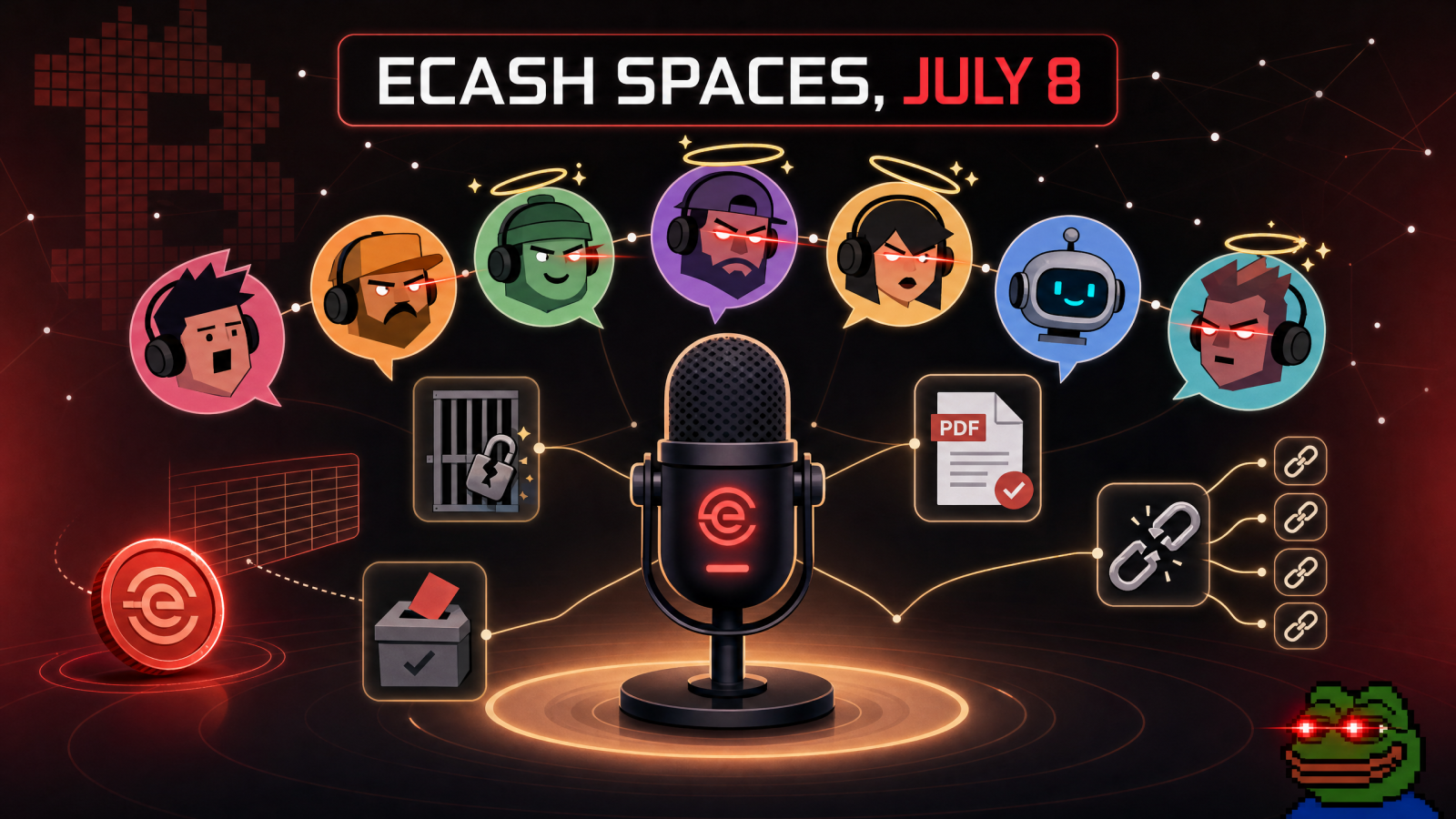
The July 8 Space was the most chaotic of the entire run-up, and it was chaotic on purpose. What started as a calm housekeeping session from Paul Sztorc turned into a two-hour free-for-all featuring Bitcoin Puppet trolls wearing fake BIP-110 laser eyes, a heated argument over the eCash name, a genuinely moving first-person account from a Silk Road figure about stolen Bitcoin, and a repeated plea from the hosts to "land the plane." You can find the recording on Paul's X account and the referenced videos on the eCash YouTube channel. Below is a map of what happened.
Warm-Up: A Cameroon Privacy Parable
To kill time before ten people joined, Sztorc opened with a study out of Cameroon that he found charming as a privacy use case. His framing was that in many non-Western cultures, the moment anyone earns more money than those around them, relatives and in-laws line up for a handout. He described a program that would invest people's money at a deeply negative return, essentially minus 25 percent, precisely because its real feature was that it would not tell anyone how much money you had. The negative yield was the price of confidentiality.
It is a loose anecdote rather than a citation, but it lands on a real theme. Cameroon has genuinely been wrestling with financial privacy. The country only enacted its first standalone data protection framework, Law No. 2024/017, which was gazetted in December 2024 and has since come into force, moving away from a fragmented, sector-by-sector approach. Before that, protections had to be pieced together from the constitution and scattered legislation, even as mobile money services like Orange Money and MTN Mobile Money exposed consumers to rampant scamming, hacking, and phishing. So the instinct Sztorc was gesturing at, that people will pay real money to keep their balances secret, is well grounded, even if his specific example was told loosely.
Housekeeping: Bug Hunt 3 Done, Dry Runs Incoming
Two concrete updates followed. First, Bug Hunt number 3 is finished, and Sztorc committed to publishing the full list of bugs, something he had held back on before out of concern about advertising unfixed vulnerabilities. The plan now is to publish and then work through fixing every one, including the many minor bugs that still need fix verification before being pushed out.
Second, and more important for the launch, the dry runs begin this Saturday. He described these as a full rehearsal: "if the fork happened now, like that's what it would be." Every participant will get to test claiming, difficulty behavior, mining, and everything else about the fork mechanics. He plans to run roughly seven of them, about one per week, and warned the first will probably be a "disaster," which is exactly the point. Better to find the failure modes now.
BIP-47 and the Address Book Bitcoin Never Got
Sztorc revisited a tweet about BIP-47 and Luke Dashjr. His argument connects to the BitNames vision he pitched the prior week: an app that lets you text money to someone the way you text words, with no copy-pasting addresses, no wondering whether the clipboard got hijacked, no asking whether the address is real.
His claim is that BIP-47, which dates to 2014, set up exactly the primitive that could have grown into this. A notification transaction establishes a shared secret (he referenced the Diffie-Hellman mechanism) so that two people learn each other's public keys and can send coins and encrypted messages freely. From there, he argues, it is a short hop to an address book inside Bitcoin, then a short hop from that to chat, then to texting money back and forth. Instead, "Luke killed 47," then went on to kill more OP_RETURN functionality, and, as Vlad Costea noted, this pushed builders toward Counterparty and Ethereum and helped birth the altcoin world. It is the same brain-drain thesis, told through a specific dead feature.
Michael Saylor: Buying High, Selling Low, and Solving Spam
Sztorc turned to a "new waste of time Michael Saylor article," admitting his own list of Saylor's greatest hits had grown too long to be useful, and pointing instead to a tightly curated Udi Wertheimer thread from a few days prior.
His specific complaints: Saylor recently claimed that one satoshi per virtual byte fees prove Bitcoin has "solved spam," which Sztorc found incoherent. And on trading, he charged that Saylor sold 32 Bitcoin, bought 3,600, then sold the same amount at a much lower price, a pattern of "constantly buying at the top and now selling at much lower prices." His verdict tied three things together: "Michael Saylor, BIP-110 and Lightning are all the same thing," each in his telling a "cult fake idea" propped up by social pressure.
A long tangent followed about whether Saylor, who controls hundreds of thousands of coins, could really be non-technical. A guest named Oiko insisted nobody puts billions into Bitcoin without personally understanding the key custody, and recounted Randy McMillan laughing at him over exactly this point. Sztorc's more measured take was that MicroStrategy certainly has some documented multisig, MPC, or Fireblocks-style setup with SOC reports, because corporations at that scale are required to, but that being obsessed with Bitcoin is not the same as being technical. He drew a comparison to Roger Ver, who became deeply knowledgeable while everyone still said "he's not technical."
The BIP-110 Troll Operation
Here the Space took its strangest turn. Several guests revealed they were Bitcoin Puppet and ordinals-community trolls who had renamed themselves "David BIP-110," "Julio 110G," and similar handles, slapped on laser eyes, and infiltrated the pro-110 camp.
Their bit, explained with gleeful candor: the pro-110 crowd will not let ordinals people onto their stages to argue with logic, so the trolls instead pose as fellow believers. One explained the whole social dynamic reduces to a very low bar. Put "BIP-110" in your name and laser eyes on your avatar, and "you're gonna be, I got 50 followers within 20 hours." They described the movement as cult-like, needing to "love bomb" any newcomer, and said they had been running 12-hour-a-day spaces titled things like "BIP-110ers for the win" to bait supporters into defending the idea, then gently dismantling them. The recurring image was "playing basketball with a 12 year old," being nice while still blocking every shot.
Sztorc leaned in, noting the mechanic-impersonation account genuinely made him laugh, a rarity given how "predictable" he finds most Bitcoin content.
Why a 110 Fork Would Stall on Block One
Amid the trolling, a genuinely useful technical explanation surfaced about what happens if BIP-110 activates via mandatory signaling and a chain split occurs on the signaling deadline.
The argument: as soon as a block fails to signal, the network cleaves, and if you land on the minority side, "you will just be on the minority side and you will never get any," because that chain would struggle to even reach 100 blocks. This is where Sztorc praised the 100-block coinbase maturity period as "one of the most ingenious parts of Satoshi's design" and, in his view, widely misunderstood. He rejected the standard Blockstream and Greg Maxwell explanation (that it is about database annoyance during reorgs) and offered his own: a miner does not get paid until 100 future blocks bury their block, which means you cannot mine "for fun" on a doomed fork. You only get paid if you mine on the real chain everyone uses.
The practical upshot for a 110 minority chain: they might squeeze out one block "just to prove a point," but with the difficulty inherited from Bitcoin and no meaningful hashrate, the next retarget could be days away. They would pay 100 percent of the cost and collect none of the revenue, forcing them to hard fork again, likely swapping in an LWMA difficulty adjustment, precisely the kind of ad hoc centralized intervention Sztorc argued the 110 crowd would rationalize in the moment.
Do We Even Like Core?
A revealing exchange clarified where Sztorc actually stands. He does not defend Bitcoin Core so much as consider 110 a low-quality competitor. His frustration is strategic: "the problem with Bitcoin Cash and with 110 is that they're low quality ideas," so they will lose and thereby make Core look better than it deserves.
He reached for a political analogy, comparing it to running a barely-functional candidate against Donald Trump and handing him the win. His ideal is genuine, high-quality competition for Core, which neither Bitcoin Cash nor 110 provides. Guests agreed that if 110 had simply shipped a client without a mandatory activation, people would have welcomed it as a healthy second option.
The Fight Over the eCash Name
The most heated stretch was a running battle over Sztorc's use of the eCash name, with a chat member "freaking out with emojis" and multiple guests insisting he rename the project.
Sztorc's position, delivered several ways: no human owns a name. The existing eCash (Amaury Sechet's XEC) sits around 175th to 180th on CoinMarketCap, down 78 percent over the year per a chart supplied by a listener, with a market cap under 100 million dollars and daily volume under 3 million. He called it a "tombstone," a project that "born dead" and "lived and died," while eCash.com and related domains sat available. Names, he argued, have "an organic quality" and "a center of gravity." When people google eCash, they will land on eCash.com, and "because ours is going to be bigger we are the real" referent.
Then came the sharp turn. A guest asked why that logic would not equally let Luke Dashjr claim the name Bitcoin if Knots became dominant. Sztorc's answer, briefly reversed and then re-affirmed, was striking: "No he can, and he would. And I wouldn't complain." He extended it into a small theory of language, that the "true name is what the audience thinks you're referring to," not something owned by a creator, illustrated with the fact that "Vader" is Dutch for father, a built-in Star Wars spoiler for Dutch speakers.
Guests pushed back hard with car-brand analogies (you cannot just call your company Volvo or Ford), and one suggested buying some of the old XEC in case the attention pumps it. Sztorc revealed he had actually messaged Omri months before announcing, when a rename and a possible sale of eCash.com was still feasible, and had prepared pages of notes and a proposal, only to be invited onto their show and then "kicked off like two sentences into my speech." Multiple guests corroborated that Omri is widely disliked, with one noting he "helped bully Omri off of Bitcoin Cash." Others chimed in that the eCash trademark is apparently held by an unrelated money-transfer company anyway, that "fedimint" and Cashu already use "ecash" generically, that David Chaum coined it in the 1980s, and that an "Ethereum Cash" from 2017 sits on Bitcointalk. The consensus among the eCash camp: the name is generic, like email or e-scooter, and "the name is not changing under any circumstances."
The Main Event: Free Samourai and the Pardon Playbook
The stated "most important thing" was the Free Samourai campaign. Sztorc laid out the background: the Samourai Wallet developers, one of them in his 60s and living in Portugal, shipped free open-source software with privacy features (CoinJoin, which Sztorc does not even rate highly) and were prosecuted for unlicensed money transmission. Crucially, he alleged they had prior guidance, possibly from FinCEN or the CFTC, indicating they were not money transmitters, and that the prosecution knew but did not disclose it in discovery. Out of money and unable to fight the government, they took a plea and were sentenced to five years.
His proposal is a 30,000 dollar prize across a series of contests, with a 10,000 dollar first phase, to produce a single authoritative PDF that makes pardoning them as frictionless as possible. The document would contain a one-page summary, the exact facts, honest inclusion of the worst-case arguments against the devs (to earn the reader's trust), and ready-to-send draft tweets, effectively copy-pasting the structure of the Ross Ulbricht pardon. Phase two is distribution: shop it to Trump-aligned Republicans as a winning issue with a 52 to 53 million crypto voter bloc ahead of the midterms, and simultaneously to Democrats as a hypocrisy angle. He floated the idea of "stapling" other names to the effort (Ian Freeman, Roger Ver, and others) to pool support and possibly unlock seized funds, while explicitly excluding Sam Bankman-Fried as too toxic.
A recurring tension ran through this segment. The hosts repeatedly told Paul to "land the plane" after he spent 20 minutes on one point, and a sharper strategic disagreement emerged. The Bitcoin Puppet camp argued that memes, not PDFs, move the needle: "there needs to be meme coins popping up on Solana to get the motherfucker out of jail type vibes," AI-slop jailbreak flash games, TikTok dances. Sztorc conceded memes drive attention but insisted substance still matters, because "live by the vibe, die by the vibe," and influential readers like a Victor Davis Hanson or Tucker Carlson type would want to know the facts are real. The compromise reached was that the two strategies complement each other: memes for reach, the PDF for anyone who asks "what's all this about."
Vlad added a poignant detail: Samourai was one of the first wallets to adopt BIP-47 and used PayNyms to generate cute robot avatars with vanity addresses, tying the pardon effort directly back to the earlier BIP-47 thread. He argued that Bitcoin's privacy culture effectively "died" when the Samourai devs were arrested and Wasabi shut down, leaving "Saylorism as the dominant ideology."
Feds, Wasabi, and a Silk Road Ghost Story
The privacy discussion turned dark and personal. Guests debated whether the Wasabi developers were federal agents who helped put Samourai away, and whether charging fees (versus running everything for free) was the legal tripwire. One guest argued Samourai's real mistake was "edgy marketing," specifically tweets inviting Russian oligarchs to launder money after the Ukraine war began, which a prosecutor could blow up into a poster board for a jury. The point being it was the speech, not the tool.
Then Curtis Green, a Silk Road admin, spoke at length. He recounted how a DEA agent and a Secret Service agent (Shaun Bridges, then on the Obama detail) stole Bitcoin and framed him for it, even creating a vanity address reading "Curtis Green Sr" on stolen coins. The prosecutor, he noted, was Kathryn Haun. The agents cashed out thousands of coins, lied until they were caught, and got roughly six or seven years each. His striking line: "the blockchain saved my ass" because it provided a perfect, immutable paper trail proving where the coins actually went.
This produced the darkest joke of the day, that if the corrupt agents had used Samourai, Green might never have been exonerated, an unexpected argument for transparent ledgers over mixing. Guests urged Green to pursue the Bitcoin he legally mined on a contingency basis, though the statute of limitations may have passed.
The Block Size Wars, Revisited
A long, contentious segment relitigated the block size wars. A guest (Joe) argued passionately that Bitcoin's decline in everyday usage traces to the block size limit and RBF ("RBF was the original sin"), and demanded a push to fill L1 with real activity: two-minute blocks, 32 MB, "raspberry pies could eat my asshole." His theory is that Bitcoin leads on brand velocity, not tech, and that maxis actively drive users to Solana while telling them Bitcoin is only for holding Saylor's bags.
Sztorc's counter was pointed: the 1 MB blocks are not even full today, so block size is not currently the binding constraint, and 2015-era full blocks "did not immediately result in the utopia." His resolution is the whole point of the project: drivechains let the big-block camp have their large blocks on a sidechain without forcing L1 to change. On the historical question of what really happened, he said he and The Blocksize War author Jonathan Bier largely agree the orthodox story is inaccurate. The real cause was that large blockers were "too overconfident in their ability to pull off the hard fork," and that whatever they actually proposed (XT's 8 MB, Classic's 2 MB, SegWit2x's roughly 4.4 MB, then Bitcoin Cash) was never even genuinely "large blocks."
The segment also spiraled into "everyone's a fed" territory, with guests naming Greg Maxwell (and his self-described "master of sock puppets" reddit history), Adam Back, Blockstream, and the Epstein-Blockstream funding connections. Sztorc and Joe both eventually pulled it back, agreeing that the fed accusations, true or not, are unprovable and unproductive, and that "we're all cryptocurrency users" is the more useful frame.
Shomari's GitHub Problem
Near the end, Shomari returned with a practical grievance. He had submitted a drivechain proposal as a GitHub issue about two weeks earlier and gotten no engagement, and had messaged Paul on X. Sztorc noted an impersonator may be involved ("that might not be me, I may be psztorc on GitHub"), acknowledged his DMs auto-triage everything as spam, and confirmed the bug list would be published that same day, likely on X and in a Google Doc. On adding a new drivechain, his guidance was that on the real network it needs real miners, but the upcoming signet dry runs would let Shomari test the process with fake coins. The exchange also surfaced an organizational gap: there is still no official eCash Discord, Telegram remains the main hub (which Shomari avoids over KYC), and the project is admittedly "becoming a large project" that is "a lot to keep track of."
Another guest, developing an "arena app," gently flagged the same boredom problem: once you claim your three signet coins, "all you can really do is post on CoinNews." He is building small games to make the signet coins fun before launch.
Closing: Trolls, TikTok Dances, and a Zcash Drive-By
The Space wound down with the trolls essentially pitching Sztorc on their worldview: stop sitting on the island talking GitHub technicals with Shomari every week, come troll the 110 crowd, "make it fun," and "connect the bridges." They promised more spaces later that day and a Jim-versus-Leonidas 110 debate.
Sztorc plugged the new Dan Krawisz video (the "Rambo" number 3) on the eCash YouTube. And in the final seconds, since Vlad as host had to end the room, one guest launched a purely-for-laughs Zcash drive-by ("Zcash is going to zero, it's a Mossad coin"), which he immediately admitted was just trolling an AFK Vlad, before pivoting to declare Solana "a fed chain." On that note, everything being a fed chain, the Space ended.
The throughline this week was tension between two theories of how eCash wins: the patient, substance-first approach Sztorc embodies, and the meme-first, attention-native approach the ordinals trolls insist is the only thing that moves in 2026. Both sides more or less agreed the answer is "both," and that the launch needs to be more fun than three signet coins and a CoinNews post.