BitAssets: ERC-20 Style Tokens on eCash, Without the Casino Chain Underneath
This is the fourth piece in our series covering the seven BIP-300 sidechains launching alongside the eCash hard fork on August 21, 2026. Previous entries covered Thunder, zSide, and BitNames. Here we look at BitAssets, the tokens and digital-assets sidechain.
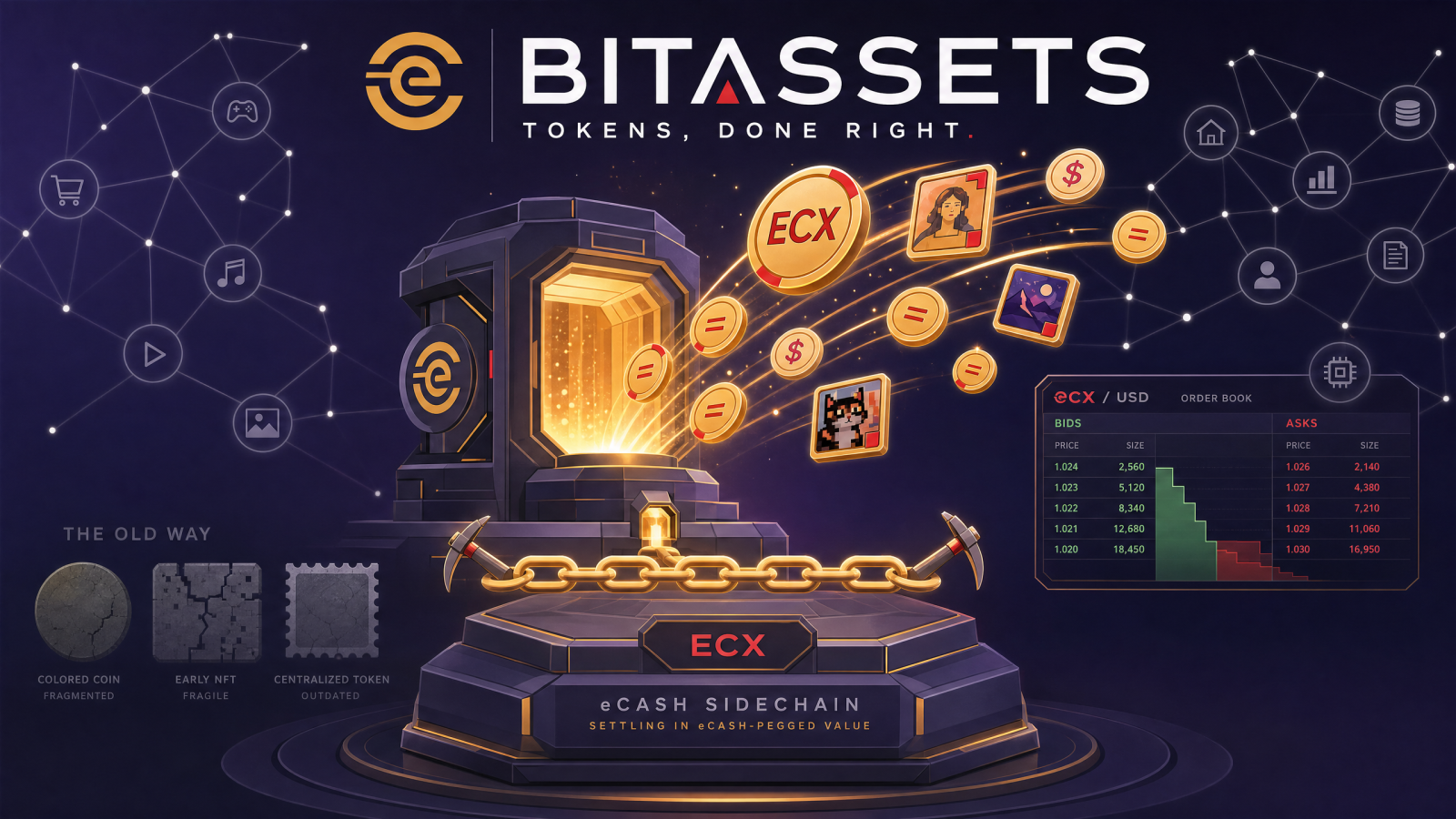
Of the seven sidechains shipping at fork, BitAssets is listed as live, with code developed under the repository plain-bitassets. Its one-line description is deliberately provocative: "Bringing ERC20 tokens and other CryptoFinance to Bitcoin, on its own specialized chain." In practice that means fungible tokens, NFTs, token issuance, decentralized exchange, and the rest of the machinery that made Ethereum useful, running as a drivechain that settles in eCash-pegged value rather than in a brand-new native coin.
The pitch is not that BitAssets invents something Ethereum cannot do. It is that BitAssets does the useful parts without requiring users to buy and hold a separate volatile gas token, and without dragging the entire apparatus of a casino chain along for the ride.
What BitAssets Actually Is
BitAssets is a drivechain, so it inherits the two BIP-300 and BIP-301 mechanisms at the center of every sidechain in this series: hashrate escrow and blind merge mining. Value moves onto the chain through the drivechain peg and becomes the unit that pays fees and denominates tokens. As the Reflexivity Research overview of LayerTwo Labs describes it, "the plain-bitassets sidechain mimics Ethereum's ERC-20 and ERC-721 standards while settling fees and withdrawals" in the pegged base asset. Developers "compile contracts in Rust, mint tokens, launch ICOs, and even issue NFT collections without creating a separate gas token. Because the peg is two-way and miner-insured, wrapped assets cannot de-peg the way bridge tokens sometimes do."
Sztorc's own design writeup, the BitAssets post on Truthcoin, frames the chain around two categories of demand that he considers genuinely real. The first is "a crypto-art form, with immutable characteristics," meaning NFTs and collectibles. The second is "an asset-backed token form, which can have administrators who interact with owners on an ongoing basis," meaning tokenized shares, stablecoins, and other instruments with an issuer behind them. The chain is built to support both.
One design choice runs through the entire architecture and is worth stating up front, because it is the philosophical core of the project. On BitAssets, the pegged base asset is money and everything else is explicitly not money. The chain "uses BTC for all txn fees," in the original drivechain framing, "making it clear that BTC is money, and the BitAssets are completely separate non-money tokens." On the eCash fork, the fee asset is eCash rather than a bespoke token. This separation, keeping the store-of-value asset cleanly distinct from the speculative tokens riding on top, is the thing Sztorc argues every prior attempt got wrong.
How It Differs From Ethereum, Solana, and the EVM Chains
The most important difference is the absence of a native token requirement at the application layer. On Ethereum you pay gas in ETH. On Solana you pay in SOL. On every EVM chain you hold that chain's coin to do anything, which means every token project is built on top of a speculative asset whose price swings, congestion dynamics, and monetary policy it does not control. BitAssets settles fees in eCash-pegged value, so a token issuer is not implicitly making a leveraged bet on a separate layer-one coin simply by existing.
Several further distinctions follow from the drivechain design.
-
Security is inherited, not bootstrapped. BitAssets does not need to recruit its own validator set or its own hashrate. It is blind merge mined by the same SHA-256 miners securing the eCash main chain, which means it does not face the cold-start security problem that every new EVM layer-one and layer-two has to solve.
-
The peg is miner-insured rather than bridge-operator-insured. Most tokens that move between chains today rely on bridges, and bridges have been the single most catastrophic source of losses in the industry. The two-way drivechain peg replaces a multisig or a bridge committee with the same hashrate-escrow mechanism that governs withdrawals across all seven sidechains.
-
The runtime is Rust, not the EVM. Developers write in Rust rather than Solidity. This trades the EVM's enormous existing tooling ecosystem for a language many systems developers already know, and it sidesteps a decade of accumulated EVM footguns. It is a real tradeoff, and honesty requires noting that the EVM's mature tooling and auditor base are a genuine advantage BitAssets will have to overcome.
-
Failures are quarantined. Because each sidechain in the drivechain model is its own chain, congestion or a pricing frenzy on BitAssets does not raise fees on Thunder payments or on the base layer. On Ethereum, a single popular mint has historically spiked gas for everyone. Sztorc has repeatedly pointed to this quarantining of state and fees as a structural advantage of many special-purpose chains over one general-purpose chain.
Why This Design Makes Sense for Tokens
The case for putting tokens on a dedicated, non-money sidechain is partly technical and partly about incentives. Tokens generate a lot of low-value, high-volume activity: mints, transfers, trades, speculative churn. Sztorc's long-standing complaint, made across his writing and the recent eCash Spaces, is that this activity does not belong on a base layer that is trying to be conservative, decentralized money. It belongs on a chain built for it, where the mess is contained and the base layer stays clean.
The Truthcoin design goes further and builds a decentralized exchange directly into the chain. It describes DEX orders that are "placed by one counterparty and then later accepted by the second counterparty," with trading fees flowing to sidechain miners. That matters because it means the marketplace for BitAssets tokens is native to the chain rather than a separate smart-contract protocol layered on top with its own risks.
Concrete use cases the BitAssets design targets include:
-
NFTs and digital collectibles with the file data committed on-chain, avoiding the off-chain-link fragility that plagues many Ethereum NFTs.
-
Tokenized real-world assets and securities, the asset-backed category, where an administrator issues and manages tokens representing shares, debt, or commodity claims.
-
Stablecoins, discussed in detail below, which are the single largest proven use case for tokens in the entire industry.
-
Token launches and ICOs denominated in eCash-pegged value rather than in a separate gas coin.
-
In-game and in-app assets, where Sztorc has noted that "ownership of an asset could trigger arbitrary events in third-party games."
Bitcoin's Meta-Protocol Lineage, and Why It Kept Failing
Tokens on Bitcoin-descended money are not a new idea. They are one of the oldest ideas in the space, and BitAssets is best understood as the latest entry in a fifteen-year lineage of attempts.
The sequence began with Colored Coins, introduced in Meni Rosenfeld's 2012 whitepaper, which proposed marking specific satoshis to represent external assets. It advanced with Mastercoin, later renamed Omni, whose July 2013 crowdsale raising roughly 4,700 BTC is widely considered the first ICO in history. It reached its most expressive early form with Counterparty, launched in January 2014 using a proof-of-burn to create its XCP token, which hosted the Rare Pepe collection and an early on-chain decentralized exchange. Crucially, the most successful token in the entire history of the space, Tether, originally launched on Omni in 2014, began life as exactly this kind of Bitcoin meta-protocol asset before migrating primarily to Ethereum and Tron.
Then came the modern revival. Ordinals, launched by Casey Rodarmor in January 2023, enabled inscriptions on individual satoshis. BRC-20, proposed by the pseudonymous domo shortly after, used Ordinals inscriptions to create fungible tokens. STAMPS and its SRC-20 variant took a different approach, embedding data in transaction outputs for greater permanence at higher cost.
Every one of these proved that demand for tokens on Bitcoin money is real and recurring. Every one of them also ran into the same structural walls. The metaprotocols consumed base-layer block space and, as the Drivechain projects page puts it, "confused retail users and murked-up Bitcoin's value proposition."
The Ordinals and BRC-20 wave congested Bitcoin, spiked fees, and generated the ongoing OP_RETURN and filter disputes that have divided the community. Colored Coins never achieved resolver support or interoperability and was largely discontinued by the early 2020s. Counterparty depended on the value and mechanics of XCP.
Why the Counterparty, Ordinals, BRC-20, and STAMP Communities Should Look at BitAssets
The argument to these communities is straightforward: BitAssets gives them what they actually want without the collateral damage that has made their activity a source of conflict.
-
It ends the block-space war they are on the wrong side of. Ordinals, BRC-20, and STAMPS all consume scarce main-chain block space, which is precisely why they draw hostility from the small-block faction and why filter proposals keep surfacing. On BitAssets the same minting, trading, and collecting happens on a dedicated chain with its own block space, so it stops competing with monetary transactions and stops being a political target.
-
It preserves the thing that made them special. The Drivechain projects page is explicit that the BitAssets sidechain "has its own blockchain and its own block space, and it uses BTC for all txn fees," reversing the two drawbacks of the earlier metaprotocols while keeping the tokens. Creators get the non-money token layer they wanted, cleanly separated from money.
-
It offers a real DEX and richer functionality. Counterparty pioneered on-chain trading but was constrained by Bitcoin's block cadence and scripting limits. BitAssets builds trading in natively on a chain designed for it.
-
It fixes the data-permanence tradeoff STAMPS was invented to solve. STAMPS exists because Ordinals inscriptions can theoretically be pruned. A purpose-built asset chain with its own storage economics addresses permanence without paying Bitcoin's most expensive data-storage prices.
The blunt version, consistent with Sztorc's framing on recent Spaces, is that these communities have spent years proving demand while fighting their own host chain. BitAssets offers them a host chain that wants them.
BitAssets Versus RGB
The most serious contemporary competitor for tokens on Bitcoin money is RGB, and the comparison deserves to be made honestly rather than dismissively. RGB, based on Peter Todd's single-use-seal and client-side-validation ideas, envisioned in 2016 by Giacomo Zucco, and developed principally by Maxim Orlovsky, takes the opposite architectural approach from BitAssets. In RGB, described in the Bitfinex overview of RGB, all contract data lives off-chain and is validated client-side, with Bitcoin used only as a commitment and ownership layer.
This delivers strong privacy, since contract state never touches a public chain, and Lightning compatibility. Notably, Tether announced in August 2025 that it would issue USDT natively on RGB, which makes RGB the most credible incumbent in this exact race.
The tradeoffs run in opposite directions.
-
Verification model. RGB requires each user to validate the specific contracts relevant to them through client-side validation. BitAssets uses a conventional shared ledger on the sidechain, which is simpler to reason about and to build ordinary applications like block explorers and exchanges against, at some cost to privacy.
-
Privacy. RGB's off-chain model is inherently more private. BitAssets is a transparent chain, closer in spirit to how Ethereum tokens work, with privacy left to a dedicated chain like zSide.
-
Composability and discoverability. A shared ledger makes a native DEX, public order books, and open composability natural. RGB's isolated client-side shards make privacy easier and open composability harder.
-
User experience. RGB's client-side validation is powerful but has proven complex to productize, which is part of why it has been slow to reach mainstream wallets despite years of development. BitAssets bets that a familiar shared-ledger model with a built-in DEX will be easier for ordinary users and developers to adopt.
Neither is strictly superior. RGB optimizes for privacy and Lightning-native transfer. BitAssets optimizes for familiarity, composability, and a native marketplace. They may well coexist, serving different needs, in the same way zSide and a transparent chain coexist within eCash itself.
Why BitAssets Has a Better Chance of Taking Off
The recurring reason every prior attempt stalled was economic and structural, not conceptual. Colored Coins and Counterparty proved demand but fought their host chain for block space. Ordinals and BRC-20 proved demand again and triggered a civil war over that same block space. Standalone token chains like most of the EVM world solved block space by minting their own coin, which reintroduced the bootstrapping, security, and speculation problems that the Bitcoin-money approach was supposed to avoid.
BitAssets is the first design that tries to have it both ways: its own block space, so it does not congest or politicize the base layer, and no native token, so it does not have to bootstrap and defend an independent currency. Security comes from blind merge mining by existing miners. The peg is enforced by hashrate escrow rather than a bridge. And the base asset stays cleanly labeled as money while the tokens stay cleanly labeled as not-money.
That combination is genuinely new. It does not guarantee success, and the honest caveats remain the same as for every sidechain in this series. BitAssets launches as new software that has to win integrations, liquidity, and developer attention against Ethereum's enormous head start and RGB's incumbent stablecoin deal. Live code is a starting line.
Why Tether and Circle Should Move to BitAssets
The stablecoin argument is the strongest single case for BitAssets, because stablecoins are the one token use case with undisputed, massive, proven demand. The combined stablecoin market sits above $300 billion, with Tether's USDT around $180 billion and Circle's USDC in the $60 to $80 billion range depending on the source and the month.
There is deep historical symmetry here. USDT was born on a Bitcoin meta-protocol, Omni, in 2014. Bringing it to BitAssets would be a return to origins, this time on a chain actually built to host it rather than one it eventually outgrew. Several concrete arguments apply to both issuers.
-
No dependence on a separate gas coin. On Ethereum and Tron, stablecoin users must acquire ETH or TRX to move their dollars, a persistent onboarding friction. On BitAssets, fees settle in eCash-pegged value native to the chain, and Sztorc has argued a drivechain stablecoin can be "fully programmatic, redeemable for real USDT, with published reserves and yield on its backing."
-
Security without a new trust assumption. Issuers would not be trusting a novel bridge or a thinly secured new layer-one. The peg is miner-insured through hashrate escrow, and the chain is secured by the same miners as the base layer.
-
A regulatory-friendly separation. BitAssets' clean split between money and non-money tokens, and its support for the "asset-backed token form with administrators who interact with owners on an ongoing basis," maps neatly onto how a regulated, reserve-backed, freeze-capable stablecoin actually needs to work under frameworks like the GENIUS Act.
-
A hedge and an alternative to the RGB path. Tether has already signaled willingness to leave Ethereum's orbit by committing to RGB. That proves the strategic appetite to diversify issuance onto Bitcoin-aligned rails. BitAssets offers a second such rail with a different, more familiar, more composable design, and a native DEX for secondary liquidity. Circle, which has leaned hard into regulatory compliance and multichain reach, has an obvious parallel reason to want issuance on a Bitcoin-secured chain that keeps dollars and the base money cleanly separated.
None of this means either issuer will move. Both have deep Ethereum, Tron, and Solana integrations, and incumbency is powerful. But the structural fit is real, and the historical rhyme of USDT returning to Bitcoin-money rails, on a chain purpose-built for tokens this time, is the kind of argument that at least deserves a hearing in Lugano and in New York.
Why BitAssets Is a Big Deal
Money got decentralized in 2009. The token layer never cleanly followed. It scattered across metaprotocols that fought their host chain, altcoins that minted their own speculative gas, and bridges that lost billions. BitAssets is a bet that the entire category, NFTs, tokenized assets, stablecoins, and on-chain trading, can live on a chain that borrows Bitcoin's security through merge mining, keeps money and tokens philosophically separate, and asks no one to buy a new coin to participate.
If it works, the payoff is not another token venue. It is the consolidation of fifteen years of scattered, contentious experimentation onto rails that finally fit the use case. Whether the market agrees, as Paul Sztorc likes to say, will be decided on the merits.