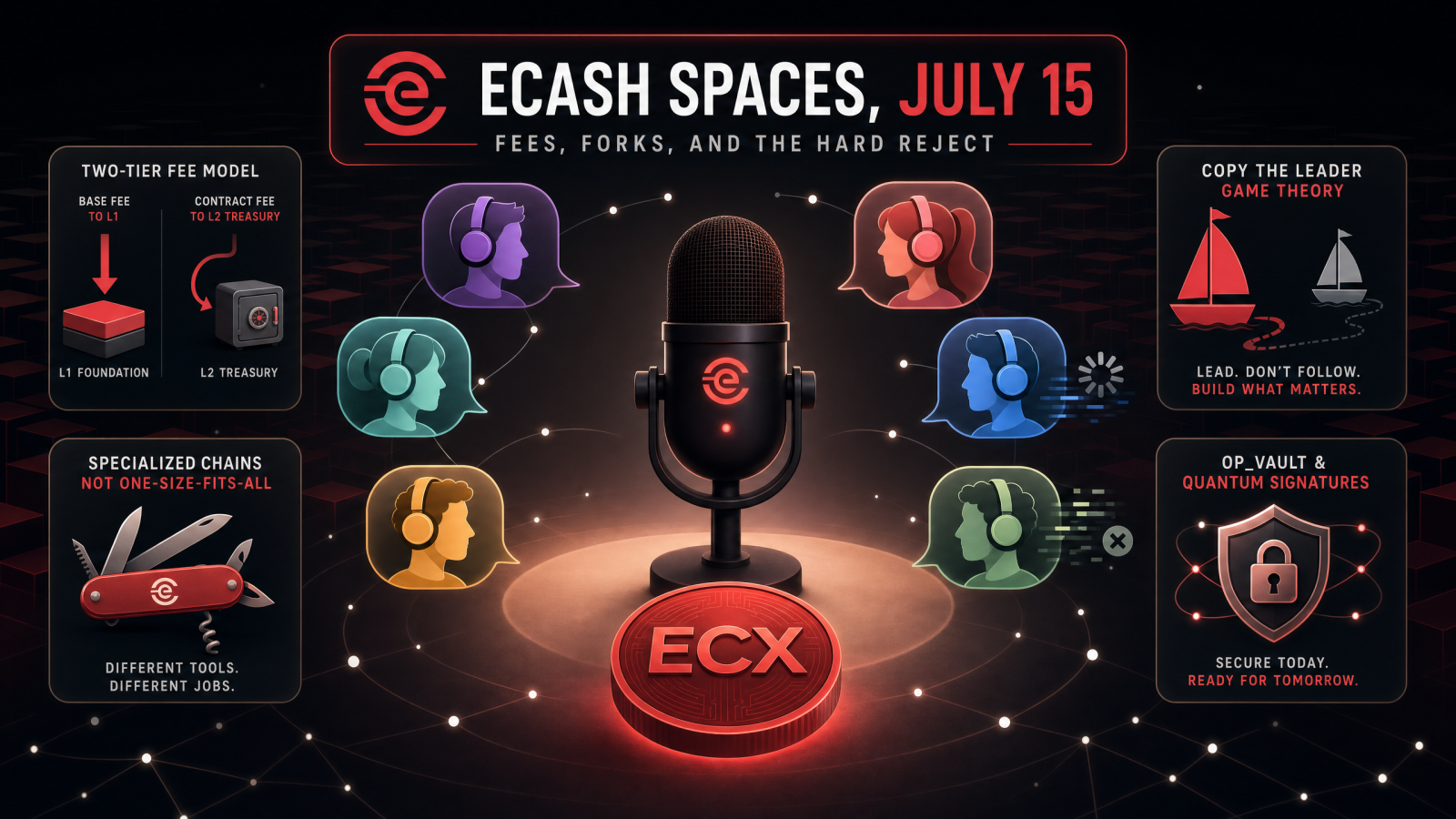
eCash Spaces, July 15: Fee Models, the Smart Contract Dilemma, and Why Paul Sztorc Will "Hard Reject" Deviating From Bitcoin
This is a summary of Paul Sztorc's July 15, 2026 Twitter Space, held roughly five weeks before the August 21 eCash hard fork. The call was lightly attended and repeatedly derailed by a misbehaving X app, but it produced some of the clearest recent explanations of the sidechain fee model, the launch philosophy, and Sztorc's governance stance. Vlad Costea co-hosted.
Are These Spaces Still Worth Doing?
Sztorc opened, as he often does, with a note of doubt about the format itself. He said the utility of the weekly calls had "fallen off a little" and floated handing hosting duties to someone else. Vlad pushed back firmly, arguing there is real value in simply showing up week after week, in letting people "see that someone actually cares about what's being built," and in demonstrating through sheer persistence that the project "is not a scam. This is happening. This is building." It was a small exchange, but it framed the whole call: this is grassroots, founder-run, and deliberately unpolished, with no professional marketing operation behind it.
The compromise Sztorc landed on was that he might rotate in other hosts and "just pop in from time to time," rather than stop entirely.
New Software: A Second CUSF, Quantum Signatures, and Elements Plus
The most concrete news was on the development pipeline. Sztorc confirmed a second CUSF client (Core Untouched Soft Fork) is being built, this one adding quantum-resistant signatures, with Hunter Beast among the contributors. He described four options, a mix of lattice-based and hash-based schemes, and said it may also add OP_CAT and OP_VAULT.
He returned to OP_VAULT several times as the feature he most wants, framing it squarely as a physical-security tool: protection against the "wrench attack," where someone bursts into your home and forces you to hand over coins at gunpoint. In his words, "if we want to make it to this cypherpunk future, we're really going to need more privacy and we're going to need OP_VAULT."
On sidechains, he listed several new arrivals joining the seven already on Signet:
-
A new EVM chain, likely a Rust-based EVM implementation, which he repeatedly promised "later this week" while wincing at his own optimism ("God, I hate every time I say that. It's like a curse")
-
Shomari's upcoming sidechain
-
Elements Plus, which he described as Elements with OP_CAT and OP_CTV added
Vlad and Sztorc shared a wry observation that runs through the whole project: BTC could adopt any of this at any time, but they are confident it won't, because, once eCash ships, the technology can be dismissed as "shitcoin tech." As Vlad put it, eCash may end up functioning as "a shield against this technology ever getting adopted" on Bitcoin, a bittersweet outcome given Sztorc spent nearly a decade pushing drivechains for Bitcoin itself.
The Discord, the Mobile App, and Platform Risk
A recurring guest, Shomari, came up to praise the project's brand-new community Discord, run by a volunteer (later thanked by name, Jared Woodard), which he said had made the community far more engaging without the "nasty Telegram and its mean KYC." Sztorc noted he is happy to be on Discord precisely because he is not responsible for running it.
This led to a genuinely useful exchange on platform risk and game theory. The mobile app is valuable because many users are mobile-only and because it hedges against deplatforming. But the app itself creates a dependency: Apple or Google could pull it. Sztorc's answer was that this is exactly why web apps matter, and why he considers them a required part of the wallet ecosystem. He and Shomari framed it in explicitly game-theoretic terms: "we're all holding a pistol at each other and it's like, don't make me use this web app." F-Droid was also mentioned as an Android fallback, since the code is open source.
How Sidechain Fees Actually Work: Base Fee vs Contract Fee
The technical heart of the call came when JK walked through a fee model that finally made the economics click for him. His starting confusion is one many newcomers share: if all the fees go to L1 miners, how does an L2 sustain itself?
The answer he arrived at, borrowing from Ethereum's structure, is two fees:
-
A base fee on every single transaction, 100% of which flows down to the L1 miners
-
A contract fee, programmable and set by the contract author, which can be shared with the L2 treasury to sustain the sidechain itself
JK also pushed back hard on Sztorc's long-floated "10 cent fee" framing, arguing from his own 2012 to 2013 Bitcoin roots that sub-penny microtransactions were always the unique value proposition. He ran the math on his own forked chain, which he said handles 60,000 transactions per second today, unoptimized. At a tenth of a penny per transaction, that implies roughly $60 per second, about $36,000 per 10-minute block, flowing to L1 purely in base fees. His point: volume at tiny fees beats scarcity at high fees.
Sztorc agreed with the thrust, noting BTC currently earns "basically zero dollars per block" in fees and that "the efforts to make it like a luxury good have all ended in complete failure." His consistent position, more than a decade old, is that a healthy system has "lots of people paying a small transaction fee" with very high total throughput, and that this "has nothing to do with the L1 block size at all."
Three Tiers of Finality
JK also sketched a layered confirmation model for his sidechain, which forked a chain with native two-minute blocks:
-
Pre-consensus / transaction level: finalizes in about two to three seconds, suitable for a cup of coffee
-
L2 block level: every two minutes, suitable for exchanges
-
L1 settlement level: five L2 blocks aggregated into a bundle hash committed to the main chain every 10 minutes, the highest security tier
He reframed the L1 event not as a "confirmation" but as a "settlement," treating security as a dial the user turns according to how much value is at stake. Sztorc was supportive but candidly "a little skeptical," noting he had entertained similar ideas himself, including staking-based double-spend prevention and even L3 constructions. His key architectural point: as long as you have "that proof of work anchor in BTC, in the three-month anchor, you could build backwards in time from that, and you can make stuff that settles instantly." He was careful not to declare it the "final form."
Another participant offered a helpful clarification that the BIP301 hash commitment (which pays fees back to the main chain) and the withdrawal bundle hash (which handles withdrawals) are separate things, and that a sidechain designer needs to account for both.
The Big Debate: Specialized Chains vs Smart Contracts
The most substantive disagreement came when Shomari returned to grind an axe he had been holding: he thinks eCash is making a mistake by shipping only specialized, single-purpose sidechains (BitAssets, zSide, BitNames) and neglecting general-purpose smart contracts.
Sztorc defended the specialized model with a Swiss Army knife analogy. A Swiss Army knife anticipates what you'll need, a knife, a screwdriver, a corkscrew, a bottle opener, and delivers it ready to use. A general-purpose chain, by contrast, is "just a piece of metal that you could shape if you wanted," which "leaves too much work to the user." His long-standing critique of one-chain-does-everything is that specific use cases "muscle out the fee" and crowd each other out.
Shomari's counter was pointed and, by his own description, "baffled." He argued Sztorc fundamentally undervalues smart contracts, and that even the token activity Sztorc waves away, minting ERC-20s and trading them, happens through smart contracts. "I don't even know who does it any other way besides using smart contracts," he said. He speaks from experience: he watched Bitcoin Cash launch an EVM chain called Smart BCH that attracted "a hundred projects in the first three months" before the wider BCH collapse took it down.
Sztorc gave real ground here. He acknowledged eCash will "probably have an EVM," pointing to a promising new Rust EVM, and reaffirmed the project's pluralist philosophy: "try everything out, anything that works can stay." But he was blunt that he personally finds the EVM "overrated" and does not "respect it." His theory of why Ethereum has fees at all is cultural rather than technical: "those are the fees of freedom," people paying to do things "BTC is not going to let them do."
The exchange surfaced a genuine tension the project has not resolved. Shomari's strongest argument was about builders: "that's where all the builders are. EVM. There are no UTXO builders. It's a handful." He insisted UTXO is "a thousand times better" but that EVM developers "cannot speak UTXO," so eCash needs a migration on-ramp rather than expecting builders to adopt UTXO from day one. Sztorc seemed to accept this could make sense while maintaining his own preference for quality control over open-ended generality.
Exchanges: A Question Sztorc Openly Dislikes
A listener, Kitty Meow, asked the question every forkcoin faces: will major exchanges support it? Sztorc's answer was layered and revealing.
His practical view is that the question has fallen in importance "by a factor of 200." Exchanges used to be gatekeepers who could smother a project "in the cradle" by denying liquidity. But today, he argued, USDT enables trivial OTC desks over Signal or Telegram, and non-custodial swap providers like ChangeNow, plus wallets like Edge, Cake, and Bitcoin.com, let anyone swap in and out of assets without ever handing over a passport. He expects some smaller friendly exchanges to list immediately, and plans to formally approach the larger ones around 30 days out, once the project is "in a really nice box for them." He noted the integration cost is very low because the L1 is just Bitcoin Core with a few audited changes, and that the absence of replay protection creates a built-in pressure: exchanges that don't support the fork risk being drained, which he frankly called "part of the fun."
But philosophically, he pushed back on the framing itself, calling it "quite a terrible question." His analogy: "It's like if Bitcoin were invented today, and people were like, does Visa support Bitcoin? Who cares?" His objection is that the question "puts all the agency in these other people" and turns the project into a popularity contest, when "if their thoughts were any good, we would be doing what they want." Vlad softened this, noting it's a natural question because people instinctively want to know how they can use and sell a new asset, and that it's actually a green flag that no one is paying for exchange listings or animated CoinMarketCap logos; the growth is meant to be organic.
The Governance Question: "Hard Reject"
The philosophical climax came from Joe, who asked the most important governance question of the call: what is eCash's policy on soft forks and deviating from Bitcoin? Sztorc's answer was immediate and unequivocal: "Hard reject."
He justified it with a competitive sailing analogy drawn from game theory. In a one-on-one race, the boat in the lead simply copies whatever the trailing boat does. If the wind shifts randomly, both are affected equally, so the leader preserves the lead by mirroring the follower. eCash and BTC are, in his framing, a one-on-one race, and eCash "would rather them just blow up the project and blow up both projects" than let BTC gain an advantage by doing something eCash didn't copy. The "out" that makes this safe for eCash is that its users can always escape to the L2s.
This tie-with-BTC discipline extends to the codebase itself. He revealed that the eCash L1 is kept so close to Bitcoin Core that they don't even rename it to eCash in the software, because doing so "would break all these different unit tests" and create a large code diff. They change the title, the readme, and little else. When BTC ships a soft fork, eCash intends to "just click merge, merge, merge," because "any deviation you have to explain or justify," and they want to minimize that burden.
Vlad added a sharp cultural observation that reinforced the strategy: the reason eCash wants to copy rather than innovate on L1 is that BTC's L1 and L2 situation is already "as bad as it could theoretically get without there being a revolt." He pointed to Lightning as the tell. Good ideas get copied everywhere, EVM, BIP39, HD wallets, block explorers, name systems, but "how many other people are copying Lightning? Literally zero, because it's terrible."
Why CUSF Is the Exception
Joe followed up with the natural objection: if the policy is hard-reject on deviation, why is CUSF (which adds quantum signatures, OP_CAT, and OP_VAULT) an acceptable exception? Sztorc's answer rested on modularity and reversibility:
-
A CUSF can be shut off completely if it turns out to be a disaster, "like it was never there"
-
It changes zero lines of the base Bitcoin Core code, which matters enormously because a single altered line "could cause the software to crash" or, worst case, exfiltrate private keys
-
Because it lives in separate software, you "don't even know if it's happening or not," which turns a non-starter into something safe
He sketched a future with a whole stack of CUSFs, perhaps 15 of them, ranging from "ultra conservative" to "more liberal" where "all the weird stuff" goes. And if BTC ever ships a soft fork that conflicts with an eCash CUSF, the plan is simply to "hard fork the CUSFs," transposing them to different op-code numbers or headers so they stay compatible, as long as eCash remains the smaller-market-cap chain playing follow-the-leader.
On Hard Forks Themselves
The call cut off mid-thread, but Joe raised a genuinely interesting final point that deserves flagging: eCash itself begins with a hard fork, yet Sztorc's older blog posts argued against hard forks "vigorously." A reader of his early writing "might think that you would never do a hard fork."
The call ended abruptly due to technical issues before Paul Sztorc could answer, but hopefully the question will be addressed in an upcoming Space.
The Solana Token, Clarified Again
A guest named Joe (a different one) asked about the Solana token bearing eCash's name. Sztorc reiterated the now-familiar explanation: eCash did not launch it, but because it feeds real money (Solana and Tether) to the project, they treat those inflows as purchases at the old $30 price, and have set aside a pool of real ECX to swap for the meme coin's entire market cap.
This gives holders genuine price exposure. He noted the implied ECX price from this market often sits around$ 100 to $200, well above the $30 to $36 private sale range, which he finds reassuring. He also warned, as always, that impersonator and unaffiliated tokens are everywhere, and that the only official information lives at ecash.com/sol-token.
Lighter Moments
For a technical call, there was a fair amount of comedy, much of it at the expense of the X app itself, which repeatedly failed to bring speakers up, froze its "dancing dots," and forced Sztorc to hover his finger over the screen without touching it lest he disconnect. His running plea "to the makers of this app, could you just do a better job?" became a motif.
Other highlights:
-
Paul, apparently deep in a World Cup betting pool, revealed he had randomly drawn Argentina and was superstitiously refusing to watch the game to avoid jinxing it, while spamming Messi memes in his group chat.
-
Paul also resurrected an economist's joke he'd once told Sergio Demian Lerner: "there are four types of economy, developing, developed, Japan, and Argentina." As he conceded, "that's what counts as a joke in the econ department."
-
The recurring "JK Rowling" gag when JK came up to speak.
What This Call Revealed
The July 15 Space was not a news-heavy call, and the thin attendance and app chaos gave it a loose, informal feel. But underneath that, three things came through with unusual clarity.
First, the fee model finally has a crisp public explanation: a base fee to L1, a programmable contract fee to sustain the L2.
Second, the tension between Sztorc's specialized-chain philosophy and the market's demand for general smart contracts and EVM builders is real, unresolved, and being negotiated in public, with Sztorc giving measured ground toward pluralism.
Third, and most importantly, the governance philosophy is now stated bluntly: hard reject any L1 deviation from Bitcoin, copy their soft forks automatically, and confine all genuine experimentation to reversible CUSFs and opt-in L2s.
That last point is the strategic core of the entire project. eCash is not trying to out-innovate Bitcoin on the base layer. It is trying to tie Bitcoin on L1, "warts and all," and win everywhere else. Whether that discipline holds through launch, and whether the smart contract builders Shomari keeps pointing at actually show up, are the open questions heading into August.