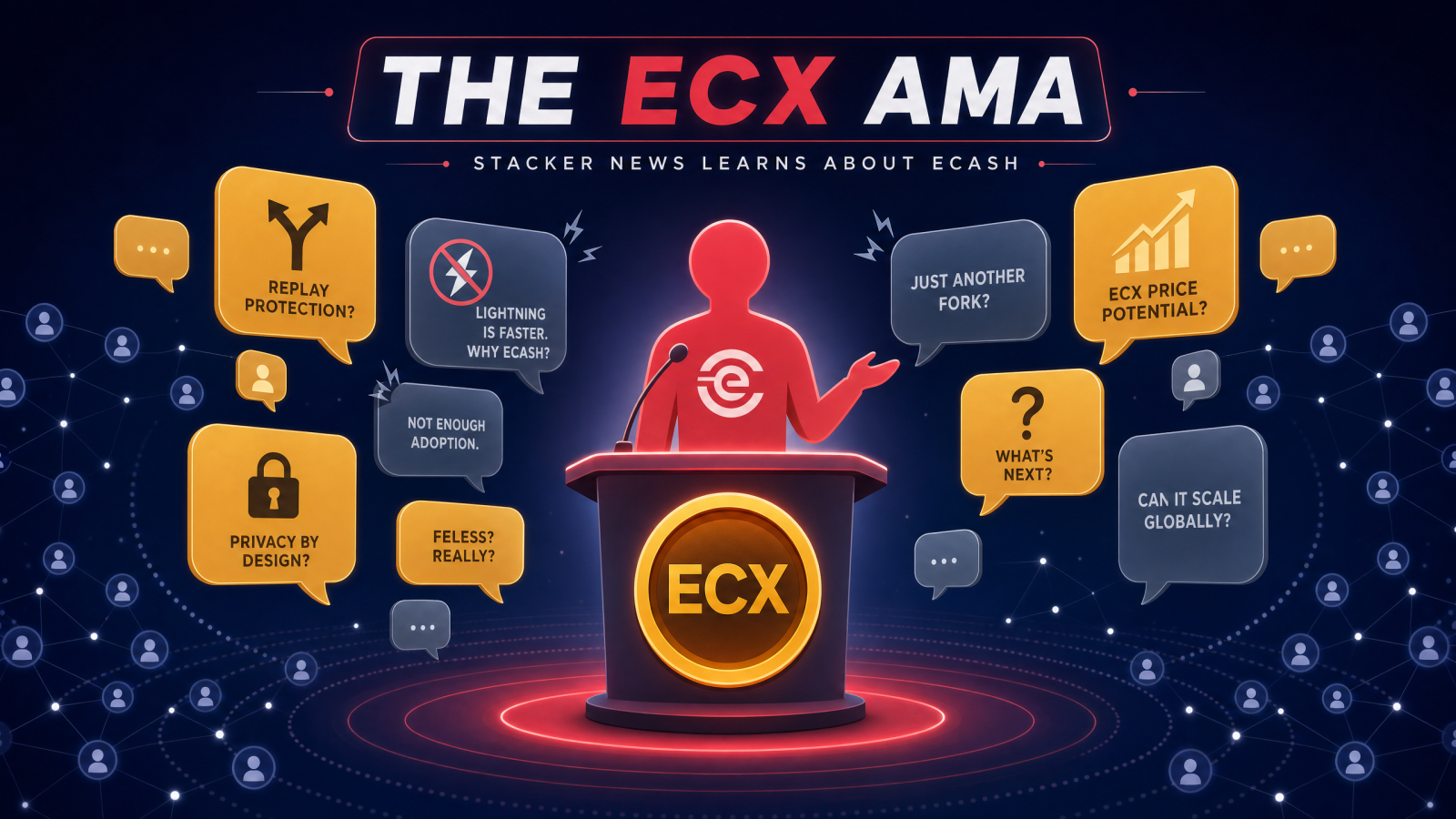
Paul Sztorc AMA on Stacker News: What We Learned
On July 18, 2026, at the request of the Stacker News moderator Scoresby, Paul Sztorc sat down for an AMA on one of the most Lightning-friendly forums in Bitcoin. The venue choice was itself a provocation, and the crowd did not disappoint. Over several hours the thread accumulated more than 160 comments, ranging from genuinely curious technical questions to open contempt. Sztorc answered most of them with the same mix of confidence, historical reference, and needling that has defined his public persona for a decade.
What follows is a tour of the most substantive exchanges, the criticism he absorbed, and a few revealing questions that went unanswered. The picture that emerges is of a community that is deeply curious about ECX, skeptical of its premises, and, whether it admits it or not, paying close attention as the fork approaches.
Replay Protection: The Most Important Answer in the Thread
The single most consequential question came early, from the user cleophas: why launch the eCash fork without replay protection?
This is not a trivial matter. Replay protection is the mechanism that prevents a transaction on one side of a chain split from being unintentionally rebroadcast and validated on the other side. When Bitcoin Cash forked in 2017, it added replay protection precisely to keep the two chains cleanly separated and to protect users from accidentally spending on both chains at once. Its absence is a deliberate and controversial design decision.
Sztorc's answer was characteristically unapologetic. He gave three reasons:
-
Citing Jameson Lopp, he argued that "replay protection is essentially admitting defeat, right off the bat."
-
Without transaction replay, he said, "your chain might look like a ghost town, even to people who are totally neutral to the coin."
-
And then the philosophy: "I don't believe in coddling people. If you aren't paying attention, you'll be left behind. Pain, blood, and suffering are the best teachers."
He pointed to two of his own 2018 essays, GARP (Gradually Activated Replay Protection) and IMEX (Imposed Mutual Exclusivity), for the fuller argument.
This is worth dwelling on, because it captures both the appeal and the risk of the entire eCash project in miniature. The refusal of replay protection is ideological. It treats the fork as a full competitor to Bitcoin rather than a polite spinoff, and it deliberately raises the stakes for users by refusing to build guardrails.
Critics will reasonably read this as reckless, especially for ordinary holders who do not understand the mechanics of a chain split. Supporters will read it as intellectually honest. Both readings are correct, and users who intend to touch ECX after the fork should understand that the burden of safely splitting their coins falls on them by design.
What Success Looks Like: Two Flavors, One Requirement
Several users, including Scoresby and npub1zapsats, pressed Sztorc on what success would actually look like for eCash over the next five years. His answer laid out two "flavors":
-
The maximal outcome, which he called "hyper-ecash-ization," where ECX dethrones BTC, climbs to $200,000 per coin, and eventually to $20 million per coin.
-
The modest outcome, where eCash serves as "a nice demo of BIP-300, and a proving ground for different L2s. An educational tool, a science experiment."
He conceded the first "must sound very extreme," but grounded it in a specific thesis: that "one cryptocurrency will make it to a $200 trillion market cap, and the rest will die," and that BTC seems "unable or unwilling to make the jump to 8 billion users."
The crucial and most quoted line came in his reply to Scoresby: "For eCash to succeed, BTC must fail." He was careful to add that he hopes BTC does not fail, and he pointed to his Derangements essay for the argument that Bitcoin's culture has grown dangerously irrational. His stated failure mode for BTC is a loss of honesty, in particular around Lightning, around Luke Dashjr's filtering crusade, and around the community's inability to answer basic accountability questions like "How would we fire Bitcoin Core, if we wanted to?"
This framing is important context for anyone evaluating ECX. Sztorc is not pitching a coin that wins on features alone. He is pitching a bet that Bitcoin's governance will fail on its own, and that eCash is the lifeboat. That is a coherent thesis, but it is also an admission that eCash's fortunes are tied to Bitcoin's dysfunction rather than purely to its own merits.
The Lightning War, In Public, On a Lightning Forum
The most heated and voluminous exchanges were about the Lightning Network, and they turned combative fast. The user justin_shocknet opened with "Lightning derangement syndrome fucked you up good eh?" and kept up a running critique for the rest of the thread.
Sztorc did not retreat. He called Lightning "a dead end" and then escalated: "Lightning is a cancer, rapidly metastasizing and killing off BTC." He pointed repeatedly to his TabConf debate, where Tadge Dryja, a co-author of the original Lightning paper, joined him on stage, and to his 2024 summary essay, the LN blackpill.
His most rhetorically vivid argument was about custodial Lightning. Most Lightning usage, he claimed, is custodial, which he compared to "a dry ocean" or "calling a motionless staircase an escalator." He accused the ecosystem of "stolen valor," of taking credit for things it did not do, and told the story of a gullible child convinced a magician really sawed a woman in half. When one user, winteryeti, asked in good faith for a plain explanation of why Lightning threatens BTC, Sztorc replied that Lightning "destroys Bitcoin's layer zero, its people," by compelling them to defend something that does not work.
The critics gave as good as they got. justin_shocknet argued that "sidechains are not security equivalent to Bitcoin, and therefore, shitcoins," and made a genuinely substantive point that gets less attention than it deserves: that Bitcoin's real scaling limit is not throughput but the distribution of the base unit, and that no Layer 2, drivechain included, changes the fact that a finite number of people can ever hold meaningful self-custodied balances. Sztorc's rebuttal leaned on the drivechain security model described at drivechain.info, arguing that a rational 51% miner coalition is more profitable maintaining a drivechain peg than attacking it, and that this makes the drivechain security model stronger than Lightning's, which fails if a hashrate majority interferes with a channel.
It is fair to note that this portion of the thread generated more heat than light. There was name-calling on both sides, including a running gag where Sztorc pointed out that, lacking any open channel, he was "surviving on Cowboy Credits," Stacker News's internal custodial credit, which prompted the retort "ALL RISE FOR THE CC SHITCOIN." The insults are worth acknowledging and not worth dwelling on. The substance underneath, whether drivechains are security-equivalent to Bitcoin and whether Lightning can scale to ordinary users, is the real disagreement, and it remains unresolved.
The Price Question, Answered Honestly
Two users, barbarian and others, asked pointed economic questions. Would Sztorc accept a 1:1 trade of BTC for eCash? His answer was refreshingly blunt: "That is kind of ridiculous, isn't it? The current market value of ECX is surely much less than $65,000 per coin."
He then offered rare, concrete price color. ECX has "traded hands, privately, for amounts near $30 to $36." He also described an "accidental natural experiment," a giveaway of about 2,000 real ECX in exchange proportionally for a Solana memecoin, whose roughly $180,000 market cap would imply a price near $90 per ECX, though he stressed this was "contrived and limited and unreliable."
Asked whether he would keep the majority of his BTC after the fork, he said "Of course," adding that "the success of eCash is VERY uncertain. Most new projects fail." This is a notable and honest admission from a founder, and it sits somewhat in tension with the $20 million-per-coin talk elsewhere in the thread. Readers can decide whether that tension reflects candor or salesmanship. Probably it is both.
Interesting Technical Exchanges
Several questions produced genuinely illuminating answers.
On the name "eCash." The user minimalist asked why choose a name already used by two unrelated projects, Chaumian eCash and the XEC chain. Sztorc's reasons were pragmatic: both are "dead projects, as I see it," eCash.com "was available and cheap," and it is "a high quality name, easy to spell and pronounce, short." Scoresby, a fan of Cashu and Fedimint, pushed back that the choice was "needlessly confusing." This is a fair criticism that Sztorc largely waved away.
On BitNames and ICANN. fiatjaf, one of the sharpest questioners in the thread, pressed on how BitNames can grandfather existing ICANN names given the sprawl of TLDs and rampant squatting. Sztorc pointed to Part 5 of his BitNames essay and suggested in follow-up that the familiar "dot com" convention could persist as a signal of authority, while popular BitNames might take forms like "fiatjaf.anarchy." The exchange did not fully resolve fiatjaf's deeper question about whether TLDs are just confusion that a flat namespace would avoid.
On Zcash's Tachyon. fiatjaf also asked about Tachyon, Sean Bowe's proposal to fix Zcash's ever-growing nullifier set. Sztorc admitted he was not familiar with Tachyon specifically but revealed a striking design attitude: when eCash analyzed Zcash as a sidechain, one option considered was that "every now and then, we can just start over with a new zCash-L2, and abandon the old one when the nullifier set gets too big." Ephemeral, disposable sidechains as a scaling strategy is a genuinely radical idea, and it dovetails with the throughput-optimized approach of Thunder.
On ARK. Asked about ARK, the increasingly popular Lightning alternative, Sztorc was dismissive but analytically specific. He called ARK "the refuge for smart LN people" who realize Lightning does not work, and quoted ARK's inventor Burak conceding he "failed to see Lightning scaling." But he argued ARK inherits two problems from Lightning: transaction fees that do not flow down to L1 miners, "setting the stage for eventual conflict," and liquidity requirements, "much improved" but not eliminated. He predicted ARK's complexity will prove to be "nerdsniping."
On soft forks. In one of his more measured moments, Sztorc distanced himself from the framing that Bitcoin needs "just a few more soft forks" before ossifying. He argued that "all modern soft forks are literally harmless," being opt-in and reversible, and revealed his own views have evolved: "If you had asked me years ago, I would have said Bip300 is all you need. But then OP Vault came out, and I kind of like it. And then OP CAT." This is a meaningful evolution worth flagging, from a drivechain maximalist toward a more pluralist view of Bitcoin's design space.
On prediction markets. Asked about Kalshi and Polymarket, Sztorc was "very happy" but "mixed." He welcomed the mainstreaming of prediction markets and called it "vindication for me, having backed this idea for 20 years." But he lamented the "overfocus on sports gambling," which he fears "will probably lead to horrible backlash, as it did with cigarette smoking," and the slow adoption of conditional markets. He also floated a characteristically clever idea for handling the quantum computing question, proposing a series of dated prediction markets on whether a quantum computer will steal a Bitcoin key, so that "people could make money by pushing back against the bullshitters."
On micropayments. Responding to Scoresby's invocation of Nick Szabo's famous mental transaction costs argument, Sztorc offered one of his most useful reframings. He argued that paying per email is misconceived, and that the right model is "pay per introduction," where a payment clears the first contact and subsequent messages are free. He called this "absolutely crucial to the survival of the internet" and said BitNames is being built to do exactly this.
Notable Unanswered Questions
A few questions slipped through without a reply. Based on Sztorc's extensive writing, we can reasonably reconstruct what he would likely have said.
"Is zSide entirely private by default, or does it have separate transparent and shielded pools like Zcash?" (asked by anon)
Sztorc did not answer this in the thread, and it is a genuinely important question about the privacy sidechain. Based on his essays Expensive Privacy and zSide and Meltcast, his likely answer is that what matters is not whether privacy is mandatory but whether it is cheap and has a large enough decoy set. zSide is modeled on Zcash's Orchard shielded design, which implies the capacity for shielded transactions alongside transparent peg movements, rather than forced privacy on every transaction. Sztorc has consistently favored optionality over mandates, telling another user in the same AMA, when asked whether Thunder should be fully private from day one, "No, I think we should just try everything. Let's be pluralist." His answer to the zSide question would almost certainly have followed that same logic: privacy available and inexpensive, not compulsory.
"What would it take to admit you were wrong about Lightning?" (asked by NEEDcreations)
This pointed question went unanswered, which critics will note is convenient. Based on his writing, particularly the LN blackpill, Paul Sztorc would likely have said that he was originally pro-Lightning, even building a Lightning prediction-market tool in 2016 and a Lightning fraud-proof scheme in 2018, and that evidence changed his mind, not stubbornness. He would probably have set his falsification bar at widespread, genuinely non-custodial Lightning use that scales to ordinary users without liquidity management, the exact things he claims it cannot do. Whether that bar is fair or unfalsifiable is a reasonable point of contention, and his silence on this particular question leaves the criticism standing.
The Criticism, Fairly Noted
It would be incomplete to present this AMA as a cakewalk. A meaningful share of the thread was hostile, and not all of the hostility was empty. The recurring charge from justin_shocknet, that drivechains are not security-equivalent to Bitcoin and that sidechain claims of scaling to billions are overstated, is a serious argument that Sztorc answered but did not put to rest. The point that Bitcoin's scaling ceiling is about unit distribution rather than throughput is one that deserves engagement on its own terms.
There was also plenty of noise: accusations of "Lightning derangement syndrome," the "CC shitcoin" jeering, and a good deal of mutual insult. The tone at times reflected poorly on everyone involved, and it is worth separating that heat from the handful of genuine disagreements underneath. On balance, Sztorc engaged more patiently and at greater length than most founders would in a crowd that openly disliked his project, a point even some skeptics, like npub1zapsats, acknowledged with "mad respect for staying so long and answering so many questions with patience."
Conclusion: A Curious Community, Willing to Understand eCash
What the AMA revealed, more than any single technical detail, is that the Bitcoin community is intensely curious about ECX even when it is hostile to it. The questions kept coming for hours, spanning replay protection, privacy pools, stablecoin-grade token design, prediction markets, quantum risk, and the price of a coin that does not officially exist yet. People do not spend that kind of energy on projects they consider irrelevant.
The excitement is real, and so is the skepticism, and the honest reader should hold both. Sztorc made genuine admissions, that most new projects fail, that he is keeping his BTC, that ECX has traded privately for a small fraction of Bitcoin's price. He also made sweeping claims about hyper-ecash-ization and Lightning as terminal cancer that his critics find outlandish. Both the candor and the grandiosity were on display in the same thread.
With the hard fork scheduled for August 21, 2026, roughly a month after this AMA, the community is doing exactly what Paul Sztorc says he wants: paying attention. As he likes to repeat, the project will succeed or fail on its merits. The AMA did not settle that question... because it cannot. What it demonstrated is that a great many people, believers and detractors alike, intend to be watching when the answer arrives.