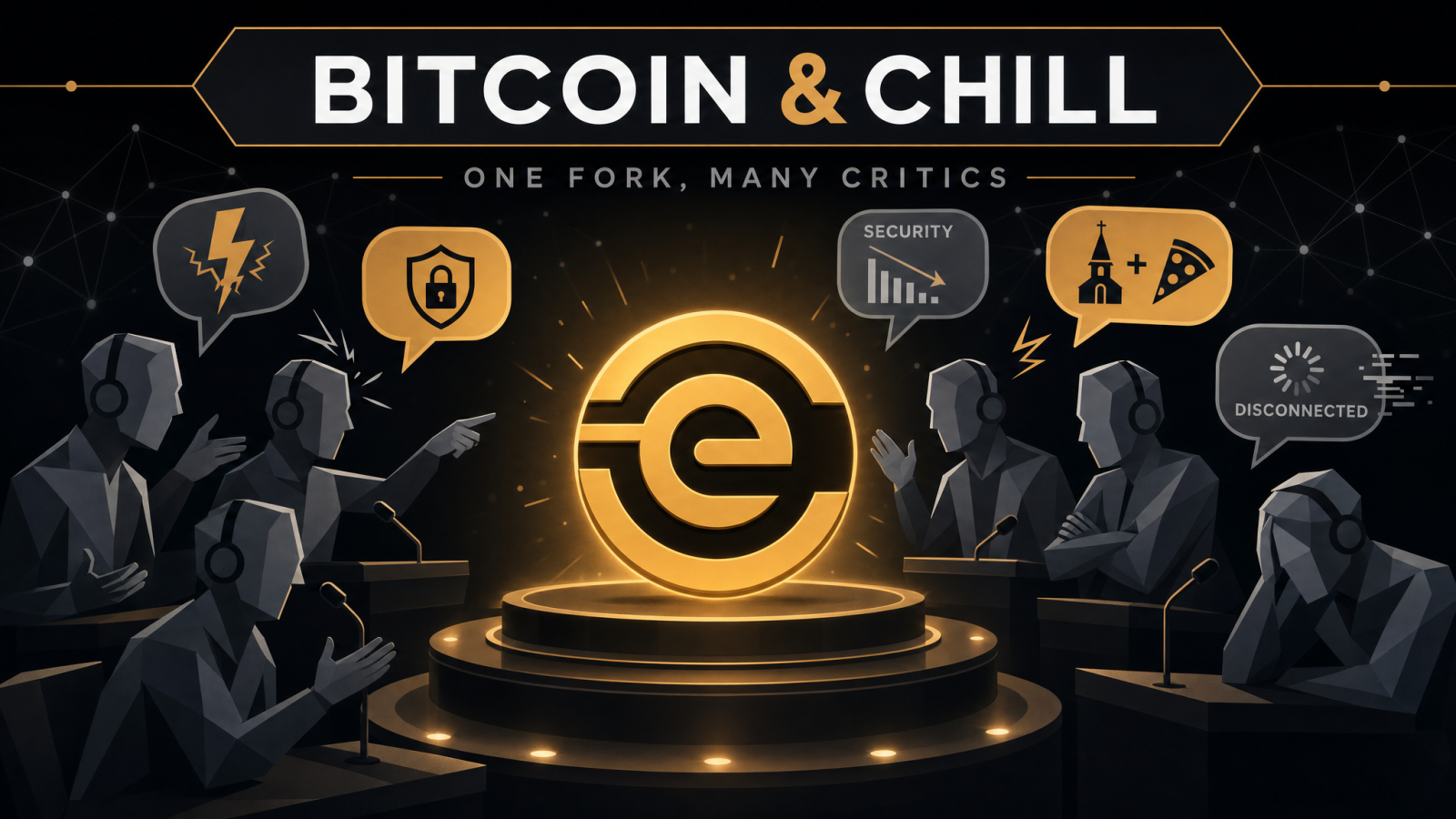
Paul Sztorc Walks Into the Lion's Den: The "Bitcoin & Chill" Debate on eCash, Lightning, and Firing Core
*This is a summary of Paul Sztorc's appearance on the X show "Bitcoin & Chill," hosted by Wicked (@w_s_bitcoin) on July 22, 2026, and archived on YouTube by Rexpaces.
Unlike the friendly eCash Spaces, this was a genuine three-and-a-half hour crossfire, with Sztorc outnumbered by hosts and guests who mostly disagreed with him. The result was combative, occasionally chaotic, frequently funny, and more revealing than any softball interview could have been. It landed exactly one month before the eCash hard fork.*
A quick housekeeping note on dates. Sztorc said on the call that eCash forks around "August 23rd," roughly two to three weeks after BIP-110's mandatory signaling begins on August 8. The official eCash countdown at ecash.com lists the activation as August 21, 2026, around block 964,000. Treat the exact day as approximate; late August is the window everyone agrees on.
The Core Argument: Why Fork At All?
The spine of the entire conversation was a single question the hosts kept returning to: if Sztorc's complaints are about Bitcoin Core's dysfunction, why fork the whole network instead of just shipping a competing node implementation?
Wicked and others pressed this hard, and it produced the most heated stretch of the night. Their position: BIP-47, BIP-39, and most of Sztorc's other grievances are not consensus changes. He could have built his own client, implemented every feature the market wanted, and let users migrate. "This is what I was trying to tell you for 12 years. You don't need Bitcoin Core," one host said. "You could have made Bitcoin better. But instead you're forcing Bitcoin's UTXO set into a shitcoin."
Sztorc's answer was that Bitcoin Core holds "a de facto monopoly on the Bitcoin brand," and that a competing implementation is a practical impossibility. His reasoning: if your node differs from Core by even one byte in consensus, you risk splitting the network, so nobody dares run anything else. He compared it to trying to launch a new Microsoft Word or a new QWERTY keyboard. The network effect, he argued, "becomes a prison when it becomes Bitcoin Core."
The hosts saw a contradiction, and said so bluntly. If Core is truly that bad and unaccountable, a better implementation would win users over time. If nobody will ever switch, then Core is simply good enough. Sztorc could not have it both ways. His response was that BTC is likely to "die off" precisely because of this lock-in, and that the only way to compete against Core is to compete against Bitcoin itself. As one host put it, exasperated: "A minute ago you said they have a monopoly and no one will switch. Now you're saying they will switch."
This exchange did not resolve. But it exposed the real philosophical fault line of the project: Sztorc believes brand and social inertia are nearly insurmountable on the base layer, so a clean fork with a built-in L2 escape hatch is the only honest move. His critics believe he is torching Bitcoin's UTXO set out of impatience.
The eCash L1 Is Just Bitcoin Core, Forever
One genuinely clarifying admission: the eCash Layer 1 is, and will remain, a near-exact copy of Bitcoin Core. Sztorc confirmed it is not even renamed in the software to keep the code diff minimal, and that the plan is to "keep clicking merge" on every new Core release, always tracking the latest version.
This led to a striking concession under questioning. Because eCash mirrors Core, its L1 success is essentially tethered to Core's continued existence. "It will always tie Bitcoin Core for as long as Bitcoin Core" exists, Sztorc said.
Asked what happens if Core disappears, he replied simply: "Then we just carry on and leave it exactly where it was." The differentiation, he stressed, is not the L1 at all. It is the BIP-300/301 enforcer (a separate piece of software) and the merge-mined L2 sidechains layered on top.
Lightning, Spark, and the Man Sawed in Half
Sztorc's Lightning critique was as uncompromising as ever, and the hosts were more informed than most, which made for a real fight.
His central claim: Lightning "constantly lies about what it is." Most usage is custodial, which he says is "no different than using a credit card that has the word lightning written on it." He reprised his favorite metaphor, the magician who appears to saw a woman in half, with the gullible child running to tell his parents. The engineers, he claimed, privately whisper to him that he is right, and the industry's drift toward Ark is itself "underlining the rejection of Lightning that everyone is experiencing."
The hosts landed some real hits here. When Sztorc insisted that paying a Lightning invoice through a custodial app means "sats are moving, HTLCs are getting" routed, they corrected him: the merchant could be receiving USDC, or a bank deposit the next day, and the user has no idea what happens under the hood. More pointedly, they informed him that Primal had moved off custodial Lightning to Spark, and walked him through how Spark works (shared UTXOs on a statechain, atomic HTLC swaps to pay LN invoices, unified on-chain and Lightning balance, no inbound liquidity headaches). Sztorc admitted he had "stopped paying attention to that" and was "happy" to have stopped having it "inflicted on my consciousness." That is a notable blind spot for someone forking the network partly over Lightning's failures, and the hosts flagged it.
Asked directly whether he had ever used custodial Lightning himself, Sztorc conceded he had, "accidentally," and that it worked fine, before pivoting back to his point that "that's not the point."
The Adoption Debate: Nobody's Code Can Create Pain
The most substantive disagreement, and arguably the one where the hosts got the better of Sztorc, was about what actually drives adoption.
The hosts (particularly the voice referred to as Mr. HODL) laid out a clean thesis: there are only two vectors of adoption, "number go up" (bull markets drawing moths to the flame) and "pain" (Canadian truckers, Iran, hyperinflation, debanking). Both are largely external to Bitcoin's code. The recurring challenge to Sztorc was devastatingly simple: "What line of code can Bitcoin Core developers write to exempt Bitcoin from capital gains tax and make the US dollar collapse? Does it go and assassinate politicians in the code?"
Sztorc's counter was that the friction is partly technical after all: high fees during adoption "super cycles" repeatedly scared off newcomers, and better scaling (drivechains) would have retained them. He argued that people do not reason like Aristotle; they try Bitcoin, hit a twenty dollar fee, conclude "this thing isn't figured out yet," and leave, and that these social impressions are contagious.
The hosts pushed back that fees spiking three times in Bitcoin's history did not kill it, that people mostly left because prices crashed (which coincided with the fee spikes), and that the real dam holding back the other 95 percent of humanity is trust in the government, not UX. One host's framing: normal people "need to be put in the frying pan," and "the thing that's going to send all those people running out of the burning theater is the fire, and we unfortunately don't have one yet."
There was a genuinely sharp point buried here that Sztorc never fully answered. Even if fiat collapses, why would people flee to BTC rather than to a custodial off-ramp like Cash App, or to a different cryptocurrency entirely? The hosts argued that in a panic, people run to where the off-ramps are, which has "nothing to do with this particular token and its nerd code." Sztorc's rejoinder, that eCash could win if it fought harder for all categories of demand, "custodial and non-custodial," is coherent but speculative.
The Store of Value Versus Medium of Exchange Meme
Vlad and a guest named Daniel opened a second front, arguing that the whole "money must evolve from store of value to medium of exchange to unit of account" framing is a "busted narrative" and a "bad meme." Daniel's point: you cannot separate the two with Bitcoin, because every send is already a medium-of-exchange event. "I just had Bitcoin sent to me the other day from another continent, and it was an excellent medium of exchange."
Sztorc partly agreed on the physics but held his ground on the psychology: if Bitcoin is perceived as constrained as a medium of exchange, people "preemptively know it has no future," and that suppresses the price today. The Wright brothers analogy came up (technically a flight, but not consumer air travel for decades), and there was broad agreement that full monetary displacement is likely multiple generations away, with Sztorc conceding it "should take longer than 15 years."
Vlad added a genuinely interesting data point that cut against everyone's Bitcoin-only framing: at 54 percent dominance, half the market is elsewhere, and there are roughly 100,000 BTC wrapped as WBTC on Ethereum, "larger than Lightning, larger than Liquid, larger than Ark and Spark." His argument: the features Bitcoin refuses to ship are being used, quietly, on other chains, whether maximalists like it or not.
The Security Budget Slugfest
A long, circular, and increasingly frustrated argument broke out over Bitcoin's long-term security budget. Sztorc used a deliberately extreme hypothetical (total miner revenue of "four cents a year" in the far future) to argue that at some point proof of work becomes "superfluous" and the chain becomes cheaply rewritable.
The hosts spent nearly twenty minutes accusing him of conflating "demand for Bitcoin the coin" with "demand for Bitcoin transactions," and of "uncritically repeating some meme."
Their view: as long as people buy Bitcoin, exchanges like Coinbase have incentive to subsidize mining, and the security budget is a non-issue for a century.
Paul Sztorc's view: the security budget is a legitimate measurement of transactional demand and deserves at least a "vague plan," and the fact that everyone "blows it off" is "exactly what I'm talking about, why we're all screwed."
It got genuinely testy. Sztorc told the hosts, more than once, that talking to them was "like a doctor and a four-year-old girl who doesn't know what cancer is," and that many of these points "were litigated a long, long time ago." The hosts gave it right back, with one delivering the line of the night: "If there's no more oxygen left, we all stop breathing and die. Why are we fixing this right now?"
What's Actually Wrong With Bitcoin Core
Asked to enumerate his top three complaints about Core (excluding esoteric governance gripes), Sztorc rolled them into essentially one giant thing plus two smaller ones:
-
The soft fork taboo. Core treats soft forks as categorically different from any other code change, which Sztorc calls absurd, since any single line can destroy everything. He cited Matt Corallo accidentally introducing an inflation bug while trying to make a tiny speedup, arguing it proves that "controversial" is an incoherent, Twitter-measured standard. His prescription: activate every proposed, opt-in soft fork.
-
No encouragement of competition. Core does nothing to foster alternative implementations or red-team/blue-team structures, partly, he speculated, out of legal fear, which leaves the project with "no accountability."
-
Prioritizing sidechains would at least let people who hate the L1 escape to an L2, a fix he says Core refuses.
When a technical guest (Keegs, who said he had worked on the Lightning protocol and BitVM) pushed back, the conversation reached its most nuanced point. Keegs argued that Sztorc misreads Core's intent as malice when the real issue is "apathy," or fear of liability:
"Who working on Bitcoin Core really wants to be responsible for a trillion dollar collapse because they happened to touch consensus in the wrong way?" Others argued Core has simply, correctly, realized that consensus changes must be market-driven from the bottom up, citing Taproot's activation as proof that widespread buy-in came first.
The BIP-110 and Luke Dashjr Show
The back half of the show turned to BIP-110, mandatory signaling on August 8, and the drama at Ocean and Start9. The consensus in the room was that BIP-110 is self-contradictory, does nothing to actually stop spam (which its own supporters have reportedly conceded), and that miners will overwhelmingly decline to signal, leaving the enforcing chain as a stillborn minority fork. The prospect of "two airdrops in one month," BIP-110's fork around August 8 and eCash around August 23, was treated as almost comic.
Mr. HODL raised a genuinely sharp point that Sztorc praised: Luke Dashjr cannot easily push a proof-of-work change (his long-standing nuclear option) because he now draws a salary from Ocean, which mines SHA-256. Firing the miners would mean firing himself.
Then came the segment that will get the most clicks. A long, colorful group effort to explain Luke's psychology concluded that his BIP-110 crusade is fundamentally religious. Guests described him as a hardcore sedevacantist Catholic (someone who believes there has been no legitimate Pope since Vatican II), and argued that, in Luke's framework, BIP-110 is not about stopping child sexual abuse material on-chain (which everyone agreed it technically cannot do) but about washing his hands "in the eyes of Jesus Christ," refusing to be complacent regardless of efficacy.
Paul Sztorc, who kept saying this was the one chapter of Bitcoin history he understood "the least well," seemed to find the religious explanation the only one that made it "very, very consistent."
The Luke anecdotes piled up and got funnier and stranger: a firsthand story of Luke casually mentioning "we haven't had a real pope since 1971" in the same breath as a soft fork design; the COVID-era account of him wearing a mask plus an N95 plus a duct-taped face shield; and the infamous story of him dunking DiGiorno frozen pizzas in hydrogen peroxide, which led to a genuinely extended debate about how many bottles of peroxide one would need to fill a cooler and whether the pizza would still be edible.
Nico, a New York cab driver, offered a parallel tale of a passenger triple-masked with a duct-taped shield as his metaphor for what BIP-110 actually accomplishes: theater that relieves the conscience without doing anything.
The Fork's Nuts and Bolts
Amid the chaos, several concrete details emerged about the eCash launch:
Difficulty reset. Sztorc is still deciding how low to set initial difficulty, floating "probably like a million." The goal is low enough to be easy to mine at launch but high enough to avoid being GPU-mineable (to prevent reorg risk) and not so low that a single petahash miner could dominate. He wants it "Bitaxe mineable." He confirmed informal pledges of hashrate "in the petahash zone."
Why not just redistribute coins to miners? Asked why he does not reset the block subsidy to 50 instead of reassigning dormant coins, Sztorc noted that setting difficulty low is economically equivalent to temporarily boosting the block reward, since mining always trends to a "zero profit condition." The difference, a host pointed out, is that redistribution to early investors avoids a mandatory lockup.
Exchanges. Sztorc reiterated that exchange listings matter far less than they used to, thanks to USDT-based OTC (every Telegram chat is "an OTC desk now") and atomic-swap providers like ChangeNow. He admitted he is running late on this, having prioritized getting the software "in a nice box" via repeated "dry runs" (currently on dry run three). His memorable framing: courting big exchanges is like planning a party, you line up food, music, and close friends first, and invite "the hot girl you like" last to build FOMO.
Ticker and branding. After Tone Vays presented an explicit lesson from Bitcoin Cash (and the BCC/BCH ticker confusion caused by BitConnect), Sztorc said he deliberately chose a name without "Bitcoin" in it. His real objection to Roger Ver, he clarified, was never the fork itself but the attempt to make a less-secure chain "seem like that was Bitcoin." A speaker noted the irony that many still find "eCash" confusing given Chaumian ecash, prompting a guest to quip it "clearly should be called P-cash."
Could Core sabotage eCash? A closing question asked whether Core could ship a change incompatible with BIP-300. Sztorc said theoretically yes, the most annoying vector being a collision over whichever OP_NOP opcode the enforcer uses, but that eCash could simply hard-fork the enforcer to a different opcode. Since BIP-300/301 lives in the separate enforcer rather than the L1, he considers the risk manageable.
Interesting Tangents
BIP-39. Sztorc called Core's rejection of the 12-word seed phrase one of its clearest failures, since it was "the first good cultural invention" that normal people could grasp and was "rapidly adopted by every other cryptocurrency." Vlad supplied the historical context (a dispute between Trezor's team and Electrum over cryptographic details), and noted that Monero and essentially the entire industry adopted it while Core did not, evidence, he argued, that "Bitcoin Core doesn't control Bitcoin." The hosts turned this against Sztorc: if the market can just route around Core on BIP-39, that proves he never needed to fork.
The libbitcoin kernel and the GUI. A long technical exchange with Keegs covered why modularizing Bitcoin (separating consensus from the wallet) has "mostly failed" over a decade of attempts, and whether Core's Qt front end should simply be deleted. There was near-unanimous agreement the front end is bad and that PSBTs have made Core's wallet roughly as capable as Sparrow for cold-storage signing. Sztorc plugged his own "Bit Window" front end for bitcoind.
Would he ever sell? Sztorc confirmed he is holding his BTC as well as his eCash, framing ECX as "a hedge against the failure of BTC." He said he would only dump BTC permanently if its price were crashing against a skyrocketing ECX "for the right reasons," and admitted, with unusual candor, that the fork exists only because "Bitcoin Core sucks so much. I was forced to do it."
What the Debate Revealed
This was the most useful Sztorc appearance in a while precisely because it was adversarial. Three things came through clearly.
First, the strongest case against eCash is not technical but strategic, and it went largely unrebutted: if Core's brand monopoly is truly unbreakable, a fork inherits an even harder version of the same uphill battle, and if it is breakable, Sztorc never needed to fork at all. He gestures at the L2 escape hatch as the resolution, but his critics were not persuaded.
Second, Sztorc was visibly less current on the state of the art than his opponents on at least one front, custodial Lightning and Spark, which undercuts some of his "Lightning is a dead end" certainty even if the broader critique retains force.
Third, and to his credit, he showed up alone, for three and a half hours, to a room that mostly disagreed with him, and engaged with real arguments rather than fleeing. The hosts landed serious blows on the security budget and adoption questions. Sztorc landed real blows on Core's soft-fork paralysis and BIP-110's incoherence. Nobody's mind appeared to change, which, as the eCash camp likes to say, is what the market in late August is now there to arbitrate.