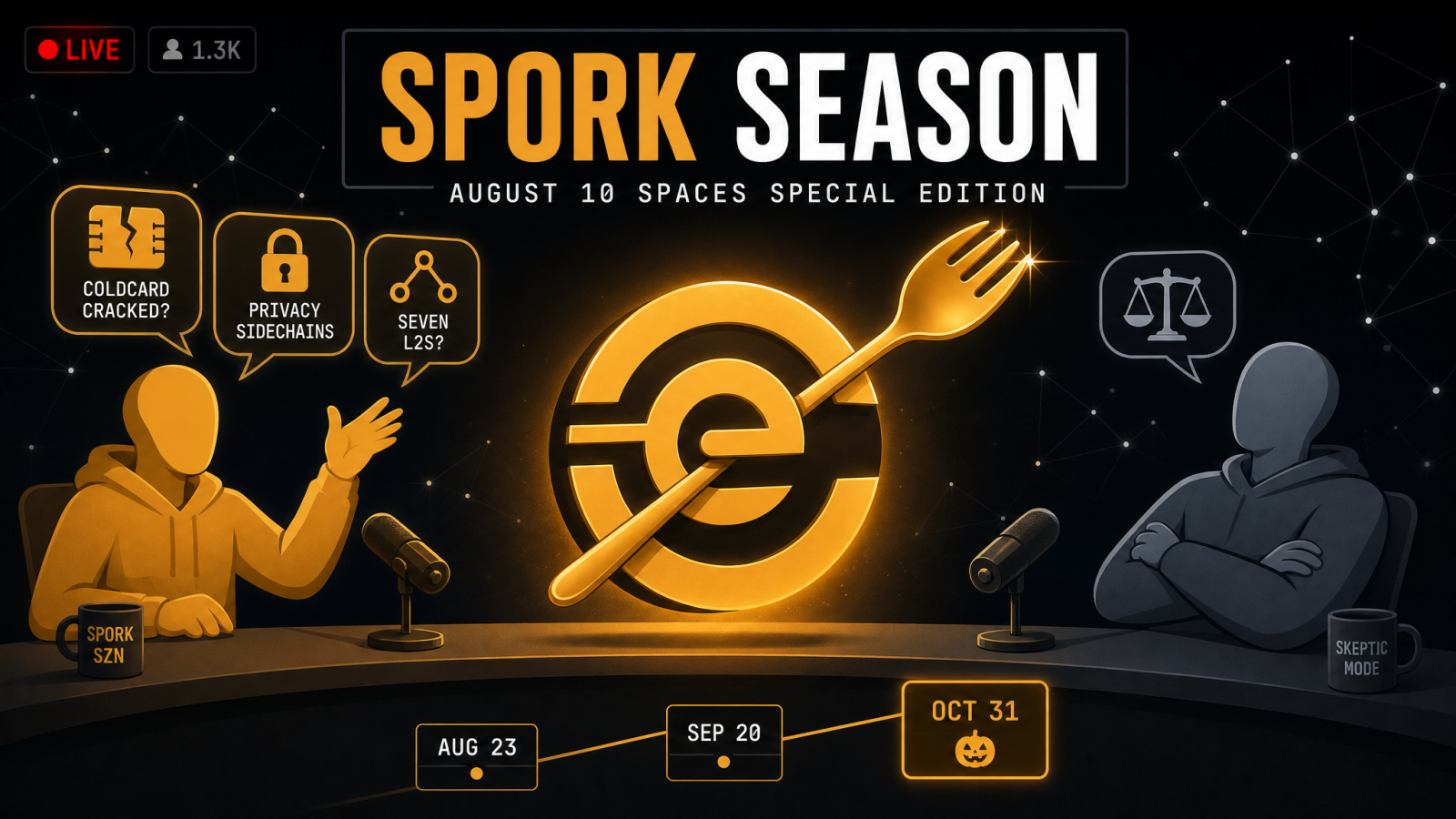
Fork, Spork, and Fog of War: Paul Sztorc Fields Two Hours of Questions in a Special Edition eCash Spaces
On the evening of August 10th, 2026, what began as a paranoid war-gaming session about the Coldcard exploit turned into one of the most substantive public Q&As on the eCash (ECX) hard fork to date. Paul Sztorc joined the stage roughly half an hour in, blessed a new nickname for his project, and stayed for nearly ninety minutes of debate on drivechains, miner incentives, replay protection, and the staged rollout that now defines the fork's roadmap. The full session has been archived on YouTube.
Act One: The Evil Genius Warm-Up
Before Sztorc ever took the mic, host Wicked and a rotating cast of regulars, including Mr. Hoddle and Daniel, spent the opening act dissecting a hypothetical "optimal attack" against Coldcard hardware wallets. The scenario, offered explicitly as a thought experiment rather than an accusation, imagined a two-stage exploit: a limited-entropy RNG flaw used to sweep pre-computed seeds in a single block, followed by a nonce exfiltration backdoor in shipped firmware that would activate at a predetermined block height and leak private keys the moment panicked users tried to move their coins to safety.
"If I had to choose a block time, just picking one out of my hat as an evil genius," Wicked mused, "I would pick block height one million."
The speculation ranged widely, from the Blockclock Mini allegedly "phoning home" to correlate xPubs with IPs, to which devices survived the attack (multisig, multi-vendor, dice-rolled seeds, and passphrases). Yet the segment ended on a deflating note for the conspiracy-minded. Participants confirmed that the weak RNG at the heart of the real Coldcard exploit was simply the default from the MicroPython module, not a finely tuned trap. "That actually was, it looks like, just a coincidence," one speaker admitted. "So that did quell some of my paranoia."
The conversation also produced a practical takeaway that no one disputed: flash your own firmware when a device arrives. As one attendee confessed, to general horror, he had never flashed his. He was not alone.
Enter the Spork
When Sztorc was brought up on stage, the tone shifted from threat modeling to branding. After a brief riff on the correct Polish pronunciation of his surname (the trailing "c" carries a "ts" sound, like the baby-carrying bird), the host asked whether the eCash fork could officially be dubbed "the spork."
"Yeah, I like that," Sztorc replied. "Alright, that's going to be it from now on, the spork."
A community member immediately floated the idea of a commemorative run of signed sporks at TABConf in October. Sztorc, who once joked that proposing a hard fork of Bitcoin means "signing up for a certain amount of fun, deranged hatred," seemed genuinely entertained.
The 3 Stage Rollout, Explained Live
Much of the session doubled as a live FAQ for the previously announced three-phase launch. Sztorc restated the schedule: an Alpha on August 23rd, a Beta around September 20th, and the full permanent release on October 31st, Halloween, the 18th anniversary of Satoshi's whitepaper.
New detail emerged on the incentives baked into the practice phases. Participants who accumulate 1,000 practice ECX on the Alpha can redeem them for 10 real ECX at the permanent launch; the same 1,000 on the Beta redeems for 20. The structure rewards early testers while keeping the stakes calibrated, and Sztorc framed the phased approach as a direct response to the security climate. "There was so much just cultural chaos in Bitcoin," he said, referencing the Coldcard fallout, "it's like, okay, ramp it up a little bit."
He also confirmed the project's ongoing bug bounty contest, noting that AI-assisted hunting has raised the stakes for everyone. "The amount of just raw bug finding firepower is very high," Sztorc observed. "I think this is probably one of the worst times to launch any software project, let alone a crypto project."
Replay Protection, the nLockTime Trick, and "Phishing the Exchange"
One of the most practically useful segments addressed coin splitting. Sztorc clarified that the fork carries opt-in replay protection: the official software splits coins automatically and warns users, but transactions from those who ignore the warnings will be replayed.
For holders unwilling to install new software at all, he described an elegant workaround. By crafting a normal Bitcoin transaction with an nLockTime set to a far-future value (he cited a number in the 4,999,999,999 range and urged listeners to verify the exact figure in the pinned fast facts repository), users can produce a transaction that is valid on eCash but unbroadcastable on Bitcoin for centuries. Because the trick only requires a PSBT, it can be signed with an ordinary hardware wallet, no private key imports required. "I didn't want to ask people to put their real Bitcoin private keys into anything invented by us," Sztorc explained. "That's a big ask, especially right now."
The same mechanic enables a game he openly enjoys: repeatedly depositing and withdrawing BTC at inattentive exchanges, collecting the eCash that trails each withdrawal. "I think it's funny," he said. "If you're not paying attention, you're going to get left behind." Others on stage cautioned that the legality of draining exchanges this way is untested territory. Sztorc was unmoved: "That which stumbles must also be pushed."
The Shinobi Debates: UASF, Miner Theft, and Tokenization
The night's intellectual main event was an extended clash with Shinobi, arguably the most prominent drivechain critic, who had apparently gotten out of bed specifically to join.
First came a dispute over historical accuracy. Sztorc objected that Shinobi's five-part sidechain series reduced drivechain's defense against miner theft to "one sentence that is not even true" about UASFs. Shinobi countered that Sztorc himself once spoke of a "UASF button." Sztorc pointed to his original 2015 post describing four layers of paranoia, framing UASF as one deterrent among several, likened to a burglar unsure whether a house has a dog, a gun, or an alarm. Because drivechain withdrawals must be announced and show months of progress, he argued, a theft attempt is visible long before it completes. Shinobi was not persuaded and accused him of shifting the model; Sztorc ultimately shrugged that on his own chain, governance questions resolve differently anyway.
The second clash was broader: does tokenization belong anywhere near Bitcoin's security budget? Shinobi argued that letting stablecoins, equities, and other issued assets pay miners introduces an "incentive-unstable equilibrium," where a centralized issuer could effectively decide which side of a fork receives revenue. Sztorc replied that in his design all fees are paid in the native coin (BTC under BIP-300, ECX on eCash), much as USDT transfers on Ethereum pay gas in ETH, and that miners' loyalty to fee-payers is a feature, not a bug. "What else would they be loyal to?" he asked. "Whatever that answer is would be much, much worse."
When the exchange grew heated, Sztorc delivered what may be the night's most quotable concession: "If you are right that it is a bad idea, then it will just be a bad idea on eCash." Atomic swaps between eCash and Bitcoin, he added, would let both visions coexist. "Everyone can live a happy life."
Seven Sidechains and the MeltCast Effect
Sztorc used the session to recap the seven drivechains launching alongside the fork, with fresh specifics. Thunder, the high-throughput payments chain, has been benchmarked at 960-megabyte blocks; fourteen such chains could, by his back-of-the-envelope math, carry every payment on Earth, cash, cards, and WeChat Pay included. Node costs for that extreme scenario came in around $2,000 to set up and $1,000 per month to operate, figures drawn from a 2025 performance hackathon whose results are public on GitHub.
He also highlighted zSide, the Zcash-style privacy chain, and fielded a sharp question about what happens to UTXOs that travel through a sidechain and back. The answer: they do not survive the trip intact. "You get a different UTXO," Sztorc confirmed, meaning every round trip through an L2 functions, more or less, as a mix. He noted his "MeltCast" front-end concept exists precisely to keep users from fumbling that privacy, since Zcash-style tools are famously easy to misuse. Several listeners immediately identified mixing as a likely killer use case. BitNames, he added with some pleasure, should be hard for critics to attack, given that Satoshi himself helped invent Namecoin in 2010.
A Clean Break: Why eCash Will Not Merge Mine Bitcoin
A thoughtful exchange addressed why eCash, despite keeping SHA-256, will not bootstrap itself by merge mining with Bitcoin. Sztorc's answer was part economics, part philosophy.
Even at 100 percent merged hashrate, a chain worth one percent of Bitcoin captures only a sliver of miner attention and loyalty, he argued, citing Namecoin's history: at one point its block reward was a thousandth of Bitcoin's, yet it held roughly 80 percent merge mining anyway. "You get Foundry, but you only get 0.5 percent of their mindshare," he said. A hard fork "wants to have its own fate." Merged chains cooperate; competitors should not. As he put it, "Should the Republican Party merge mine with the Democratic Party?"
Instead, the phased rollout and fork futures will be used to estimate price and calibrate the initial difficulty before the real launch, turning the Alpha and Beta into market-driven instruments rather than guesswork.
Fork Season, Villain Rankings, and the Bitcoin Cash Postmortem
Sztorc also offered a candid assessment of the wider fork landscape. The BIP-110 effort, he argued, is worse positioned than Bitcoin Cash or even Bitcoin SV ever were, since it commands negligible hashrate and still lacks a name, a problem he sympathized with. "Naming things is actually pretty hard," he said, noting that parents rarely announce a child's name before birth precisely to make it a fait accompli. (Backchannel rumors suggest "The Money" is under consideration for the 110 fork.)
On Bitcoin Cash, he was blunt: it hard forked to expand the block size but then "would have had to keep hard forking," never solved developer capture, and has slid to roughly half a percent of Bitcoin's value. That decline, he suggested, is both a warning and an opportunity. "If we somehow came out ahead of Bitcoin Cash, I would think, well, we had the number one Bitcoin fork." He disclosed that the project raised $5 million, with coins selling above the Bitcoin SV price, and teased an announcement on liquidity and exchange integration "very soon."
There was even a moment of dark humor about his own expectations. Sztorc admitted he had wondered whether he would become fork season's villain, only to watch Luke Dashjr seize the role with far greater flair. "He was just scoring these villain points," Sztorc said, almost admiringly.
What to Watch Next
With the Alpha two weeks out, the practical checklist for holders is unchanged: self-custody before each phase, learn the nLockTime splitting trick while the coins are practice ones, and keep an eye on the eCash GitHub and the Drivechain Telegram, which Sztorc noted now counts some 920 members. Critics and supporters can both inspect the roster of public backers at layer2labs.com/friends, a list that includes Adam Back and Robin Linus.
Whether one views the spork as Bitcoin's escape valve or its latest sideshow, the August 10th session made one thing plain: the project intends to launch in public, warts, practice coins, signed cutlery, and all.