eCash (ECX) Hard Fork 101: What to Expect This Halloween
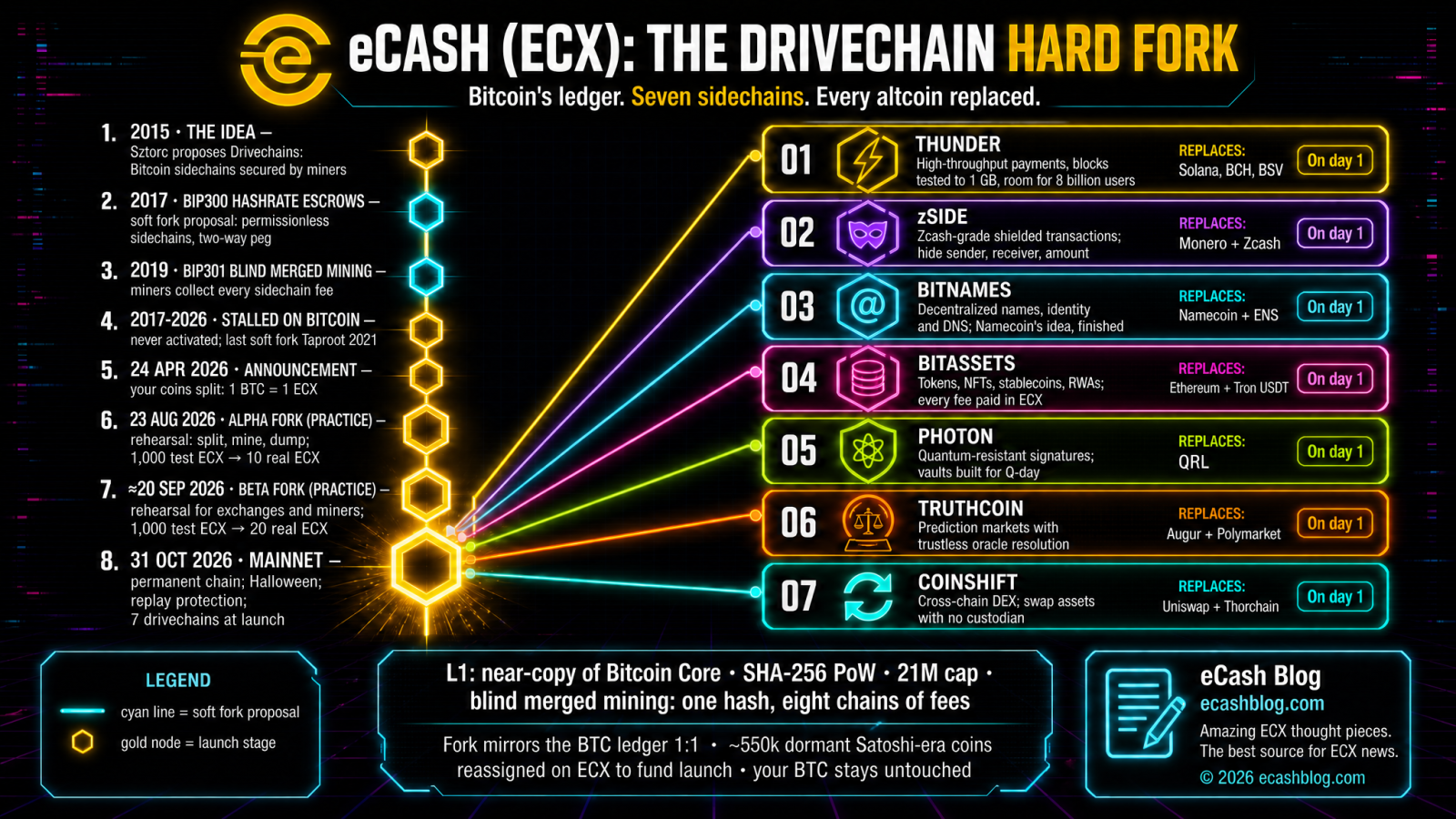
On October 31st, 2026, exactly eighteen years after Satoshi Nakamoto published the Bitcoin whitepaper, a new chain called eCash will split off from Bitcoin, copy its entire ledger, credit every BTC holder with an equal amount of ECX, and launch with seven sidechains that aim to replace the altcoin market wholesale.
If that sentence raised more questions than it answered, this guide is for you.
First, What Is a Hard Fork?
A blockchain is a shared record book that thousands of computers keep identical copies of. A hard fork happens when a group launches new software with different rules, and the record book splits into two: the original keeps going as if nothing happened, and a new copy branches off and starts writing its own pages.
Crucially, your coins do not move and do not get spent. If you hold 1 BTC before the split, you still hold 1 BTC after it, and you now also have a claim to 1 unit on the new chain. This is how Bitcoin Cash was born in 2017, and it is how eCash (ticker: ECX) will be born this Halloween. Bitcoin itself is not being changed, upgraded, or attacked. It simply gains a sibling.
Where eCash Comes From: A Decade of Rejection
The eCash story does not begin with the fork. It begins with an idea that Bitcoin refused to adopt.
In 2015, developer Paul Sztorc proposed Drivechains: a way to attach optional sidechains to Bitcoin, each with its own rules and features, all secured by Bitcoin's miners. In 2017 he formalized the concept as BIP300 ("Hashrate Escrows"), a soft fork proposal that would have let anyone create a sidechain with a two-way peg, meaning coins could move from Bitcoin to a sidechain and back. In 2019 came BIP301 ("Blind Merged Mining"), which would let miners collect fees from every sidechain without even running sidechain software.
Then, nothing. The proposals were debated, criticized, and never activated. Bitcoin's last soft fork was Taproot in November 2021. For nine years, the Drivechain vision sat on the shelf while users who wanted big blocks, privacy, tokens, or prediction markets drifted to altcoins to get them. On April 24th, 2026, Sztorc announced the conclusion he had reached: if Bitcoin would not soft fork, he would hard fork. "Your coins will split," he wrote. "1 BTC = 1 ECX."
The Three-Stage Launch: Practice First, Real Money Later
Most forks ship once and pray. eCash ships in three phases.
Alpha, August 23rd, 2026. A full dress rehearsal with zero real value. Users can practice the entire cycle: splitting their coins, mining, trading, even dumping, without risking anything. As a reward for stress-testing the system, 1,000 alpha ECX can later be burned for 10 real ECX.
Beta, around September 20th, 2026. A second rehearsal, this time aimed at the professionals: exchanges, miners, wallets, and custodians who need their infrastructure working before the real day. The burn bonus improves to 1,000 beta ECX for 20 real ECX.
Mainnet, October 31st, 2026. The permanent chain, launching on Halloween, the 18th birthday of the whitepaper. It ships with opt-in replay protection (so a transaction on one chain cannot accidentally be copied to the other) and all seven drivechains available on day 1.
The logic is simple: everyone learns on the practice chains, and nobody's rent money depends on day-one software.
The Seven Drivechains: Every Altcoin Replaced
This is the heart of the pitch. Instead of one chain trying to do everything, eCash's base layer stays a near-copy of Bitcoin Core (SHA-256 mining, 21 million coin cap, ten-minute blocks), while seven specialized sidechains each absorb an entire category of altcoin. All of them are on day 1.
01 · Thunder is the payments chain. It uses prunable big blocks tested up to 1 GB, with room, the team says, for 8 billion users. If you ever wondered why people use fast, high-throughput chains for everyday payments, Thunder is the answer. It replaces Solana, BCH, and BSV.
02 · zSide is the privacy chain. It offers Zcash-grade shielded transactions that hide the sender, the receiver, and the amount, plus a one-click mixing feature called MeltCast. It replaces Monero and Zcash.
03 · BitNames is decentralized naming: usernames, identities, and a censorship-resistant DNS. Satoshi himself co-invented this idea in Namecoin back in 2011. BitNames finishes it. It replaces Namecoin and Ethereum's ENS.
04 · BitAssets is the token factory: NFTs, stablecoins, tokenized real-world assets, all issued on a chain where every fee is paid in ECX. It replaces Ethereum's token economy and Tron's USDT empire.
05 · Photon is the vault for the era of quantum attacks, using quantum-resistant signatures so your savings survive the day quantum computers become a threat. It replaces QRL, Quantus and the rest of the quantum-resistant niche.
06 · Truthcoin brings prediction markets home: bet on real-world events with trustless, peer-to-peer oracle resolution, no company deciding outcomes. It replaces Augur and Polymarket.
07 · CoinShift is the exchange that cannot run away with your money: a cross-chain DEX for swapping assets with no custodian in the middle. It replaces Uniswap and Thorchain.
The economic engine connecting them is blind merged mining. Miners point the same hash at the base layer and all seven sidechains at once, one hash, eight chains of fees, which means every sidechain inherits Bitcoin-class security from the first block.
The Honest Fine Print
Two things you should know before forming an opinion. First, the fork mirrors the BTC ledger one to one, but roughly 550,000 of the new ECX, corresponding to dormant Satoshi-era coins that have not moved since 2010, are reassigned on the eCash chain to fund the launch.
Critics call this theft; Sztorc calls it the only way to capitalize the project without an ICO. Your actual BTC is untouched either way, since the reassignment only happens on the new chain. Second, "replaces" is a claim, not a fact. Altcooins like Monero and Ethereum have years of adoption, and the drivechains start with you and your friends as the first users.
The pitch is that identical or better features, plus real BTC liquidity, plus no new trust assumptions, will win over time. The market gets to vote with their money.
Nonetheless, eCash (ECX) is one of the most ambitious projects in the history of the cryptocurrency space. It doesn't only try to fix one problem such as scaling, privacy, or contracts. It enables everything all at once, in a way that encourages competition between developers. It's an extension of the Nakamoto consensus that leverages game theory in order to maximize the utility of Bitcoin's 21 million bitcoins. It's the altcoin that can put an end to all altcoins... and may one day come for the throne!
What Should You Actually Do?
If you want nothing to do with eCash, do nothing. Your bitcoin sits exactly where it is, and the fork cannot affect it. If you are curious, the golden rule is: never type your seed phrase into any website or app that asks for it.
Fork season is scam season, and fake "claim your ECX" pages will appear. Wait for the official, widely reviewed tools, use the alpha and beta practice runs to learn the splitting process with worthless coins, and treat the replay protection warnings in the software as mandatory reading, not fine print.
Whether eCash becomes the homecoming of everything Bitcoin pushed away, or joins the long list of forks only a few people will remember, it launches on the most symbolically loaded date in crypto: the night Satoshi's idea turns eighteen.
For deeper dives into every drivechain, launch updates, and thought pieces, stay tuned to ecashblog.com, the best source for ECX news.