August 23-26: How the eCash Alpha Went From Zero to a Living Ecosystem
The calm before the fork
To appreciate what happened on August 23rd, 2026, you have to rewind a few weeks. The Drivechain Talk chat in July was, by its own admission, a fairly quiet technical corner of Bitcoin discourse. Messages drifted between BIP-110 mockery, Lightning post-mortems, and the slow grind of drynet syncing. The dominant conversation of the month was not even eCash. It was the Coldcard catastrophe, in which over 1,300 BTC were drained due to a broken random number generator, and the slow-motion collapse of the BIP-110 "soft fork" campaign, which died with zero signaling blocks and a hasty proof-of-work pivot nobody took seriously.
eCash talk existed, but it was preparatory. "What if exchanges don't credit the airdrop?" "How does the nLockTime coin split work?" "Who is building what?" The vibe was cautious, almost academic.
Then the fork happened, and the chat turned into a trading floor, a mining co-op, a bug tracker, and a comedy club all at once.
Day one: difficulty 1 and the great block blizzard
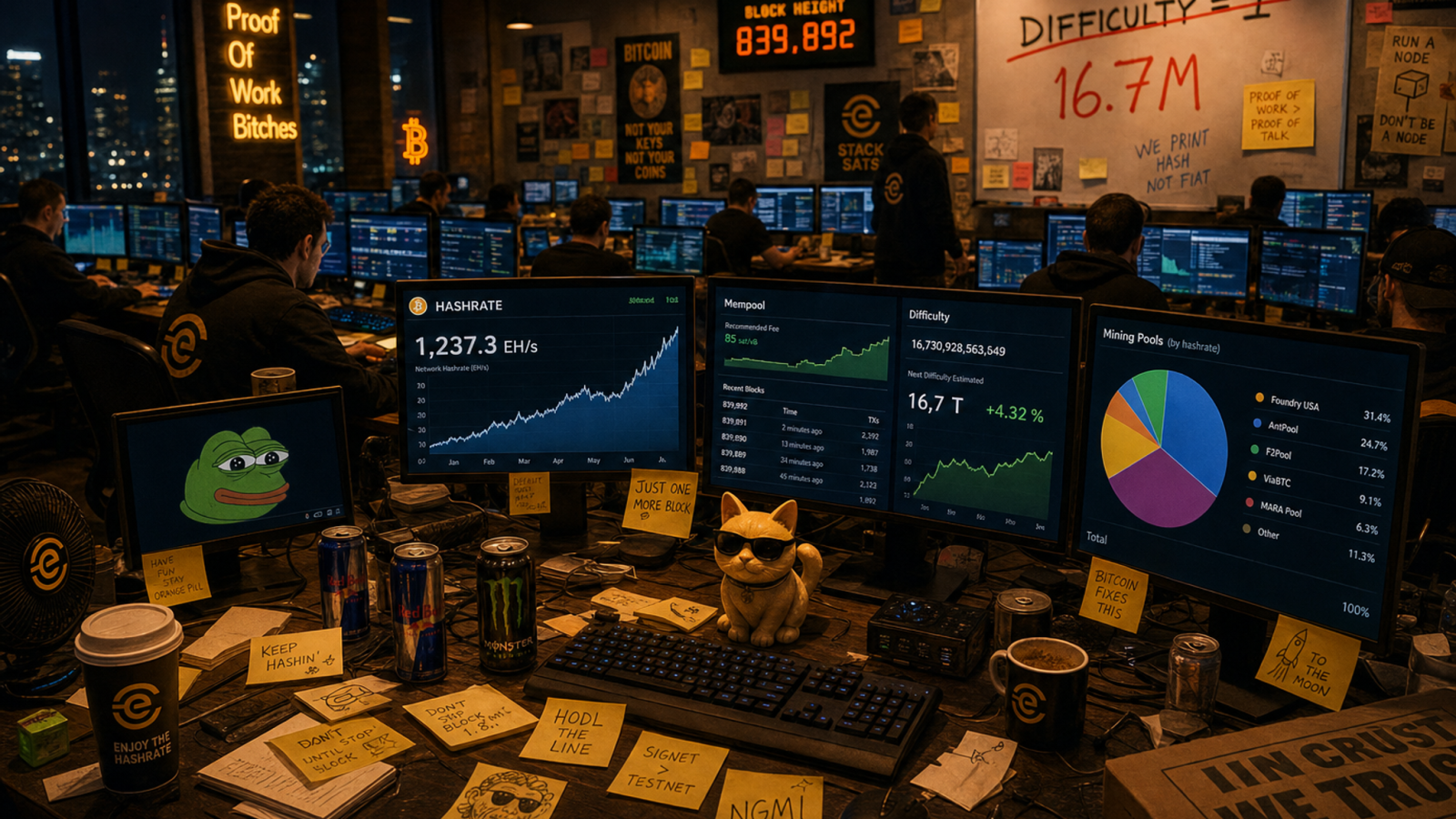
The alpha launched at block 963,648 with the difficulty set to 1. Paul Sztorc had warned everyone: "Buckle your seatbelts for craziness."
He was right. Within the first 30 minutes, thousands of blocks flew by. By 15 hours in, the chain was roughly 26,000 blocks ahead of Bitcoin, with about 80,000 pECX mined. Mempool explorers could barely render the reorgs. One user described it as "a gorillion reorgs" while another watched the pie chart of mining pools populate in real time, with unknown hashrate getting sliced up by NurseryPool, ecashpool.tech, and others.
The first memorable moments came fast:
- The first coin splits executed via the magic nLockTime trick (499,999,999, for the curious), with Marcus broadcasting the first documented split and declaring "habemus coinsplit."
- The first peesex jokes, which began within the hour and have not stopped.
- The first mobile wallet sync failures, the first enforcer crashes, and the first orphaned blocks, all before lunch.
By the end of day one, the difficulty had already retargeted from 1 to 16.7 million. Paul posted on X: "Network: Alive. Difficulty: 1 to 16.7 M. Pie Chart: now contains pool names."
Day two: the miners arrive, and so does the chaos tourism
The second day was when the experiment got serious. Hashrate spiked to around 1 EH/s at one point, driven largely by rented hash from Braiins and Nicehash customers. This immediately created the first true stress test of the alpha: rented hashpower flooded in, blasted through difficulty epochs at turbo speed, and then vanished, leaving the chain crawling at 90 minute block times.
It also produced the funniest subplot of the alpha: Braiins automatically blacklisted ecashpool.tech for receiving too much aggregated hashrate, repeatedly, despite the pool operator (Wiredancer) spinning up new ports and subdomains to satisfy their system. A dedicated Telegram support group was created. The blacklist would lift at 2 AM Prague time, except everyone in Prague was asleep. The crypto mining industry, ladies and gentlemen, professionalized to the point of total absurdity.
Meanwhile, the first real market appeared. Marcus, a community member, built a swap site (pecx.shop, with the glorious redirect peesex.shop) running a constant product AMM with about 100 dollars of total liquidity. Within hours, pECX traded anywhere from 25 dollars per coin down to fractions of a cent per szat, with the pool reserves swinging violently on every trade. Freedom Monk and Coinholio served as the guinea pigs. The first trades settled. Price discovery was happening in a browser tab someone spun up in an afternoon.
The implied price per "real" ECX, given the 1000:10 burn ratio, hovered around 90 dollars by day three. The presale had cleared at 30 dollars. People were paying attention.
Day three: the ecosystem blooms
What stood out most by day three was not the mining. It was the building. In just a few days, the following emerged from the community, entirely uncoordinated:
- pecx.shop / peesex.shop: the first pECX to BTC swap, an AMM built in days.
- szats.world: a pECX faucet giving out 1,000,000 szats per claim, immediately targeted by a residential proxy farmer rotating IPs for 50 cents a day. "The people crave ECX," as Serious Cat put it.
- explorer.alpha.ecash.ninja: the first block explorer, instantly indispensable.
- eCashPool and NurseryPool: community mining pools, one of which paid out in Thunder, the sidechain token, purely on principle.
- ecashmeter.com: a drivechain fee tracker, built weeks earlier on signet and ready to flip to mainnet data.
- The ecash-splitter: an official hardware wallet coin splitting tool, GUI and CLI, shipped by Jacob mid-alpha.
- The L2L live dashboard: a 24/7 streaming sitrep of the alpha network, complete with Space reruns.
And that is just the user facing layer. Behind the scenes, people were proposing new drivechains (JK's Elements+ with a USDT bridge, Shomari's Snowside EVM chain), testing blind merge mining, and filing detailed bug reports with root cause analysis within 72 hours of launch. The bug report culture deserves special mention: users were posting consensus failure diagnoses with block heights, error codes, and suggested patches faster than most projects' paid engineering teams manage.
The Thunder standoff: a live lesson in drivechain game theory
The most educational moment of the alpha came on day three, when Sats Scholar, running ecashpool.io, realized his pool was the only one actually mining Thunder commitments. The other pools, chasing coinbase rewards, were ignoring BIP-301 entirely, which meant the Thunder sidechain could not advance. "What the fuck is the point of mining BIP-300 if you're not mining BIP-300?" he asked, not unreasonably.
The ensuing debate, between Sats, giaki3003, and others, was the first real world demonstration of a claim Paul has made for a decade: sidechain activation is an economic negotiation between miners, not a technical switch. The protocol was working exactly as designed, which is to say, painfully. "Literally working as expected," giaki noted dryly, as the lone Thunder supporting pool fought 800 PH/s of indifferent hashrate. Drivechain skeptics spent years arguing about miner incentives in theory. The alpha produced the argument in production, within 72 hours, for free.
The characters
A few names recur so often in the logs that they deserve direct mention.
Paul Sztorc spent the alpha in characteristic form: posting block counts, deflecting drama with single word replies ("ok", "K"), and occasionally dropping a Pulp Fiction clip when tensions rose. Notably absent from the front lines for stretches, partly due to illness in the run up to launch. And here is the twist nobody planned but everybody benefited from: Paul's reduced presence forced the ecosystem to self organize.
The swap site, the faucet, the explorers, the pools, the bug reports, none of it waited for permission. The alpha's biggest decentralization win was accidental. When the founder steps back, whether from a sick bed or a conference stage, and the thing keeps running, you have learned something a thousand audits cannot teach you.
Bjørn Olav (octobocto) was the tireless engine of Bitwindow support, shipping fixes at all hours, answering the same sync questions dozens of times with inexplicable patience, and apologizing to "cursed Windows" users while putting "the offending clanker to death."
Wiredancer built a pool from scratch in a week, fought the Braiins blacklist, and posted honest post mortems when his pool mined ten orphaned blocks on an invalid template. That kind of transparency in week one builds more trust than a hundred marketing threads.
Sats Scholar emerged as the drivechain fundamentalist of the mining world, refusing to pay out on L1 because "the whole point of drivechains is to use the drivechains."
Freedom Monk, Marcus, Coinholio, Penia, Juan Libertad, kac, Serious Cat, BTCapsule and a dozen others formed the testing corps, splitting coins, breaking wallets, renting petahashes, and memeing the entire time.
Before and after August 23rd 2026
The contrast is stark. Before August 23rd, the chat averaged a few dozen messages a day, mostly technical troubleshooting and Bitcoin culture war commentary. After launch, the chat ran hot for 96 hours straight. Mining troubleshooting at 4 AM. Swap tests at 6 AM. Difficulty epoch speculation at breakfast. Memes, always, at all hours.
The enthusiasm shift is measurable in more than message counts. People who had lurked for months started running nodes. People who had never mined rented hashpower. People who had never written a line of code vibe coded dashboards and faucets. The alpha did something the Bitcoin conference circuit has failed to do for years: it gave people something to do.
Why the three stage launch was the right call
The decision to split the launch into alpha (August 23), beta (September 20), and mainnet (October 31, Bitcoin's 18th birthday) was initially met with mixed feelings. Some wanted the big bang. The alpha vindicated the phased approach completely:
- Real bugs got found with fake money. Consensus halts, orphaned template bugs, enforcer sync loops, wallet rescan issues, pool template mismatches. All of these would have been front page disasters with real value at stake. Instead they were Tuesday.
- Infrastructure got battle tested. Pools, explorers, wallets, and split tools all needed live fire. The Braiins blacklist fiasco alone justified the alpha.
- A community formed before the money did. The people mining pECX at a loss, renting hash to move the chain along, and building tools for free are the same people who will defend the network socially in October. That is not something you can buy.
- Price discovery happened early and honestly. pECX trading gave the market two months to argue about what ECX is worth, rather than a single violent day.
- Miners got a rehearsal. The difficulty overshoot problem (the chain stalling at 4.6 hour blocks after rented hash leaves) is now a known, modeled, discussed issue with proposed mitigations, rather than a surprise.
Launching Bitcoin's most ambitious fork in one shot on a single day would have been macho. Launching it in three stages was smart.
The funny bits
No honest account of these days can omit the comedy:
- The persistent, escalating peesex joke, which began within minutes of the alpha going live and culminated in the purchase of peesex.shop as a redirect to the actual swap. Someone has already claimed peepeesex.shop for the beta. This is the community we deserve.
- A scammer calling users while impersonating Paul, first with a Mexican accent, later Eastern European. "Please buy the last batch of ecash premine at discount," followed by an Ethereum address.
- The "professor" and "marketing manager" spam invasion, with Redwan valiantly holding the line: "You are claiming you are marketing expert but you don't know grop rules."
- Paul being crowned "the new Vitalik" by Vlad on Pete Rizzo's show, prompting immediate community concern about sock choice.
- The revelation that Paul gets one hour blocks whenever he sends a transaction, the Bitcoin equivalent of the dog staring at the grill.
- A Coldcard emergency firmware update bricking devices during the same week, prompting the immortal observation that the fix for the hack was itself a hack.
- And of course, the sacred truth discovered during the alpha's peak chaos: Braiins' blacklist lifts at 2 AM Prague time, but everybody in Prague is asleep. The chain must wait.
The expectations
What do the prominent supporters actually expect? Reading between the lines of the logs, there is surprising sobriety. Marcus pegs the odds of eCash overtaking Bitcoin as low but the upside as asymmetric. Joe sees it as a "cultural hedge." Paul himself has said the primary goal remains getting drivechains onto Bitcoin, with eCash as the forcing function. The recurring bet in the chat is not number go up, it is: if the fee loop works, everything else follows. If it does not, no amount of marketing saves it.
That is a refreshingly honest posture for a crypto launch. Nobody in these logs is promising a Lambo. They are arguing about extranonce sizes and M1 proposals at 3 AM because they want to see if the machine works.
4 days can make a difference
Four days. A chain that did not exist now has tens of thousands of blocks, multiple pools, a functioning (if tiny) market, a faucet under attack by proxy farmers, a sidechain fighting for its life against miner apathy, and a chat that has not slept. The alpha has already produced more real world data about drivechain economics than a decade of theory.
The beta is in September. The real thing is on Halloween. If the first four days are any indication, the Bitcoin whitepaper's 18th birthday party is going to be very strange, very crowded, and very worth attending.
Just do not call the number on the flyer. It might be European Paul.