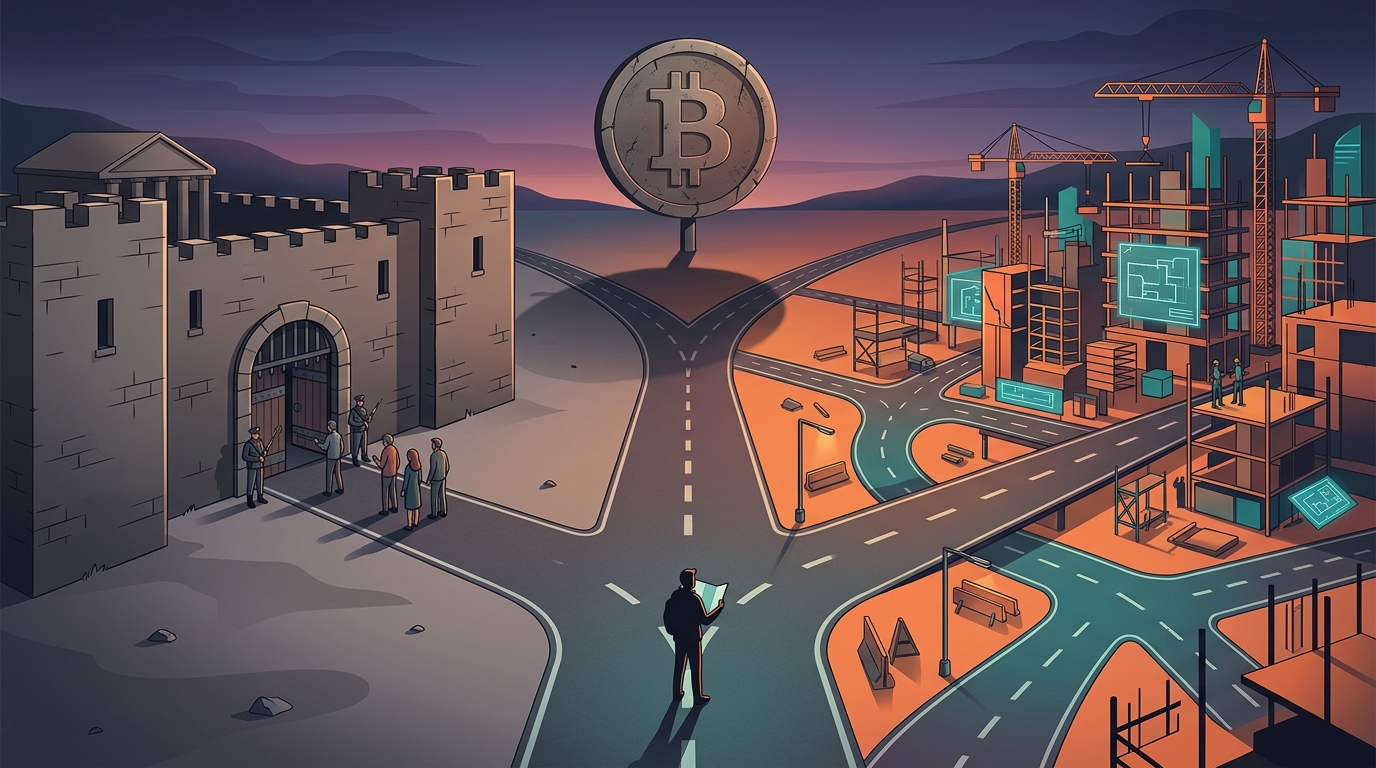
Two Bitcoin Forks, Two Philosophies: Blake2b Chain (BIP110) vs. eCash (BIP300)
The summer of 2026 produced something Bitcoin had not seen in years: two serious, irreconcilable attempts to leave the main chain, live within weeks of each other. On August 8, the BIP-110 "Reduced Data Temporary Softfork" enforced its rules at block 961,632, stalled after two blocks, and was reborn on September 1 as a Blake2b proof-of-work chain. On August 23, Paul Sztorc's eCash (ECX) hard fork activated its alpha phase at block 963,648, the first live deployment of BIP-300 drivechains in Bitcoin's seventeen year history.
Both forks were led by veteran Bitcoin developers with decade-long grievances against Bitcoin Core's direction. Both claimed to be saving Bitcoin. Both airdropped coins to every BTC holder at their fork heights. And they could not be more different, technically, philosophically, or temperamentally. One is a conservation project. The other is a construction project. Comparing them honestly, with praise and criticism assigned where each is due, is the best way to understand what each fork actually is, and what each is likely to become.
What each fork technically seeks to accomplish
BIP-110: the Reduced Data Temporary Softfork
BIP-110, formally the Reduced Data Temporary Softfork (RDTS), was authored by the pseudonymous Dathon Ohm with substantial advocacy from Luke Dashjr, maintainer of Bitcoin Knots. Its goal was subtractive: restrict arbitrary non-financial data at the consensus level. The rules capped most new transaction outputs at 34 bytes, OP_RETURN payloads at 83 bytes, and data pushes at 256 bytes, targeting Ordinals inscriptions, BRC-20 tokens, Runes, and large Taproot data payloads. The restrictions were designed to expire automatically after 52,416 blocks, roughly one year, a genuinely unusual design choice worth crediting: the authors were not asking for a permanent regime, only a temporary quarantine.
The proposal emerged as a direct response to Bitcoin Core v30 (October 2025), which relaxed the default OP_RETURN relay limits and was perceived by the "Bitcoin is money" camp as an invitation to spam. Supporters, including Matt Kratter and parts of the Knots node community, argued that unbounded data embedding bloats the chain, raises node operating costs, distorts fee incentives, and creates legal liability for node operators who unknowingly relay or store illicit content.
The activation mechanics were the aggressive part. BIP-110 used a modified BIP9 deployment requiring only 55% miner signaling instead of the conventional 95%, and if that threshold was not met, a mandatory signaling window opened at block 961,632 after which enforcing nodes would reject every block that failed to signal support through version bit 4. In effect, a minority of node operators, primarily Knots users, declared they would orphan the majority chain's blocks until the majority complied. This is the mechanism critics, including Adam Back, called technically defective and a fork by another name, and it behaved exactly as critics predicted.
When the mandate activated on August 8, roughly 2.53% of hashpower, all of it from Ocean pool, had signaled support. The enforcing chain mined two blocks and stalled for three weeks, inheriting Bitcoin's crushing SHA-256 difficulty with none of its hashpower. On August 10, Dashjr was removed as a BIP editor within 26 hours of a formal motion citing conflicts of interest, a removal he called an abuse of power. He took a sabbatical from Ocean, then separated from the company entirely by the end of August.
The resurrection came on September 1: the minority chain swapped its proof-of-work from SHA-256d to Blake2b (an algorithm Dashjr selected by random draw from a shortlist), reset its difficulty, shrank its block size to roughly 300 kB, and restarted block production. The Blake2b chain, which trades under tickers like BTCB2, is now a distinct network: CPU and GPU mineable, with a small but real solo mining community, a single notable exchange listing on Neoxa, and a price that has swung wildly between $100 and $1,500 on extremely thin liquidity. Supporters like Chris Guida frame it as a return to Bitcoin's roots: small blocks, commodity hardware, no reliance on KYC exchanges, and commerce in goods and services.
eCash: BIP-300 drivechains as a hard fork
eCash's goal is additive. BIP-300, written by Paul Sztorc and CryptAxe in 2017, introduces drivechains: sidechains pegged to the main chain at a fixed 1:1 rate, with deposits and withdrawals enforced by hashpower vote (the "hashrate escrow"), and BIP-301's blind merged mining, which lets miners earn sidechain fees without running sidechain software. The architecture has been public for a decade, refined through years of debate, and exhaustively documented at drivechain.info and in the BIP-300 CUSF paper.
The fork itself, announced in April 2026, is deliberately conservative everywhere except the one feature that matters. The eCash L1 is Bitcoin's consensus rules carried over wholesale: same supply schedule, same emission, same block template, an airdrop of 1 ECX per BTC at the fork block. The only material L1 changes are the addition of BIP-300/301 via the CUSF enforcer, opt-in replay protection implemented through an elegant trick (transactions with nLockTime 499,999,999 are treated as final on eCash but are unspendable on Bitcoin for millennia, letting users split coins with ordinary wallet software), and a staged launch: a practice alpha on August 23, a beta on September 20, and the permanent chain on October 31, the eighteenth birthday of the Bitcoin whitepaper.
The philosophy behind the design is laid out in Sztorc's sidechain vision and Derangements of Bitcoin: the L1 should ossify, blockspace should be small and expensive, and all experimentation, from large blocks to privacy to smart contracts to prediction markets, should happen on opt-in sidechains that pay fees back to L1 miners, eliminating the incentive to ever fork again. Seven sidechains are slated for launch day (Thunder, BitNames, BitAssets, Truthcoin, zSide, CoinShift, Photon, plus community chains like Elements+), each solving a problem that has historically driven users to altcoins.
The fork's most controversial design choice, and it deserves to be named plainly, is its funding mechanism. Roughly 500,000 coins attributed to Satoshi's "Patoshi pattern" addresses were reassigned at the fork: about 30,000 to founders and LayerTwo Labs employees, and the rest sold or being sold in funding rounds ($3 million in 2022, $5 million in early 2026). Supporters frame this as a one-time endowment that front-loads the work instead of taxing the chain forever, with Sztorc's full defense published as "Stealing Satoshi's Coins (you'll thank me later)". Critics, including some eCash community members, see a property rights violation that sets a corrosive precedent. Both readings are available in the record.
Approach and marketing: spectacle vs. stubbornness
The two forks could hardly differ more in how they present themselves to the world.
BIP-110's campaign was a moral crusade. The framing was existential ("If BIP110 fails, Bitcoin fails with it," Dashjr declared) and the enemy was specific: inscriptions, JPEGs, and the developers who tolerated them. The movement drew real energy from a perceived Core capitulation on OP_RETURN policy, from Knots node counts that at one point reached roughly a fifth of reachable nodes, and from endorsements by figures like Matt Kratter and Fred Krueger. But it also attracted damaging associations. The community's internal rhetoric fixated on the threat of illegal content on-chain, and critics, including Jameson Lopp, warned that the most likely way to prove that threat was for a supporter to plant it. The campaign's numbers also invited skepticism: when over ten thousand nodes suddenly appeared signaling support in March, Lopp posted the chart with the caption "Spot the Sybil Attack."
When the fork failed to attract miners, the pivot to Blake2b was technically pragmatic but rhetorically costly. A movement whose central argument was that Bitcoin's rules must not change had changed the most fundamental rule of all, the proof-of-work function, cutting itself off from the entire ASIC security base it claimed to defend. The chain's subsequent branding ("Bitcoin Blake2b," "BTC2," "Xbt") and Dashjr's continued insistence that the minority chain is the genuine Bitcoin have not helped its case with the broader market.
eCash's marketing has been slower, weirder, and more self-aware. There is no sacred enemy, only a pile of documented derangements (Lightning's limitations, the security budget, Core's governance monoculture, the custodial drift) and a proposed exit. The project's public layer mixes long-form essays, weekly Twitter Spaces, and Pete Rizzo interviews with an ecosystem that generates its own material: the alpha's live dashboard, a $10,000 creator contest, a Seinfeld AI parody, and a community that names its smallest unit the szat and its practice coins peesex. The asymmetry is deliberate. As Sztorc put it when asked why eCash's attention was a fraction of BIP-110's: "110 got so much attention because it was so bad. People wanted a front row seat to the train wreck." Whether one finds that answer satisfying or evasive is a fair dividing line between the forks' supporters.
To be fair to BIP-110: it understood narrative better than its critics admit. It identified a genuine grievance (Core's unilateral relay policy change), mobilized a real constituency around it, and kept its name in the conversation for months on a budget of approximately zero. Its failure was not a marketing failure; it was a legitimacy failure at the exact layer where Bitcoin actually decides things, the miners and the economic majority.
The philosophical divide: which problem is Bitcoin's?
Underneath the technical differences is a clean philosophical inversion, and this is the heart of the comparison.
BIP-110's diagnosis is that Bitcoin's problem is too much change. Core relaxed a relay rule, inscriptions flooded in, and the cure is to restore discipline: smaller data fields, smaller blocks, fewer use cases, back to money only. It is a philosophy of subtraction, and it has an honorable lineage in Bitcoin's small-block tradition. Its deepest assumption is that the community can and should define which fee-paying transactions are legitimate. Its critics answer, as Michael Saylor did, that invalidating currently valid, fee-paying transactions is the precedent that actually endangers Bitcoin, and as Adam Back argued, that a spam filter which does not even stop spam (inscription workarounds were demonstrated before activation) trades Bitcoin's credible neutrality for nothing.
eCash's diagnosis is the mirror image: Bitcoin's problem is not enough permitted change. Fifteen years of governance gridlock, a Lightning Network that never overcame its fundamental limitations, a security budget question with no answer, and a culture that drives builders to Ethereum or custodians. The cure is not to litigate which transactions are legitimate but to make the question obsolete: shrink the battlefield to a tiny, ossified L1 and let every faction build its own chain under one monetary roof. Where BIP-110 says the community must choose what Bitcoin is for, BIP-300 says the community never has to choose again, because drivechains let every answer coexist. Even its blocksize politics are inverted: Sztorc has argued for years that the L1 blocksize should shrink once activity moves to sidechains, which means the eCash camp contains people who agree with Dashjr about L1 restraint and disagree with him about literally everything else.
The forks also diverge on the meaning of miners. BIP-110's theory of governance was user-first: nodes declare rules and miners must follow, the UASF lineage of 2017. Its collapse is the strongest evidence yet that this theory no longer holds in 2026: nodes enforced, miners ignored, and the enforcing nodes simply froze. eCash's theory is unapologetically miner-first, miners are the economic engine and should be paid for every new use case, which is precisely why BIP-301 routes sidechain fees to them. Ironically, both forks ended up demonstrating the same lesson from opposite directions: hashpower is the constituency that cannot be skipped.
Survival odds: an honest assessment
The case for the Blake2b chain surviving rests on a few real assets. It has a committed community that has already demonstrated willingness to spend money on hashpower and hardware. CPU mining is a genuinely appealing on-ramp for hobbyists locked out of SHA-256, and early solo mining economics looked favorable. It has one exchange listing and a price, however illiquid, which is more than most minority forks ever achieve. And its underlying grievance, arbitrary data on the chain, is not going away; if inscriptions ever produce a genuine crisis, the Blake2b chain becomes the protest vote with an existing ticker.
The case against it is structural. Its PoW swap severed it from the security base that gives a Bitcoin fork its meaning, which is why even sympathetic observers treat it as a new altcoin rather than a Bitcoin continuation. Its liquidity is so thin that its celebrated prices are artifacts of single-digit order books. Its value proposition is negative (freedom from inscriptions) at a moment when the market prices things by what they enable, not what they exclude. And its leadership has absorbed severe blows: the BIP editor removal, the Ocean separation, and a community already showing early signs of the purity spirals that fractured Bitcoin Cash. Adam Back's epitaph, "live by the fork, die by the fork," captures the consensus view of its long-term ceiling: this cycle's Bitcoin Gold, a footnote with a ticker.
The case for eCash succeeding rests on different assets. Its L1 inherits Bitcoin's full SHA-256 compatibility, so it competes for, rather than abandons, the world's largest security budget. Its staged launch has produced real evidence of life: tens of thousands of blocks, multiple independent pools, community-proposed sidechains activated under proof of work within two weeks, a functioning market discovering a price for the coin in public, and an infrastructure layer (wallets, splitters, explorers, faucets) built largely by volunteers. Its narrative is constructive: it sells what Bitcoin could gain, not what it must purge. And its strategic position is genuinely hedged: if drivechains prove the fee model, even a modest success makes the "why not just do this on Bitcoin" question unavoidable for the industry.
The case against eCash is equally real and should not be softened. Its distribution is its largest liability: 97.5% of supply airdropped to Bitcoin holders, most of whom are indifferent or hostile and represent permanent sell pressure at every rally. The Satoshi coin reassignment, however defended, hands every future critic a ready-made attack. Awareness remains strikingly low outside its own community. The technology, while live, is young, and the drivechain fee loop is unproven at any meaningful scale. Its success depends on a coordination problem (miners must actually enforce and BMM sidechains) that the alpha has already shown is not automatic. And forks, as an asset class, have a brutal base rate: since 2017, nearly all of them have trended toward zero against the parent.
On balance, the two forks are not competing for the same future. The Blake2b chain's best realistic outcome is survival as a niche protest chain with a dedicated few hundred miners and a ticker that trades on the fringes, which is, to be fair, more than most forks achieve and a real form of persistence. eCash's outcome distribution is wider: it can fail completely if the fee loop does not materialize, but its ceiling is categorically different, because it is the only fork in years attempting to expand what Bitcoin can do rather than restrict it. The market's own signals, however early, lean the same way: eCash's practice coins have held an implied price near or above its presale valuation through genuine two-way trading, while BTCB2's price exists mostly as a curiosity of thin books. Survival belongs to the stubborn. Success, if it comes at all, will belong to the fork that gave people something new to build.
Conclusion
BIP-110 and eCash are best understood as answers to opposite questions. Dashjr's fork asks: how do we protect Bitcoin from what it has become? Sztorc's fork asks: how do we let Bitcoin become more without breaking what it is? One treats the base layer as a museum to be defended. The other treats it as a foundation to be built upon, carefully, with the foundation itself left untouched.
History offers a pattern, though not a verdict. Forks built on subtraction (Bitcoin Gold, Bitcoin SV, and their smaller cousins) have consistently faded as their single grievance lost salience. Forks and platforms built on permissionless addition (Ethereum most of all) captured entire industries, even when their critics were right about their flaws. The summer of 2026 gave Bitcoin both kinds, three weeks apart. The next two years will show whether the pattern holds, and on October 31, when eCash's permanent chain activates on the whitepaper's eighteenth birthday, the experiment stops being a rehearsal.
Whichever fork one roots for, the season has already clarified something valuable: Bitcoin's civil wars are no longer fought only over the past. They are fought over who gets to build the future, and how.