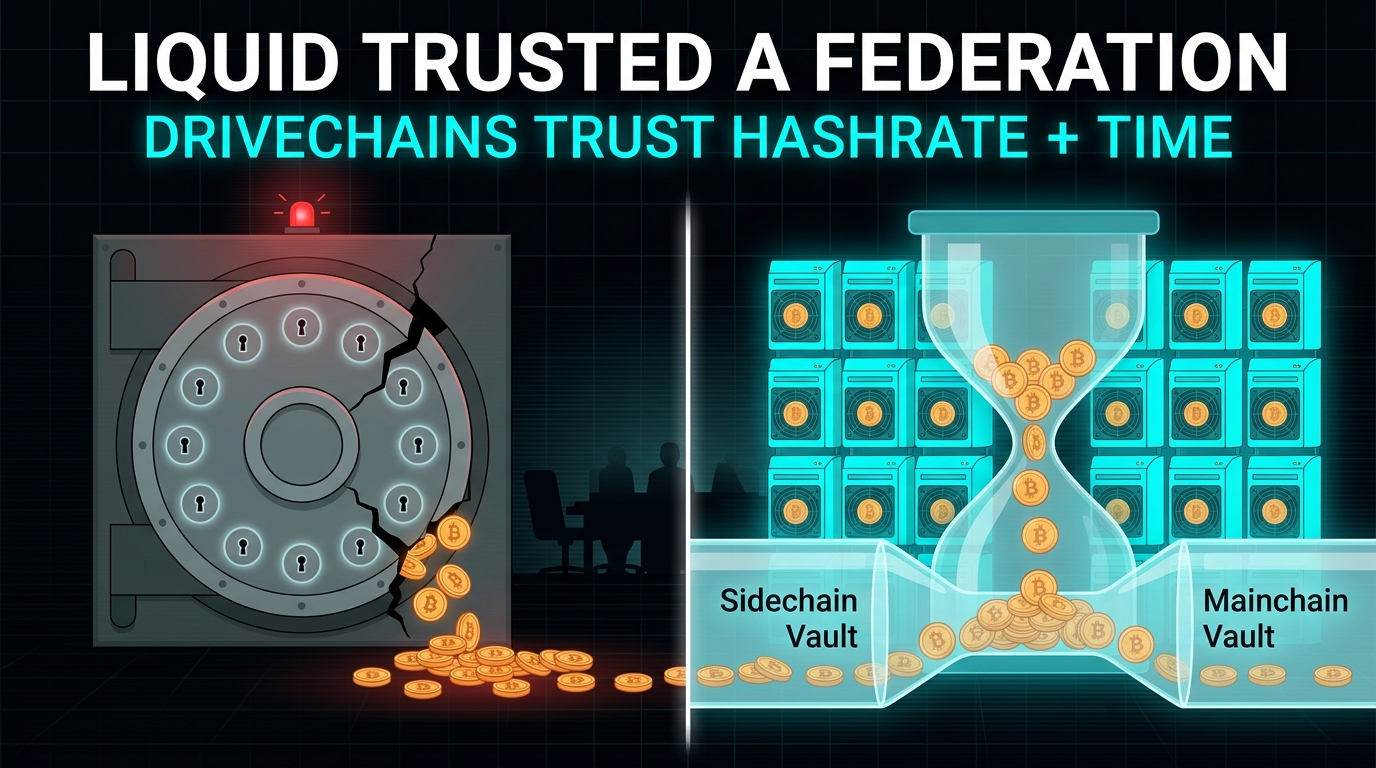
Liquid Trusted a Federation. Drivechains Trust Hashrate and Time
On September 6, 2026, roughly 4,000 BTC, worth about $319 million, moved out of the Liquid Network's peg wallet in a transaction the federation never meant to sign. ErgoBTC flagged the pegout in real time, along with an on-chain message from the perpetrators: "we are whitehats. contact us on chain." Liquid's official account confirmed the incident, Blockstream paused the chain, and the largest "Bitcoin sidechain" in production spent the weekend negotiating with its own attacker through OP_RETURN messages.
The technical post-mortem, assembled publicly by developers like stu and others, is worse than the headline number. Liquid's confidential transactions rely on rangeproofs to prove that outputs are non-negative without revealing amounts. A validation caching bug allowed a malformed rangeproof to pass on unpatched nodes.
The fix had been committed on August 3. It was never shipped to the functionaries. When the crafted transaction propagated, patched infrastructure (including the mempool.space explorer) rejected it while the federation's own signing nodes accepted it, producing a consensus split and, ultimately, a valid-looking pegout of other people's Bitcoin.
This is exactly the failure mode we warned about in Federations Are Not Decentralization. The question that matters for any peg is simple: what mechanically prevents the operators from taking the funds? For Liquid, the answer was fifteen hardware security modules, a patch release schedule, and the good judgment of a committee. All three failed at once, quietly, and invisibly. Because amounts on Liquid are confidential, the public could not even audit the peg's integrity from outside. You had to trust the signers to tell you they had been robbed, which they did, after the coins were gone.
How a BIP-300 Drivechain Peg Works Instead
Drivechains replace the committee with the mining process itself. When you deposit into a drivechain, your coins sit in a publicly visible escrow output (the "CTIP") that no person holds keys to. Getting them out requires a withdrawal bundle: a proposed set of pegouts that miners vote on, block by block, for thousands of consecutive blocks. On Bitcoin the full period spans 13,150 blocks, roughly three months. Every block either advances the bundle or votes it down. The whole process is observable by anyone running the open-source BIP-300/301 enforcer, and miners are paid for participation through sidechain fees via blind merge mining, so honesty is not a favor, it is the profitable default.
The security property here is not that theft is impossible. It is that theft is slow, public, and contestable. A malicious withdrawal would have to accumulate miner approvals in the open for months while every user, explorer, and competing pool watched it happen.
The Honest Risks of Drivechain Withdrawals
In order to remain honest, we need to say the uncomfortable parts out loud.
First, a majority of hashrate could, in principle, approve a bad withdrawal. That is the "miners can steal" critique, and it is technically true, the same way a 51% attack on Bitcoin is technically true. The defense is economic and social: miners who steal forfeit the fee stream that made the sidechain worth mining, torch the value of the coin they are paid in, and give the user base months of lead time to coordinate a rejection. On eCash, where ECX is the asset miners earn, the incentive to protect the escrow is direct.
Second, the current software is young. On the alphanet test chain, voting parameters are shortened (144 blocks), enforcers acknowledge withdrawal bundles by default, and there is no mature oracle infrastructure yet to help miners distinguish good bundles from bad ones. LayerTwo Labs developers have been publicly blunt that on testnet today, proposing a theft is trivially easy. That is what testnets are for, and the alpha period is precisely the window to build the watchers, explorers, and alerting tools that mainnet will need.
Third, the months-long pegout is a genuine cost. Most users will not wait three months; they will pay a liquidity provider for a fast withdrawal, which reintroduces a trusted intermediary. The difference is that intermediation becomes a convenience layered on top of a trust-minimized exit, not the foundation of the system itself. You can always walk the slow, sovereign path.
Why the Difference Is Structural
A federation fails in secret and all at once. A drivechain can only fail in public and in slow motion. Liquid's committee could be compromised without a single outsider noticing, and confidential amounts guaranteed that nobody could verify the books. On a drivechain, the escrow, the deposits, and every vote on every withdrawal are on a transparent ledger that anyone can parse. When Paul Sztorc called Liquid one of Bitcoin's worst ideas years before this incident, the argument was never that Blockstream's engineers were careless. It was that the architecture asks them to be perfect forever, while offering users no way to check.
Three Takeaways for Miners and Holders
-
Miners: the escrow is your revenue stream. Sidechain fees only flow to you if users trust the peg. Running the enforcer, examining withdrawal bundles, and voting honestly is not governance theater; it is the job description of a BIP-300 miner. Pools that build this muscle now will be the ones users route deposits through later.
-
Holders: demand a mechanical answer to "what stops theft?" If the answer involves named companies, hardware modules, or a patch queue, you are a depositor, not a user. Prefer systems where you can audit the supply and watch the exit door yourself.
-
Everyone: treat withdrawal time as a feature. The three-month window is the security model. If you use a drivechain, learn to read bundle voting on an explorer, and support the tooling (public sidechain explorers, ack/nack alerting, watchtower services) that makes the window meaningful. eCash mainnet launches October 31, and the infrastructure built during the alpha is what will make ECX's peg worth trusting.