From eCash Beta to the ECX Main Net Launch: Drivechains Become a Reality
The last Bitcoin block before eCash took about two hours to arrive. On a network that averages ten minutes per block, that is a long, awkward silence, and it played out in front of a Telegram group full of people refreshing block explorers and waiting for block 973,727 to finally get mined.
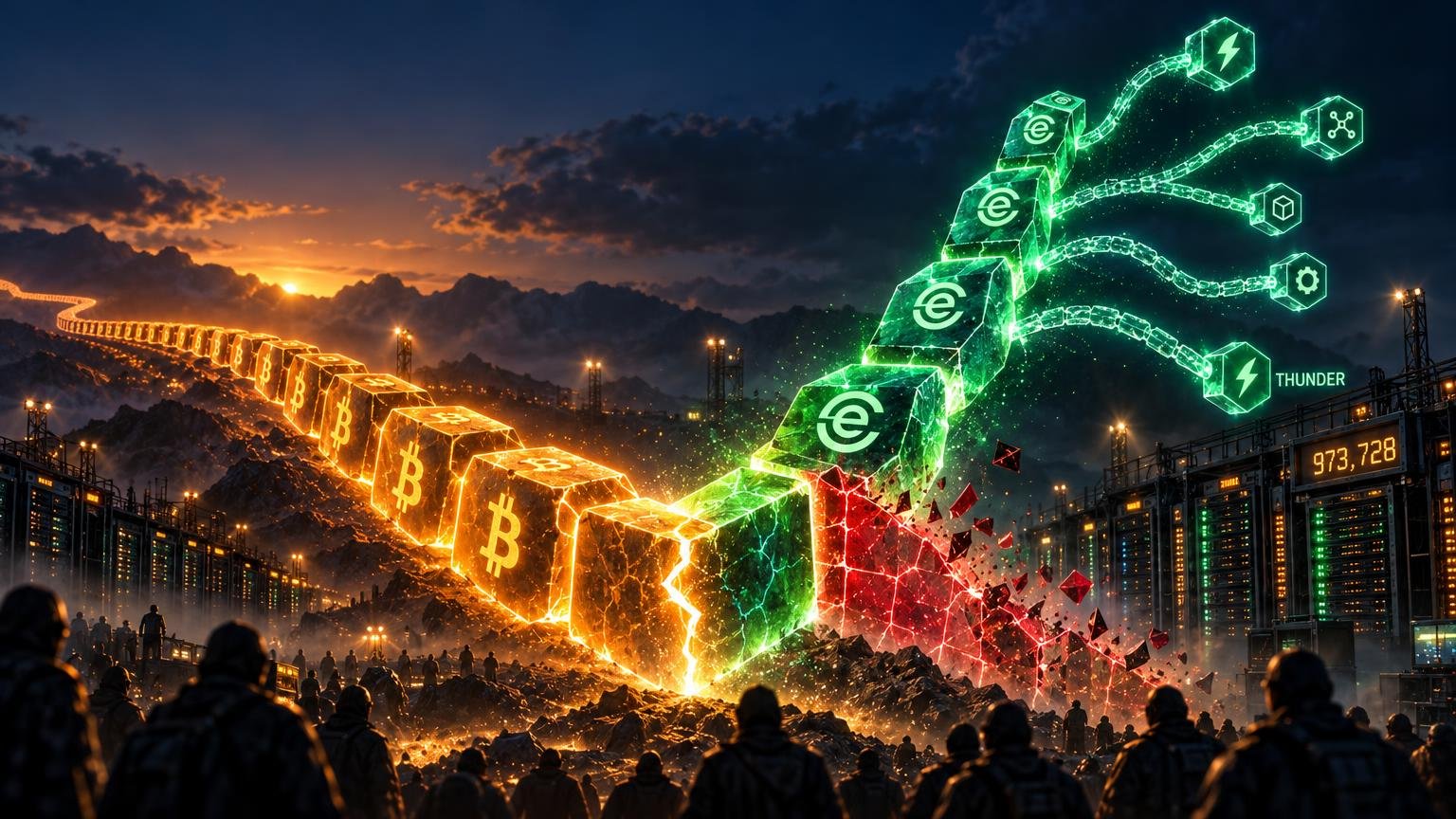
When it finally did, the fork followed. At around 19:00 UTC on October 29, Bitcoin split at block 973,728 and eCash (ECX) stopped being a beta, a roadmap and a controversy. It became a chain with its own coins and its own price, in the hands of people with no stake in the project's internal debates.
The day that followed was not the one anyone had planned. Every sidechain proposal failed on its first attempt. A single miner blocked the drivechain experiment for about four hours, and the man who later claimed responsibility said he had done it because he thought it was funny. Then the blockade lifted and five sidechains activated in close succession. Along the way the official explorer went down, the mobile wallet broke and the drivechain enforcer crashed, while the largest crypto hack on record unfolded the same afternoon and took the news cycle with it.
The Last Weeks of the Rehearsal
The previous dispatch on this blog ended on October 10, with the beta three weeks old, eight sidechains running and a difficulty dispute that would not go away. The final three weeks of the rehearsal were less dramatic and, in hindsight, more revealing.
The market arrived first. On October 12 the project confirmed an official wrapped token on Solana, wECX, with a liquidity pool on Orca. It opened around $10, and a sister token for beta coins, wbECX, started at $1. Paul Sztorc, the drivechain inventor who leads LayerTwo Labs, later conceded in the community chat that starting them at $1 and $10 "was probably a mistake" because of anchor bias. The early liquidity providers multiplied their stake many times over. According to GeckoTerminal, wECX touched an intraday high of about $162 on October 21. A chart like that attracts tourists, and it did. One newcomer launched a memecoin paired against wrapped beta coins, prompting a long overnight quarrel in which Serious Cat repeatedly called it an affinity scam.
The chain itself was struggling more than the chart suggested. Beta difficulty had overshot to 10G, and at one point the network went 83 minutes without a block. Hashrate on a small SHA-256 chain behaves like a mercenary: it floods in when blocks are cheap and vanishes when they get expensive. Community members had been pressing for a faster difficulty adjustment for weeks. An ASERT pull request had been open since September 22 and was never merged. Sztorc's stated reason, as quoted there, was that "there's probably something terrible about it that we haven't discovered yet."
Instead, a commit titled "Add 288-block dampened retarget after eCash fork" landed late on October 26, about three days before the fork. Every 288 blocks, the new target is six parts old target to one part measured, and difficulty can rise at most 12% and fall at most 30% per window. Starting difficulty was set at 2.6G. In the chat, Sztorc acknowledged that Satoshi's calculation is a poor fit for a chain like this and called the change regrettable but necessary. The candor was welcome. The timing was harder to defend: a consensus rule governing issuance was changed with about 72 hours to spare.
Much of the testing burden fell on volunteers. krile, one of the most persistent testers in the group, reported on October 16 that zSide was finally producing blocks and on October 19 that shielding worked, asking why there had been no announcement. On October 21 he posted a blunt review: the Bitwindow and sidechain interfaces felt "pre-alpha-ish" with mainnet about a week away. Sztorc answered with a line that became a kind of motto. There will always be a pile of stuff that works, a pile that barely works, a pile that is mostly broken and a pile that does not work at all yet, and "that is a pretty healthy situation I think." Whether that reads as realism or as a description of the problem depends on which pile a given user's coins happen to be in.
The most visible building came from outside LayerTwo Labs. Michael Blowes set up easynet, a proof-of-work test network for when the beta was too slow. Lewis built Flush, a fast token and DEX chain with 15-second blocks, which BlockFab introduced on October 28. Andrés kept working on SideBoost, a merged-mined sidechain with ten-second blocks based on Namecoin's code, and by launch eve had a version running in beta slot 83. JK maintained Elements+.
On exchanges, Sztorc took a hard line. On October 24 he told the chat that exchanges had asked for $100,000 to $200,000 or more to list ECX and that he had declined, arguing that the wrap and unwrap path was "something that ECX supporters can control." On October 28 he posted an Exchange PSA warning exchanges to split their coins or risk losing ECX to transaction replay, adding that he had explained this more than six months earlier and questioning how much sympathy they deserved. Replay protection on eCash is opt-in, which is why Crypto Finance published a disclosure on October 26 describing a cross-network replay risk and how to mitigate it, one of the few signs of an institution treating the fork as an operational matter.
Small holders, meanwhile, scrambled to make their beta coins count. Burning beta coins earns real ECX, but the 1,000-coin minimum left many people out, so community members including krile and podcaster Vlad Costea pooled coins from small holders and burned them in bulk. Vlad's pool, more than 2,300 coins, was burned in the early hours of October 29. As of launch morning, LayerTwo Labs had not yet paid out beta burns, with Sztorc estimating one to two days to collect and double check the totals.
Launch Day: Four Hours Under Veto
Block 973,728 arrived around 19:00 UTC. Minutes later the official @BTCdrivechains account posted its launch message: "Seven sidechains launch on day one. If one fails, L1 doesn't notice." Within about an hour, the first part of that sentence was in trouble.
The first proposal was Thunder, LayerTwo Labs' payment sidechain, in slot 9, included at block 973,786. FreeBank in slot 130 followed, then Flush in 46, Tally in 131 and Elements+ in 24. Between roughly 20:09 and 21:30 UTC, all five failed.
The arithmetic explains why. Under BIP300, a new sidechain slot needs more than 1,815 approvals in 2,016 blocks, or 90.1%. A miner producing just over 10% of blocks and voting no can therefore sink every proposal for as long as it keeps mining. On launch day, blocks mined under the name of Skydoge, a Dogecoin fork that also implements BIP300, were voting no. Michael Blowes estimated that miner at more than 15% of hashrate. People representing Skydoge in the group denied involvement, one of them noting that they were "quite broke." Lewis believed the obstruction was deliberate. The Skydoge X account spent the evening demanding payment for 65 alpha-network burners and later posted that ECX had "LOST 50% on launch."
Hours after the blockade ended, Coinholio, a regular in the chat, claimed responsibility. He wrote that he did not care about Skydoge and had simply thought it was funny, apologized for delaying the proposals, said he had not realized the threshold was 90%, and added that he did not trust running the enforcer at those block speeds. He also embraced the "gay bear" nickname the mystery miner had picked up, saying he still wanted eCash to succeed. His account cannot be independently verified and should be treated as a claim. If accurate, the first drivechain veto exercised in the wild was a prank by a member of the project's own community.
The veto was not the only problem. Because blocks were arriving every few seconds, the enforcer could not drop stale blind merged mining bids fast enough, so bids stuck and no merged mining took place. Enforcer v1.0.1 also crashed its block template server with an "Amount subtraction error" when the mempool filled in a burst, which Lewis attributed to replayed Bitcoin transactions. The official explorer, the buy page and the releases site went down under load, and Sztorc pointed users to releases.drivechain.info. The Android wallet's 1.4.6 release had a bug that its developer, Jacob, fixed in 1.4.7. Braiins paused its hashrate market and blacklisted pools that were issuing new jobs too quickly, and Lewis's ePool saw most of its early blocks orphaned. Two capped +12% retargets hit at blocks 974,016 and 974,304.
At 22:22 UTC Damian Saturn published a write-up whose headline point was that eCash had launched without a single drivechain activating. Around 22:42 UTC Michael Blowes reported that the Skydoge-named miner had stopped, although Nurserypool was still voting no. Lewis and ⚡️Wired4ncer⚡️ had resubmitted proposals. At 23:18 UTC Lewis posted "FLUSH & THUNDER ACTIVATED!" Tally followed two minutes later and FreeBank within the hour, with Michael Blowes thanking Lewis and the miners and noting that at least two miners had tried to shut the proposals down. Elements+ followed. "I proposed them, miners mined them," Lewis said, which is a fair summary of how drivechains are meant to work.
The day-one tally, then: five sidechains activated about four hours after the fork, each after failing its first vote. Thunder was the only LayerTwo Labs chain among them. zSide, BitNames, BitAssets, Truthcoin, Photon and CoinShift, the LayerTwo Labs chains that had run on the beta, were not proposed on day one. Marcus summed it up: the community's drivechains arrived before LayerTwo Labs' own.
The overnight repairs came largely from the same community. Michael Blowes traced the enforcer crash to a fee-accounting underflow introduced in an earlier commit and opened a fix as PR #139. eSTAMPS went live on the base layer at ecx.stampchain.io. The next morning Sztorc said quite a few things had crashed because of the superfast blocks and that he expected them to return over the next 24 to 48 hours. He also admitted he had half expected to discover that every device he owned had been keylogged and every key and login compromised, and had been braced for the worst. His public verdict was brief: "Wild day! Turns out, ECX was more popular (with miners) than I'd thought.." krile was more generous, saying it had all gone smoothly, with no catastrophic crash, and that the community should be proud.
The launch also had bad luck. The same day, Binance suffered the largest crypto hack on record, roughly $6.3 billion, with Circle and Tether freezing funds and about $3 billion locked up. krile joked that Binance stole eCash's thunder. Sztorc remarked that Binance would simply absorb a multi-billion dollar loss, calling it economics over cybersecurity. The fork landed in near silence. The X post for Pete Rizzo's stream, "ECASH OFFICIALLY FORKS | Bitcoin Sidechains Are FINALLY Live", showed about 5,300 views the next morning, and the post for the official countdown stream about 7,700. Penia, a miner in the group, lamented the lack of content and hype, and that Binance news had drowned out the launch.
Measured Against the Forks That Came Before
The figures below are snapshots taken between 08:18 and 08:42 UTC on October 30. None is a market capitalization in the aggregator sense: CoinMarketCap and CoinGecko still list ECX only as a preview page with no price.
Native ECX trades against USDC on Neoxa. The first print was $500, and the first hour ranged from roughly $36 to $86 before the price slid as miners sold. At 08:41 UTC the last trade was $16.01, essentially the 24-hour low of $15.50, with a $16.02 bid against a $32 ask. About 2,200 ECX had traded, roughly $109,000 across 379 trades. Wrapped ECX on Orca stood near $71, down about 41% in 24 hours from a fork-day high of about $128, with about $274,000 in daily volume and $634,000 in liquidity. Wrapped coins cannot yet be redeemed for native ECX, so the gap between the two prices reflects a bet on the bridge rather than an arbitrage. Felix Ha, who said he had been buying on Neoxa for hours, put native ECX at 20% to 40% below wECX overnight. The gap has since widened considerably.
With Bitcoin near $78,000, a $16 ECX is about 0.02% of the Bitcoin price. The eCash dashboard multiplies the wrapped price by 20 million coins for an implied value of about $1.42 billion, around 53rd place. The native price implies roughly $320 million. Both come from thin markets.
Bitcoin Cash remains the benchmark for a Bitcoin split. On CoinMarketCap's snapshot for August 2, 2017, BCH traded at $452.66 against Bitcoin's $2,710.67, about 16.7% of the Bitcoin price, with a $7.46 billion market cap and third place in the rankings. Today it trades near $283, with a $5.69 billion market cap. Measured relative to Bitcoin at launch, native ECX sits at well under a tenth of a percent of where BCH started. BCH had large miners, big-block advocates and major exchanges behind it from the outset, so the comparison is harsh, but it is the relevant one.
Bitcoin Gold is the closer analogue, a developer-led fork with an allocation controversy. Its futures fell 66% to $161 before launch, and when mainnet went live on November 12, 2017, it traded between $250 and $275 with 18 exchanges on board and a 100,000-coin endowment for its team. BTG now trades for about 23 cents. Bitcoin SV split from Bitcoin Cash in November 2018 after a hash war that pitted roughly 8.9 EH/s against 3.5 EH/s, and now trades around $17 with a $342 million market cap. At its native price, ECX is now valued in roughly the same range as BSV.
The most recent comparison is the kindest. BIP110, the reduced-data fork the chat calls LukeCoin, split in August and became the fork that mined two blocks and stopped, reviving weeks later only after changing its proof-of-work. Sztorc described eCash's launch as yet another case of being the opposite of LukeCoin. On the narrow question of whether the chain keeps moving, the record supports him.
Hashrate was the surprise. It peaked around 12 to 13 EH/s, which Tomas Povilaitis put at about 1.3% of Bitcoin's. By 08:18 UTC the BlockFab explorer showed about 6.1 EH/s against Bitcoin's roughly 1,045, about 0.6%. By a Coin Dance reading in September, Bitcoin Cash runs at about a third of a percent of Bitcoin's difficulty, which makes Marcus's claim that ECX briefly had double BCH's hashrate plausible. But cheap hashrate is not committed hashrate. Between the fork and 08:18 UTC the chain produced about 6,767 blocks in 13.3 hours, roughly 47 days of issuance at ten-minute blocks, or around 21,000 new ECX. Difficulty climbed from 2.6G to 35.2G one capped 12% step at a time, and blocks were still arriving about every 29 seconds. The Skydoge account put it bluntly: ECX was popular because it gave away 41 days of emission in eight hours. Joe, in the chat, offered a milder version: whatever the merits of ASERT, the real problem was the low starting difficulty, "so we made skydoge rich." The new rule prevented another 83-minute stall. It did not prevent a gold rush, and much of that newly mined supply is what has been hitting the Neoxa order book.
The Shortcomings and the Signal
The money is the obvious starting point. LayerTwo Labs raised a $3 million seed round in December 2022, and a further $5 million round closed in 2026. According to the investment details document, that round bought 160,000 ECX plus 2.53% of the company, which puts the price at no more than $31.25 per coin if the equity is valued at zero. Native ECX is now trading at roughly half that. The same document planned the fork for June or July 2026; it moved to August, then to October 31, and finally arrived on October 29 because Bitcoin blocks came in quickly. Sztorc has worked on drivechains since 2015.
Against that budget and timeline, several shortcomings stand out. LayerTwo Labs' own chains were largely missing on day one: one activated, carried over the line by community proposers and miners, while six that ran on the beta were not proposed. The official explorer, buy page and releases site failed on the day of peak attention. The mobile wallet shipped with a bug. The enforcer, the software at the heart of the drivechain design, crashed under a burst of replayed transactions, and the first proposed fix came from a community developer. The difficulty algorithm was replaced three days before launch after a more studied proposal sat unmerged for five weeks. Withdrawal parameters were still under discussion, with Sztorc saying the final version would use one-month and two-month windows instead of three and six. Alpha-network burners were publicly demanding payment, and beta burners were still waiting for totals.
Distribution was thin. TokenPost reported that bitFlyer would neither list nor credit ECX and that Coincheck had no plans, while bitbank suspended Bitcoin deposits and withdrawals around the fork. Sztorc's refusal to pay listing fees is defensible on principle, but it left a single small exchange as the only native market. The official YouTube channel's interview videos have a few hundred views each, and the launch streams drew a few thousand. Some of that was the Binance hack. Much of it reflects communication gaps that krile and others had flagged for weeks.
Critics were vocal. On X, one reply to the launch post called it "another scam", and another critic labeled it an "eTrash bitcoin affinity scam." Another user questioned why withdrawals should depend on miner votes at all, the oldest objection to BIP300 and one that still lacks a widely persuasive public answer. The decision to reassign roughly 600,000 coins from Satoshi-era addresses remains the most contested design choice among ordinary Bitcoin holders.
The other side of the ledger is just as concrete. The chain works. It forked at the scheduled height, has produced thousands of blocks, absorbed a hashrate surge above 1% of Bitcoin's, and Sztorc's feared security disaster did not materialize. The veto, the most criticized feature of BIP300, was exercised on day one in full public view, and the system recovered within four hours without a hard fork, an emergency patch or any central coordinator. Critics have long warned that miners would capture drivechains. On launch day, one miner tried, and the others overrode him simply by continuing to mine.
Apart from Thunder, every sidechain that activated was built by people outside LayerTwo Labs. Flush, FreeBank, Tally and Elements+ came from the community, Lewis did the proposing, and Andrés has SideBoost waiting. The launch post contrasted the old model of lobbying for a soft fork with the new one of simply building, and on October 29 that contrast was visible on-chain.
There are markets, however shallow. Neoxa produced a native order book with six figures of volume on day one. CoinW committed to crediting holders 1:1, GMO Coin published distribution plans, Tria added wallet support, and SideShift listed wECX on October 27. Bitcoin Gold launched with 18 exchanges and a price above $250 and still faded to cents, which suggests that listings alone do not determine a fork's fate.
The community, despite its quarrels, carried the launch. krile filed bug reports for weeks. Michael Blowes wrote the enforcer fix. Lewis proposed other people's chains. Even Serious Cat, who had left the group, returned to clarify that he had not quit anything, only stopped hanging out with everyone.
On the morning after, eCash is a live Bitcoin fork with real if transient hashrate, five activated sidechains (most of which have yet to produce a block), one native market, one wrapped market, a list of broken websites and a founder who says he expected worse. The next 12% difficulty step is due at block 980,640. Beta burn payouts are expected within a day or two. The rest of LayerTwo Labs' sidechains will come whenever someone proposes them. The price will be shaped for now by miners selling weeks' worth of issuance mined in a single night.
For years the question about drivechains was when they would be real. On October 29 they became real, and the first thing that happened was a veto. The second was that miners routed around it. For anyone weighing whether the experiment deserves attention, those four hours say more than the price chart.