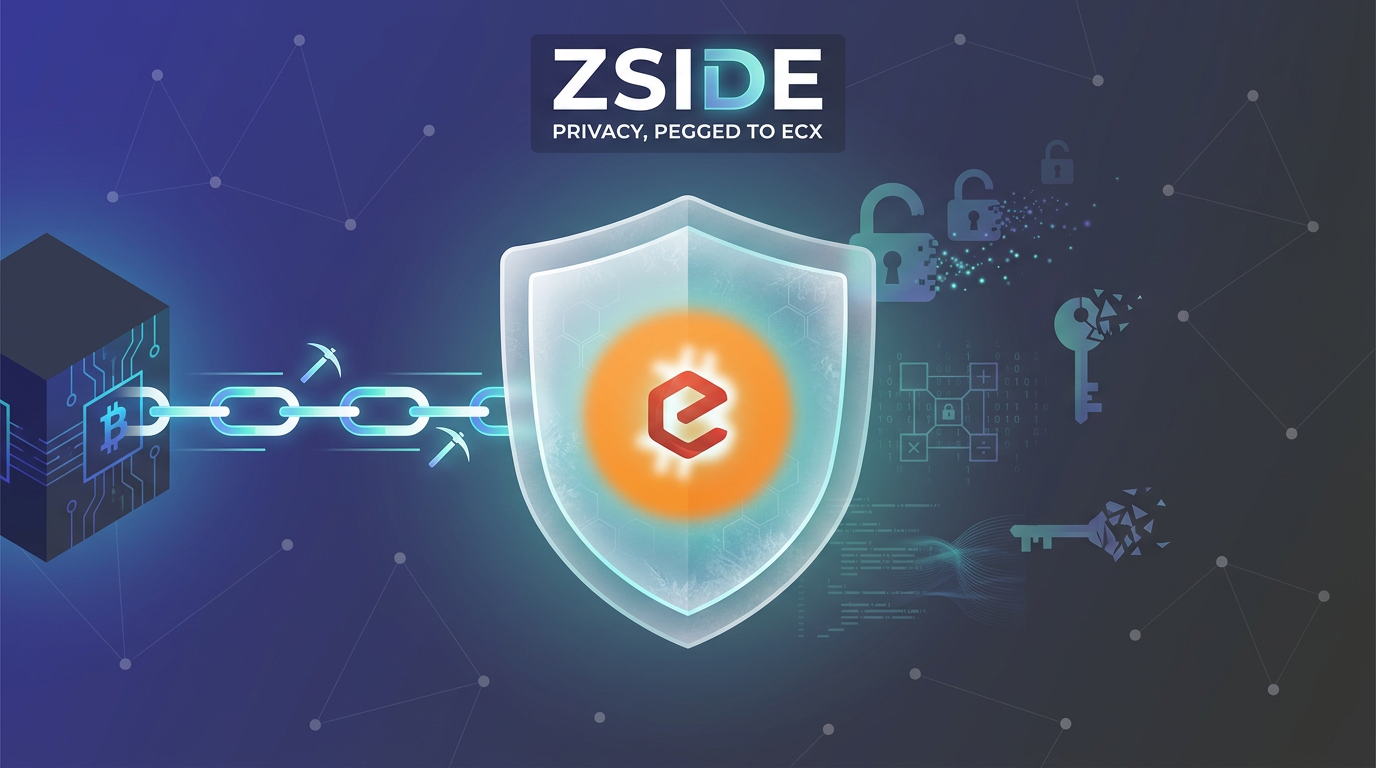
zSide: Zcash-Grade Privacy, Pegged to Ecash Instead of Its Own Coin
This is the second piece in our series covering the seven BIP-300 sidechains launching alongside the eCash hard fork on August 21, 2026. The first covered Thunder, the high-throughput payments chain. Here we look at zSide, the privacy sidechain.
Of the seven sidechains launching at block height 964000, zSide is the one most likely to make privacy advocates and Bitcoin maximalists uncomfortable at the same time. It is a shielded-transaction sidechain modeled on Zcash, built by LayerTwo-Labs, with its code developed under the repository name zebra. It is listed as live and ready for launch day. The premise is simple and, depending on your priors, either heretical or overdue: take the strongest privacy technology in the cryptocurrency world and let it operate on Bitcoin-descended money, without asking anyone to buy a separate privacy coin.
What zSide Actually Is
zSide is a drivechain, which means it inherits the two mechanisms at the heart of BIP-300 and BIP-301: hashrate escrow and blind merge mining. Coins move onto zSide through the drivechain peg, where they become shielded-capable units on the sidechain, and they move back to the main chain through the same slow, miner-supervised withdrawal process that governs every drivechain. On the sidechain itself, users get the kind of cryptographic shielding that Zcash pioneered: the ability to transact without broadcasting sender, receiver, and amount to the entire world.
The distinction that matters is what is being kept private. On zSide, the asset being shielded is pegged to Bitcoin's monetary base, not to a freshly minted token with its own inflation schedule and its own market capitalization. This is the entire pitch, and it is worth stating plainly rather than dressing up.
Why zSide Exists: The Privacy Gap Sztorc Has Long Complained About
Paul Sztorc's argument for drivechains, laid out for years on drivechain.info and in interviews, has been consistent. Bitcoin became conservative and slow to innovate, so functionality that could have lived on Bitcoin instead fled to altcoins. Privacy is the clearest example. Bitcoin's base layer is transparent by design, and the people who tried to add practical privacy to it have generally not fared well.
That last point stopped being abstract on the July 8 eCash Space. Much of that call was devoted to the Free Samourai campaign, an effort to win a pardon for the Samurai Wallet developers, who shipped a free CoinJoin-based privacy tool and were prosecuted for unlicensed money transmission. As one participant put it, Bitcoin's privacy culture effectively collapsed when the Samurai developers were arrested and Wasabi subsequently shut down, leaving what he called "Saylorism" as the dominant ideology. Whatever one thinks of that framing, the practical reality is that bolt-on Bitcoin privacy tools have repeatedly been shut down or driven offline.
zSide is a bet that the more durable path is to move privacy off the base layer entirely, onto a sidechain where shielded transactions are native rather than grafted on, while keeping the underlying value pegged to Ecash (ECX). Notably, Sztorc himself is skeptical that older mixing techniques were ever very good. On that same July 8 call he remarked that he does not "even think CoinJoin is a good privacy feature at all." That skepticism is consistent with choosing the Zcash shielded model over a Bitcoin mixing approach for zSide.
Who Should Use zSide
zSide is aimed at anyone whose threat model requires that transaction details not be permanently public, but who does not want to exit the Bitcoin ecosystem to get it. In practice that includes several groups:
- People in extractive social or family environments, the exact situation Sztorc described with the Cameroon anecdote on the July 8 call, where simply being known to have money invites a stream of demands. Confidentiality of balances is the feature, and people will pay for it.
- Businesses that cannot broadcast their supplier and payroll flows to competitors, which is a normal commercial requirement, not an exotic one.
- Individuals in jurisdictions with weak financial-privacy protections, where a transparent ledger is a personal safety problem rather than a compliance abstraction.
- Bitcoin (and Ecash) holders who want optional privacy for specific transactions without converting to and holding a separate volatile privacy coin.
It is worth being honest about the other side. Shielded transaction systems attract regulatory scrutiny, and the eCash project's own community is openly aware that privacy tooling carries legal risk. Anyone using zSide should understand that the regulatory environment for privacy technology in 2026 remains hostile, which is the entire reason the Free Samurai campaign exists.
Why zSide Is Positioned as Better Than Zcash
The claim is not that zSide's cryptography is superior to Zcash's. It borrows Zcash's model. The claim is about economic structure and network effect, and it rests on the standard drivechain critique of altcoins.
Zcash requires its own coin, ZEC, with its own issuance, its own security budget, and its own market to defend. A privacy coin's usefulness depends on its liquidity and its user base, and a coin that trades thinly is both a worse medium of exchange and a weaker anonymity set.
Paul Sztorc's long-running thesis, described in the Bitfinex overview of drivechains, is that in a drivechain world you would not need thousands of separate altcoins each bootstrapping its own coin and its own security. You would have Bitcoin, with each unique feature living on a sidechain that is merge-mined by Bitcoin miners and denominated in Bitcoin-pegged value.
Applied to zSide, the argument runs like this:
No separate token to buy or trust. Users get privacy on Bitcoin-airdropped funds rather than on a distinct asset with its own risk profile.
Security inherited through merge mining. zSide does not need to attract its own independent hashrate to avoid being cheaply attacked. It is blind merge mined by the same SHA-256 miners securing the main chain.
A potentially larger anonymity set. The privacy of any shielded system improves with the number of users. A privacy chain pegged to a large monetary base has a structurally larger pool of potential participants than a standalone coin ranked far down the market cap tables.
That is the steelman. The honest counterpoint is that Zcash has a running network, years of cryptographic auditing, exchange listings, and a research community, while zSide is a new sidechain launching on fork day. Live code is not the same as battle-tested code, and the eCash project has been candid about this, running weekly signet dry runs and multiple bug hunts precisely because launch-day software tends to break. zSide's advantage is structural and economic; its disadvantage is that it is new.
Why zSide Is a Big Deal
The significance of zSide is not that another privacy option exists. It is the demonstration that Bitcoin-grade money can carry Zcash-grade privacy without a hard fork of Bitcoin itself and without minting a new coin. If BIP-300 and BIP-301 work as designed, privacy becomes a feature you opt into on a sidechain rather than a separate ecosystem you have to migrate to. That reframing is the whole drivechain thesis in miniature.
There is also a strong contrarian current worth flagging for readers, because the eCash community does not speak with one voice on this. On the July 8 Space, one participant delivered an unprompted broadside against Zcash, arguing that "if you really want privacy you should just mix bitcoin" and that shielded systems amount to hiding in a "black box."
He later admitted he was mostly trolling an absent listener who is a Zcash fan. But the underlying tension is real and predates the joke: there is a genuine disagreement in the space between people who believe transparent ledgers with optional mixing are sufficient and people who believe native shielding is necessary. zSide plants a flag firmly in the second camp while keeping its feet in Bitcoin.
There is one more irony the July 8 call surfaced, and it is worth sitting with. Curtis Green, the Silk Road figure who was framed by corrupt federal agents for stealing Bitcoin, said flatly that "the blockchain saved my ass," because the transparent, immutable ledger proved where the stolen coins actually went and helped exonerate him. Transparency has genuine uses, including protecting the innocent.
A mature privacy tool has to acknowledge that trade-off rather than pretend it away. zSide's answer is that privacy should be optional and user-controlled, coins move onto the shielded chain when a user wants confidentiality and settle back to the transparent main chain otherwise, rather than forced on everyone or banned for everyone.
That optionality, pegged to Bitcoin and secured by Bitcoin's miners, is what makes zSide more than just "Zcash again." Whether the market agrees will not be settled by argument. As Sztorc put it in a different context on that same call, projects "will probably succeed or fail on their own merits." zSide is about to become a live test of whether Bitcoin-denominated privacy can win where standalone privacy coins have struggled.