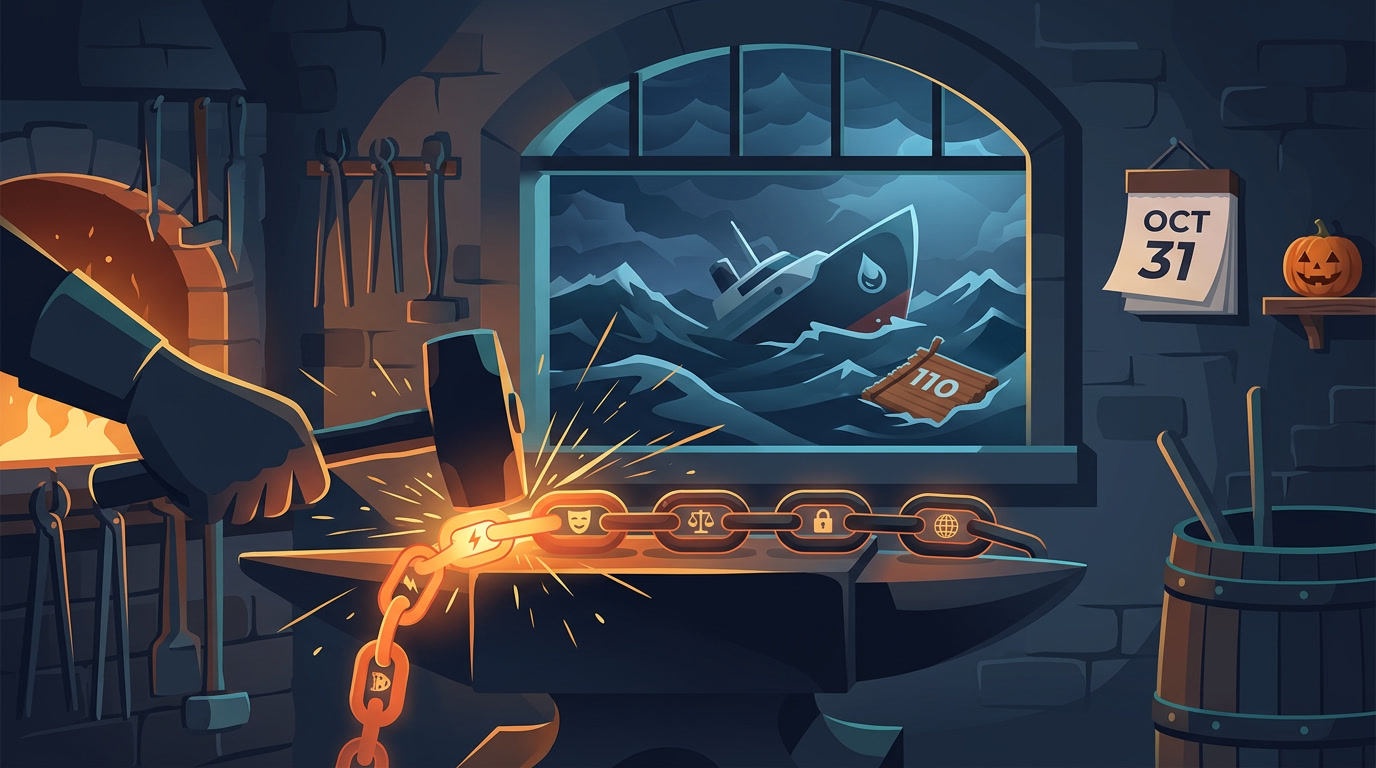
The eCash Alpha, Days 4 to 15: Doldrums, Orphan Blocks, and the Week the Old World Cracked
Our last dispatch closed on August 26, four days into the eCash alpha, with the chain alive, the pools multiplying, and the first pECX changing hands for real sats. The eleven days since have been less photogenic and far more important.
The alpha stopped being a launch and started being a network, with everything that implies: a hashrate hangover, the first production incident, the first community drivechains activated under proof of work, the first withdrawal bundle ever proposed on a live BIP-300 chain, a price that refused to sit still, and, in the final days, a nine figure failure in Bitcoin's old guard that arrived like gift wrapped vindication.
This is the story of the second stretch, August 26 to September 7, 2026.
The great hashrate hangover
The alpha's first week ran on rented adrenaline. Once the big rental contracts ended, most visibly Juan Libertad's petahash scale bursts, the difficulty retargets they had triggered remained behind like a hangover. By August 27 the network difficulty sat at 4.29G, which ecashpool.tech's now beloved weather report translated into plain language: roughly 30.7 PH/s of hashrate was needed to keep ten minute blocks, and the network had about 5. The forecast: "mostly slow, chance of drift."
Block times stretched to ninety minutes, then to multi-hour gaps. Michael Blowes, writing from Australia, reached for the correct nautical term: "the doldrums." At one point the chain went eight hours between blocks while Bitcoin itself, in a moment of cosmic comedy, produced a one hour block gap of its own and briefly became the slower chain.
What happened next is the part that matters. People mined at a loss on purpose. Penia rented a petahash for ten hours at a time, sold pECX into the swap to fund more hash, and publicly documented the arithmetic of his own unprofitability. Wiredancer kept a rental running overnight to move the chain along. Blowes pointed fresh hash at the network simply to keep his FreeBank sidechain ticking. "Billions must hash," Serious Cat declared, and so they did, at personal expense, for practice coins.
The doldrums also produced the alpha's first serious monetary policy debate. Joe argued the block subsidy is the deeper problem, since it pays for empty blocks regardless of demand, a critique with roots in Paul's own writing on the economic security model. Others floated ASERT, Dark Gravity Wave, or harmonic retargeting, the algorithms that let minority chains like Bitcoin Cash survive hashrate oscillation. Paul's answer was the most Sztorc possible: "We need to see those consequences!" Better to watch a practice chain nearly stall in August than to model a real one stalling in November. On August 30, the difficulty finally adjusted down, and the chain exhaled.
Block 996403 and the value of a public post-mortem
On August 26, ecashpool.tech published block 996403 with a malformed M8 withdrawal request. The pool's enforcer correctly rejected it as invalid. Bitcoin Core, however, kept the template, and the pool kept mining on what was now a dead branch. Ten orphaned blocks and nearly three hours passed before another pool's valid block extended the real chain and the enforcer, restarted after an unrelated crash, flushed the poisoned template and rejoined the network.
Two things about this incident deserve emphasis. First, the response. Within hours there was a public post-mortem with a full timeline, and within three days every affected miner had been refunded: 31.54250608 ECX across 38 addresses, paid in a single transaction, no ticket required. Second, the timing. This is exactly the class of bug, a pool software and enforcer interaction failure, that would have been a front page catastrophe with real money at stake. On the alpha it was a Wednesday.
It was also not the only fire. The same pool absorbed a flooding attack that kicked miners offline and required IP level mitigations. Separately, a race condition in the enforcer's error handling, documented in forensic detail by Jarrod Woodard, caused nodes to invalidate a valid block near height 987,358 and regress dozens of blocks; NurseryPool hit 89 consecutive orphans at the same height before fixes landed. By the end of the fortnight, enforcer sync times had collapsed from hours to minutes, with Coinholio clocking a full sync of 963,649 blocks in under two minutes. The bug reports coming out of this community, complete with block heights, root causes, and proposed patches, would embarrass most paid engineering organizations.
The sidechain spring
The most significant development of the second week is the one that will be easiest to underestimate in retrospect: drivechains proposed by ordinary community members started activating under real proof of work.
On August 25, JK submitted his Elements+ proposal for slot 24, a Blockstream Elements fork with CTV, Simplicity support, and plans for a USDT bridge and a perpetuals DEX. The mechanics required a miner running a full alphanet node to include the M1 proposal in a coinbase, followed by 30 acknowledgement blocks, the alpha's accelerated version of the mainnet's much longer activation window.
Michael Blowes, whose home connection in Australia could not finish the sync, stood up a VPS in Singapore, endured a Nicehash KYC and AML gauntlet that eventually defeated him, switched to Mining Rig Rentals, won a block, and put two M1s in it: one for Elements+, and one for his own project, FreeBank, a Scottish free banking inspired credit chain on slot 130. On August 28 he confirmed the result: "Elements and FreeBank have activated. First non L2L drivechains to do so under PoW."
Read that sentence again. A decade of drivechain discourse, and the first permissionless sidechain activations on a live BIP-300 network were executed by a guy on a rented VPS who had a hard stop because he had to go to a ball.
The floodgates, once opened, stayed open:
- Sohibit proposed BBC, the Big Block Covenant chain, with CTV, CAT, CSFS, and APO on 16 MB blocks.
- Shomari's Snowside, an Avalanche based EVM chain, took slot 88, with a signet bridge already running.
- Nikita resurfaced with beth, an Ethereum sidechain built on reth.
- Coinshift produced the alpha's first M8, and then its first M3: Coinholio broadcast the first withdrawal bundle proposal ever mined on a live drivechain network, and in doing so discovered a crash bug, since nodes fell over if the M3 was mined more than one block late. Testing working as intended.
- JK bootstrapped a Truthcoin node and mined its first block, then noted with admirable honesty that the chain had exactly zero registered voters.
- Coinholio slop-patched a Bitassets fork into alphanet compatibility, reserved the ALPHA ticker, and seeded its AMM pool. Serious Cat responded by registering fartcoin with a 69 million supply. The ecosystem is healthy.
Meanwhile the mining layer matured visibly. ecashpool.tech shipped a sidechain status page reading live data from its enforcer: open BMM bids, per-block votes, bundle countdowns. Louis built ePool on DATUM with something genuinely novel: hashrate weighted voting, where each miner's share of the reward window determines their power to ack, nack, or formally reject (BIP-300's alarm vote) any proposal, plus support for pruned nodes mining BIP-300 blocks with pool supplied commitments. He even slipstreamed a portrait of Luke Dashjr into the chain for posterity.
The Thunder standoff from week one, in which pools mined coinbase only blocks and ignored BIP-301 entirely, dissolved as pool after pool wired up enforcer templates. When tempers flared mid-debate, Paul posted the Pulp Fiction diner scene. Everyone be cool.
One honest caveat: infrastructure is still catching up to the protocol. The main explorer briefly displayed an orphaned ePool block as canonical because it was not enforcer aware. These are the seams showing, and they are being sewn in public. For anyone who wants to understand the machinery underneath, the community produced an excellent internals guide at bips.bip300.xyz covering all eight drivechain messages, the hashrate escrow, and blind merged mining.
Thunder learns to walk
Thunder, the flagship big block chain, spent the week transitioning from "activated but unreachable" to "actually usable." Seed nodes refused to peer for days; testers learned to connect manually to a community node by IP. Then on September 1, Bjørn shipped the milestone: light client support for Thunder in Bitwindow, no full node required. A Thunder faucet went live at szats.world/thunder.
On September 4, BTCapsule sent Thunder coins from a full node on macOS to a lite wallet on Windows, a mundane sentence that represents the first time most humans can actually touch a drivechain. Mobile wallet support is in active testing, and Sats Scholar's pool continues paying out in Thunder on principle, because the whole point of drivechains is to use the drivechains.
The 1,000 pECX question
Not every controversy was technical. The alpha's redemption terms, a minimum burn of 1,000 pECX for a 1000:10 conversion to real ECX, collided with reality: Bitaxe miners who showed up on day one had 30 to 90 pECX and no path to four figures once difficulty overshot. The debate was genuine. Lower the threshold and invite participation, or keep the rules as announced? Paul held the line with a market argument: "If the coin is cheap, it should be easy to get 1,000."
The community responded the way healthy communities do, by routing around the problem. krile publicly offered to pool smaller balances into his own burn. Coinholio began speccing a trust minimized redemption pool. Don Wonton supplied the libertarian punchline: "Seems like a non issue, just sell your peesex, no coordination required, no trust, no changes."
Felix Ha raised the sharper structural point: with 100 block coinbase maturity and glacial blocks, coins mined late in the alpha may not even be spendable before the burn window. Expect this to shape beta design.
The price of practice
The pecx.shop AMM, which started life with about $100 of liquidity and a joke domain, matured into something resembling a market. Marcus more than doubled the liquidity pool twice, reaching 1,632 pECX, and the price did what prices do when real people disagree about the future:
| Date (2026) | pECX price | Implied ECX (100:1) | What drove it |
|---|---|---|---|
| Aug 23 to 24 | $25 spike, then under $1 | n/a | Novelty prints on roughly $100 of liquidity; first sells crash the tiny pool |
| Aug 25 | $0.30 to $0.51 | $30 to $51 | Paul's 1,000 pECX OTC sale seeds the pool near the presale price |
| Aug 26 to 27 | $0.47 | $47 | Miners sell rewards; first steady two-way flow |
| Aug 28 | $1.14 to $1.58 | $114 to $158 | Local top; Vlad buys his first ECX; sellers take profit into strength |
| Aug 29 | $0.76 | $76 | Liquidity doubled to 643 pECX; price stabilizes |
| Sept 1 to 4 | $0.60 to $1.30 | $60 to $130 | Liquidity reaches 1,632 pECX; the constraint shifts from liquidity to volume |
For calibration: the presale cleared at $30 to $36, the Solana meme token implies roughly $80 to $93, and Juan Libertad's rented hash cost basis worked out to about $0.70 per pECX, a $70 implied ECX. Marcus, appearing on Pete Rizzo's show, called it the asymmetric bet of the decade and noted the market was already implying $50. Joe's hashrate equilibrium math landed at $40. Nobody knows what ECX is worth, and that is precisely the point of running the experiment twice before Halloween.
The custodian question
The fortnight also surfaced the fork's most uncomfortable conversation. quietNaN, writing from a custodian's perspective, pressed for burn specifications and objected to the project's open encouragement of "fishing," the practice of withdrawing BTC from exchanges that have not split their coins and keeping the replayed ECX. Paul did not blink: the creation event was announced in April, the burn spec would arrive well before it was needed, and "we are under no obligation whatsoever to conform to Coinbase's policies."
He has said elsewhere that the staged design gives exchanges "a light whack instead of a huge crisis." Reasonable people can disagree about the etiquette here, but the game theory is deliberate, and the exchange listing campaign is already collecting votes. The BIP-110 fork's tiny exchanges are currently running the same replay experiment in production, which brings us to the competition.
Meanwhile, in the old world
While eCash debugged itself in public, the fork that dominated August's attention completed its transformation into farce. BIP-110's Blake2b chain launched quietly, began trading on Neoxa and nonkyc at prices between $100 and $1,500 on order books thin enough to see through, and watched its community celebrate a "higher price than BCH" achieved with single digit coin depth.
Luke Dashjr separated from OCEAN by mutual agreement on August 30. The rebrand candidates, "Bitcoin Blake2b," "BTC2," "Xbt," tell you everything about the product. Coinholio bought a few Blukies at $100 and exited at 9.5x, which may be the only trade that chain ever facilitates. Vlad's framing has aged well in two weeks: the Blake fork is this cycle's Bitcoin Gold, a protest vote with a ticker, while the BIP-300 fork is attempting to be this cycle's Ethereum, a platform people build on.
Then, on September 6, the main event. Liquid, Blockstream's federated sidechain, was drained of roughly 4,000 BTC, about $320 million, through a rangeproof caching bug in confidential transactions that had existed since 2019, was patched in a commit in early August, and was never deployed to the federation's signers. The attackers left an on-chain note: "we are whitehats. contact us on chain." The chain halted. The peg dashboard's source could not even be located by the people defending it on Twitter.
The eCash chat's reaction was not gloating so much as recognition. "If Blockstream can't do a safe federation, who can," JK asked, before moving to disable confidential transactions on Elements+ entirely. Marcus had, in a detail too perfect to invent, sat down that very day to build on Liquid for the first time. Paul's thread on the affair passed 1.5 million views in under twelve hours, his largest audience ever, delivered at the exact moment his life's work needed it.
Federated custody failed instantly and catastrophically; drivechain withdrawals, by design, take months and answer to hashpower and a watching public. You could not buy this timing. Between Coldcard's RNG, BIP-110's collapse, and Liquid's drain, the old solutions have spent two months failing on schedule while the new one gets its reps in.
The marketing wars
No honest chronicle can skip the fortnight's longest running argument. Matt, a community member, spent the period making the case that eCash needs paid influencers, a content army, and conventional crypto marketing, and that his own unreleased video would triple the market cap.
The community's response ranged from "show us the video" to open hostility toward the premise. Paul's eventual public accounting was diplomatic but clear: the deal collapsed over unusual contract mechanics, a 2-of-2 multisig collateral structure and an option framed purchase at an unchanged price, not over philosophy.
On philosophy, Paul was equally direct. The project plans to spend roughly $1 million on promotion in October across all categories, but he believes marketing money spent now would largely be wasted, because attention without product is the industry's oldest grift. "Post airdrop, it will at least be much much better," he noted, "because there will be bag holders."
His strategic frame remains unchanged, laid out years ago in Derangements of Bitcoin: Bitcoin plus a pile of mistakes will eventually lose to Bitcoin without those mistakes plus an error correction flywheel for development and culture. The other 99.9999% of the design is still Bitcoin.
It is worth being objective here: Matt's underlying anxiety, that almost nobody outside the chat is talking about eCash, is factually true today, and he is not the only person who holds it. The counterargument is empirical. What actually shipped during the fortnight was the genuinely excellent "Department of Bitcoin Experimentation" spot, Vlad's Seinfeld AI clips, a 24/7 live network dashboard, a full media archive at archive.ecash.com, two long form Pete Rizzo interviews with community builders (Marcus and JK), coverage from Bitcoin News, and a skeptical but high profile dissection from the Hell Money podcast. Whether that is enough is a fair question. Whether it is nothing is not.
The status board
Fourteen days in, here is the honest inventory:
| Piece | State on September 7 |
|---|---|
| L1 alphanet | Live since block 963,648, height around 996,900, full blocks and a real fee market at peak |
| Coin splitting | Magic nLockTime working in the wild; hardware wallet splitter and an Electrum fork shipped |
| Mobile wallet | Android builds shipping near daily; iOS approved on TestFlight after Apple briefly rejected the team for copycatting itself |
| Mining | Four plus pools, a solo port, rented hash flowing, DATUM templates with per-miner sidechain voting |
| pECX market | AMM live with 1,632 pECX of liquidity; faucet dispensing szats; OTC deals in chat |
| Thunder | BMM live; light client shipped; faucet running; peering still manual |
| Elements+ | Activated under PoW; Esplora and UI in progress; confidential transactions disabled post Liquid |
| FreeBank | Activated; seed node up; CLI only, GUI distant |
| Coinshift | Deposits and the first ever withdrawal bundle mined; crash bug found and being fixed |
| Truthcoin | First block mined by a community node; seed server in progress; zero voters so far |
| Bitassets | Community fork producing blocks; first token and AMM pool created |
| Snowside, RISCy, BBC, beth | Proposed or in active development |
Why skipping the August mainnet was the right call
The counterfactual is now easy to state precisely. Had the mainnet launched in August as originally planned:
- The 996403 template bug would have orphaned real rewards and made real headlines.
- The Thunder standoff would have played out with live money, proving on the record that pools will happily mine a drivechain network without enforcing any drivechains.
- The difficulty doldrums would have arrived unannounced on a chain people were paying $30 a coin for.
- BIP-110 would have consumed the entire attention cycle anyway, and its subsequent collapse would have tarred every fork by association.
- The Liquid lesson, that federated sidechains are not the competition but the cautionary tale, would have landed after launch instead of before it, when it can still be woven into the pitch.
- Apple would have rejected the wallet anyway.
Instead, the project bought itself two months of live fire with practice coins, a community that has already survived its first incidents together, and a price discovery process that gets to argue in public rather than detonate in private. The alpha did not delay the launch. It is the launch, decomposed into survivable pieces.
Why you should try drivechains today
Because the window where your contribution is disproportionately large is open right now, and it will not stay open. The faucet at szats.world hands out free szats. A Bitaxe can still find a block. You can download Bitwindow or the mobile wallet, split coins with the nLockTime trick using the official guide, point a miner at any pool in the public directory, trade on a live AMM, or propose your own sidechain with a single grpcurl call and watch pools vote on it.
Bug reports filed in the chat get read by the people who wrote the code, and the bounty program pays. The alpha runs to September 20, the beta follows, and everything you learn now is rehearsal for October 31, when the coins stop being practice.
Fifteen years of theory are sitting in Paul's writing, from the sidechain vision to the fee model to the misinformation rebuttals. But the alpha has done something no essay could: it turned the argument into a machine you can touch.
What gets better by October 31
Extrapolating from the observed velocity of the last two weeks, rather than from hope: light client support for the remaining sidechains, pruned node support in the enforcer, sync times measured in hours instead of days, sidechain seed servers on multiple continents, Thunder in the mobile wallet, a public Electrum server fleet, finalized burn tooling with actual documentation, pool software hardened by its third or fourth post-mortem, an on-chain order book on Elements+, the first exchange integrations, and a promotional budget that finally has something finished to point at. Each new stage also resets the difficulty, which means the doldrums get a designed exit rather than an endured one.
The fortnight in one paragraph
The first four days proved the chain could start. The next eleven proved it could take a punch: a stalled difficulty, a forked pool, a flooding attack, a faucet farmer, a marketing schism, and the collapse of two of Bitcoin's sacred institutions in the background. The alpha ends September 20. The beta follows. And on October 31, the Bitcoin whitepaper turns eighteen and gets its first drivechains, tested by the people who showed up early and broke everything that was breakable.
Be cool. See you at the beta.