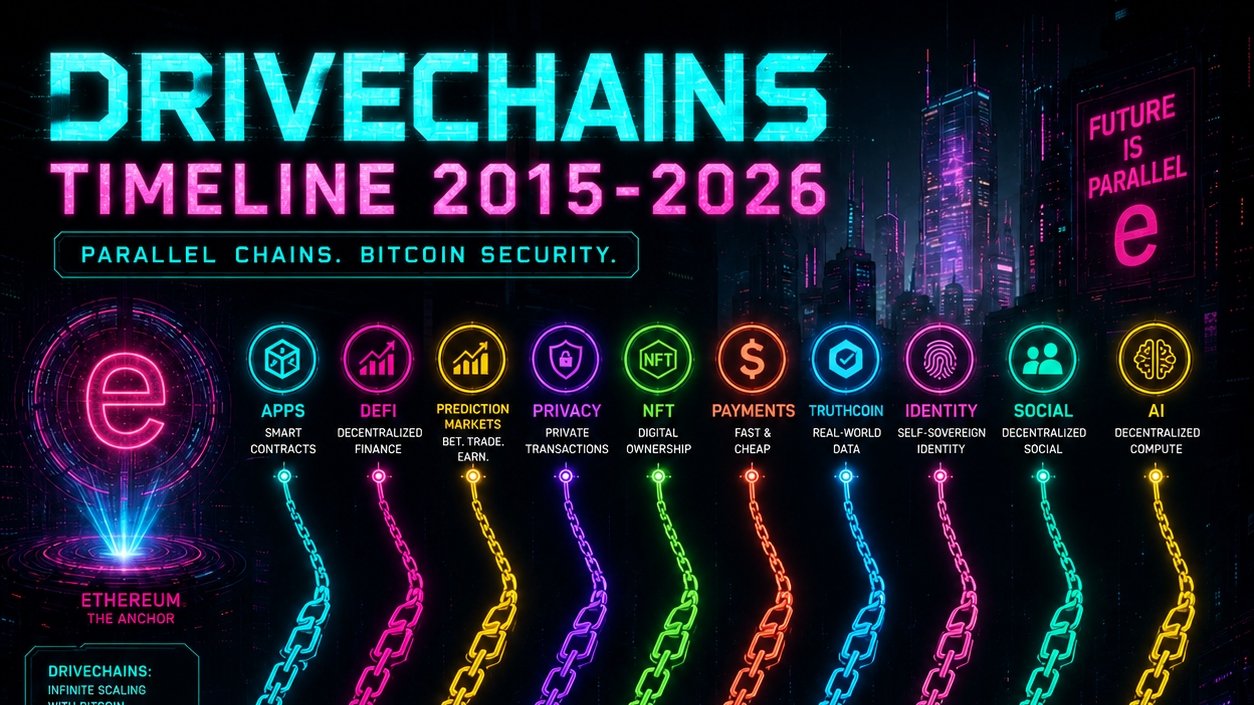
The Drivechain Timeline: From November 2015 to August 2026
The drivechain proposal is one of the longest-running technical discussions in Bitcoin's history. It has been proposed, refined, debated, prototyped, politically blocked, paid-critiqued, defended in conference debates, and eventually carried forward into a hard fork that activates the architecture on Ecash. Eleven years have passed between the original publication and the deployment.
This essay is the canonical timeline of those eleven years. It is intended as a permanent reference for anyone trying to understand how we got from a November 2015 blog post to the August 21, 2026 Ecash launch. Every date in this essay is sourced to public records. Every event is verifiable from primary sources.
2015: The original proposal
In November 2015, Paul Sztorc published Drivechain: The Simple Two Way Peg on truthcoin.info. The essay introduced the core drivechain mechanism: hashrate-escrowed sidechains, miner voting on withdrawal proposals over a multi-week window, blind merged mining as the consensus mechanism for sidechain blocks. The technical design that would later become BIP-300 and BIP-301 was substantially complete in this initial publication.
The context for the proposal was significant. Bitcoin was in the early stages of what would become the blocksize war. Blockstream's Enabling Blockchain Innovations with Pegged Sidechains paper had been published in October 2014. The cryptocurrency community had broadly accepted that sidechains were the right architectural answer to Bitcoin's scaling and feature-extension needs, but the technical details remained unresolved.
Sztorc's drivechain proposal was a specific answer to those unresolved details. It used hashrate as the security mechanism, miner voting as the withdrawal authorization, and blind merged mining as the way to keep miners from needing to run sidechain full nodes. The design was distinctive in its simplicity: far fewer moving parts than the federated multisig models that would later emerge in Liquid and other federated sidechains.
The November 2015 publication is the canonical origin date of the drivechain proposal. Everything that follows builds on this foundation.
2016: Early refinement and prediction market integration
Throughout 2016, Sztorc refined the drivechain design through additional blog posts on truthcoin.info. The most significant development was the integration of drivechains with his Hivemind prediction market design. Hivemind, originally published as Truthcoin in 2013, was the use case that motivated Sztorc's interest in sidechains in the first place: prediction markets require complex state and contract logic that Bitcoin's L1 cannot host directly, but a sidechain secured by Bitcoin's miners could.
The drivechain-Hivemind integration established the pattern that would define the entire ecosystem: drivechains as the infrastructure, specific sidechains as the applications. Hivemind was the first concrete application designed for drivechains. Thunder (payments), ZSide (privacy), BitNames (identity), and the other sidechains in the Hivemind master plan would follow over subsequent years.
In December 2016, Sztorc began the work of formalizing drivechains as a BIP. The community feedback period extended through early 2017.
2017: BIP-300 submission
In August 2017, BIP-300 was formally submitted to the Bitcoin Improvement Proposals repository as a draft. The submission formalized the hashrate escrow mechanism that had been described in the 2015 blog post, with additional technical specifications around the voting window, the M1-M6 message types in coinbase OP_RETURN outputs, the D1 and D2 cached data structures, and the OP_DRIVECHAIN opcode (redefining OP_NOP5 for backward compatibility).
The timing of BIP-300's submission was unfortunate. August 2017 was the peak of the Bitcoin Cash fork drama. Segregated Witness had activated earlier that month after a contentious activation process. The Bitcoin community's attention was consumed by the blocksize war and its aftermath. BIP-300 was submitted into a discourse environment that had no bandwidth for additional technical proposals.
Despite the unfortunate timing, the formal submission established BIP-300 as a serious technical proposal worthy of community review. The draft has remained available in the BIPs repository continuously since August 2017.
2018: Quiet development and continued advocacy
2018 was the year of altcoin proliferation and Initial Coin Offering mania. Cryptocurrency attention was elsewhere. Sztorc continued to refine the drivechain design and Hivemind prediction market through blog posts, conference appearances, and podcast interviews.
In August 2018, Sztorc presented drivechains at the Scaling Bitcoin conference. The presentation was technically substantive and well-received among the developers who attended, but did not translate into activation momentum within Bitcoin Core.
Throughout 2018, the broader cryptocurrency community continued to launch altcoins for use cases that drivechains would have natively supported on Bitcoin: prediction markets on Augur and Gnosis (Ethereum-based), privacy coins like Zcash and Monero, smart contract platforms like Ethereum itself. Each of these launches was, in retrospect, a brain drain artifact that drivechains could have prevented.
2019: BIP-301 and blind merged mining
In July 2019, BIP-301 was formalized as the companion specification to BIP-300. BIP-301 defined blind merged mining: the mechanism by which sidechain blocks could be endorsed by Bitcoin's miners without requiring those miners to validate the sidechain's rules.
The BIP-301 specification addressed a critical practical problem: how to make drivechain mining economically viable for miners who did not want to run sidechain full nodes. The blind merged mining solution allowed miners to commit to sidechain block hashes in their coinbase transactions and collect fees from sidechain users, without needing to read or validate the sidechain's actual contents.
Together, BIP-300 and BIP-301 constituted the complete technical proposal for drivechain activation. From mid-2019 onward, the technical case for drivechains was as complete as it would ever be in proposal form. The remaining decade of activity would be primarily about implementation, advocacy, and political navigation.
2020: Reference implementation and quiet building
In 2020, Sztorc and a small team began work on a reference implementation of drivechains. The work proceeded primarily through Layer 2 Labs, the company Sztorc would later formalize to support drivechain development. The reference implementation was published on the drivechain.info website, with a download button at the top of the homepage and supporting documentation in the Hivemind GitHub repositories.
The 2020 implementation included a functional Bitcoin Core fork with BIP-300 and BIP-301 consensus rules activated. It supported sidechain creation, deposit and withdrawal workflows, and the voting mechanism for withdrawal approvals. Several proof-of-concept sidechains were prototyped, including an early version of what would become ZSide (Zcash-based privacy).
The cryptocurrency market spent 2020 distracted by the COVID-19 pandemic and the subsequent monetary policy response that drove Bitcoin's price from $4,000 to $29,000. Technical drivechain work proceeded outside the spotlight.
2021: Layer 2 Labs and Thunder
In 2021, Sztorc formally launched Layer 2 Labs as the development organization supporting drivechain implementation and the broader Hivemind ecosystem. The company was funded by Bitcoin OGs with long time horizons rather than venture capital, which would later become a relevant fact when critics accused the project of being VC-driven.
The most significant technical publication of 2021 was Sztorc's Thunder essay, which formalized the design for a high-throughput payments sidechain. Thunder was the architectural answer to the blocksize war debate: large blocks for payments on a dedicated sidechain, conservative L1 for settlement and decentralization. The design gave both sides of the war what they actually wanted, on different chains, secured by the same hashrate.
Thunder was the second major sidechain design after Hivemind. It established the pattern of multiple specialized sidechains rather than one monolithic chain, which would define the Hivemind master plan ecosystem.
2022: Bitcoin season 2 and growing recognition
2022 was the year drivechains began entering broader Bitcoin discourse. The triggering events were external: Lightning's limitations became increasingly visible, the FTX collapse demonstrated the failure of custodial services, and the broader Bitcoin community started looking for "Bitcoin season 2" architectural proposals.
In February 2022, Sztorc published the first version of Lightning Network Fundamental Limitations on the mailing list. The April 2022 expanded blog post version documented Lightning's structural problems in detail. The piece would become foundational to the broader recognition that Lightning was not going to scale Bitcoin to global use.
The Friends of Drivechain list at layertwolabs.com/friends began to grow significantly in 2022. Adam Back, Robin Linus, Jameson Lopp, Fiatjaf, Dan Held, David Bailey, Pete Rizzo, and dozens of other credible technical voices publicly stated support for drivechain activation during this period.
Litecoin briefly considered activating drivechains in late 2022. The discussion was active for several months and produced significant technical engagement, but ultimately did not result in activation. The Litecoin near-miss was a preview of the broader political dynamic that would define the next several years.
2023: The Bitcoin Core pull request and the Peter Todd critique
2023 was the most active year for drivechain activation attempts within Bitcoin itself.
In August 2023, Luke Dashjr submitted pull request #28311 to the Bitcoin Core repository, proposing the formal addition of BIP-300 consensus logic to Bitcoin Core. This was as close as drivechain activation has ever come within Bitcoin. The pull request was a formal code submission by a developer who is famously hostile to most innovation, asking for the proposal to be merged.
In October 2023, Peter Todd published his commissioned critique of drivechains. Layer 2 Labs paid Todd $2,500 for sixteen hours of work to write the strongest possible technical objection to drivechains, in an unusual act of intellectual openness. Todd's resulting essay was incomplete by his own admission and contained internal contradictions that Sztorc would later identify in the Stephan Livera debate.
The Bitcoin Core pull request was effectively shelved by the broader Core review process. Todd's critique was widely cited as the technical justification for not proceeding with activation. The 2023 momentum dissipated as the OP_RETURN moral panic began to consume developer attention.
2024: TABConf and the political ceiling
In 2024, drivechain activation attempts inside Bitcoin reached their political ceiling. The OP_RETURN drama that had begun in late 2023 expanded throughout 2024. Knots and Ocean Mining were positioned as alternatives to Bitcoin Core, with transaction filtering as their distinguishing feature. The political environment was hostile to any new technical proposal, regardless of its merits.
Sztorc continued the patient explanation strategy that had characterized the entire decade. He appeared on podcasts. He published essays. He engaged with critics. He held weekly Twitter Spaces sessions where anyone could ask questions.
The most significant single event of 2024 was the TABConf debate in October. Sztorc accepted an invitation to debate his Lightning critique with a room full of Lightning developers. Tadge Dryja (the co-author of the original Lightning Network paper) was in the audience and eventually came on stage. By the end of the panel, Dryja had conceded the central technical point of Sztorc's critique. The Lightning consensus that had dominated Bitcoin for a decade quietly began to dissolve.
2025: The Derangements essay and the fork decision
In July 2025, Sztorc published Derangements of Bitcoin on truthcoin.info. The essay was a comprehensive catalogue of the cultural and political problems preventing Bitcoin from shipping substantive improvements. It documented Lightning's failure, the OP_RETURN moral panic, the loss of the truth-oriented culture that had characterized early Bitcoin, the brain drain of serious researchers, and the broader pattern of complacency.
The Derangements essay was the philosophical foundation for what would follow. Sztorc and Layer 2 Labs began seriously considering a hard fork as the only remaining path to drivechain deployment. The political process inside Bitcoin had demonstrated for over a decade that it could not ship BIP-300. The market for drivechain functionality was real. Other chains were capturing the use cases Bitcoin's L1 could have hosted. The structural case for a hard fork had matured.
Late 2025 was characterized by quiet preparation. The Ecash fork was discussed privately among Layer 2 Labs investors and supporters. Pre-fork investment opportunities became available for early supporters who wanted to back the project before public announcement. Sztorc's Wednesday Twitter Spaces continued throughout this period, with growing audiences as the broader Bitcoin community began to anticipate that something significant was coming.
Early 2026: The announcement and the podcast tour
In March 2026, Sztorc began formally announcing the Ecash hard fork on the podcast circuit. The announcements were calibrated to four major shows over the following weeks: Bitcoin Rails with Isabel Foxen Duke, Bitcoin Takeover with Vlad Costea, The Bitcoin Historian with Pete Rizzo, and Digital Cash Network.
The four interviews, totaling nearly twenty hours of substantive content, became the canonical public communication of the Ecash thesis. Each interview brought out a different aspect: the news framing, the technical depth, the historical context, the practical mechanics. Together they constituted the most comprehensive public defense of any cryptocurrency hard fork in the project's history.
In April 2026, Bitcoin 2026 in Las Vegas quietly renamed its "Mining Stage" to "Energy Stage" — a small editorial choice that revealed the structural reality of mining's pivot to AI. The context for Ecash's launch was now visible: Bitcoin's security model was under pressure, drivechains were the architectural answer, and the political process inside Bitcoin had proven unable to deliver them.
In May 2026, the Ecash launch site at ecash.com went live with the public countdown. The hard fork was scheduled for block 964,000, approximately August 21, 2026. Seven sidechains were announced for launch: Thunder, ZSide, BitNames, BitAssets, Photon, Truthcoin/Hivemind, and CoinShift.
June and July 2026: Final preparation
The final two months before launch were characterized by code freezes, security audits, exchange outreach, and continued public communication. Sztorc maintained his weekly Twitter Spaces. Layer 2 Labs published implementation details, replay protection specifications, and the technical documentation needed for wallet developers and exchange operators to prepare for the fork.
The Friends of Drivechain list at layertwolabs.com/friends continued to grow. Critics published their objections. The Greg Maxwell Reddit dismissal, the Matthew Kratter security budget video, and the recurring citations of Peter Todd's 2023 critique all received responses on this blog and elsewhere. The public conversation reached a level of intensity that had not been seen since the SegWit activation debates of 2017.
August 21, 2026: Activation
At block 964,000, approximately August 21, 2026, Ecash will fork from Bitcoin. The fork will inherit the UTXO set, the monetary policy (21 million coin cap preserved), the SHA-256d proof-of-work, and the broader architectural conservatism that has defined Bitcoin since its inception. The fork will add what Bitcoin's political process refused to add: BIP-300 and BIP-301 activated from genesis, enabling drivechain sidechains immediately.
The seven launch sidechains will come online over the days and weeks following the fork. Thunder will provide high-throughput payments. ZSide will provide Zcash-style privacy. BitNames will provide decentralized identity. BitAssets will provide tokenization. Photon will provide quantum-resistant transactions. Truthcoin/Hivemind will provide prediction markets. CoinShift will provide decentralized exchange. Each sidechain will be merge-mined by Bitcoin's existing mining infrastructure, generating fees that flow back to the L1 hashrate.
The architecture that Paul Sztorc proposed in November 2015 will, eleven years later, finally exist in production.
What the timeline reveals
Step back from the year-by-year detail and several patterns become visible.
The technical case has been stable since 2017. The substantive design of BIP-300 and BIP-301 has not changed in any major way since the original specifications were published. What has changed is the political environment around them, the broader cryptocurrency landscape that makes them more obviously necessary, and the implementation maturity that makes deployment possible.
The political ceiling was higher than the technical merit predicted. By any reasonable technical standard, drivechains should have activated years ago. The supporters list is overwhelming. The objections have been answered repeatedly. The political process inside Bitcoin has nonetheless been unable to ship the proposal. This is the lesson that motivated the Ecash hard fork.
The opportunity cost has been enormous. Every year drivechains did not activate, the broader cryptocurrency ecosystem captured fees and use cases that Bitcoin could have hosted. Ethereum, Solana, Polygon, Avalanche, and dozens of other chains have collectively captured hundreds of billions of dollars in value that drivechains would have routed to Bitcoin's miners and Bitcoin's monetary asset. The decade of delay is not free.
Sztorc's patience strategy worked, eventually. A decade of patient explanation, refusing to lose his temper, accepting every podcast invitation, attending every conference debate, answering every critic on substance rather than personality — this approach has been criticized over the years as insufficiently aggressive. The criticism turns out to have been wrong. The patient strategy produced the cultural conditions that make the August 21 fork viable. Less patient strategies would have produced burnout and abandonment instead.
What comes next
The August 21, 2026 fork is not the end of the drivechain story. It is the beginning of the deployment phase. The technical questions that have been debated theoretically for eleven years will be tested empirically over the coming years. Miners will or will not allocate hashrate to Ecash. Sidechains will or will not achieve product-market fit. Drivechain fees will or will not grow to meaningful levels.
The empirical record will eventually be substantial enough to settle questions that argument alone has been unable to settle. People who held both BTC and Ecash positions through the fork will have direct evidence of how the two architectures perform. The contrast will be visible.
But the eleven-year timeline up to August 21 is now closed. The technical work is done. The political process has produced its verdict. The fork ships. Whatever comes next will be a new chapter, not a continuation of the activation debate.
That is what makes this particular timeline worth preserving as a permanent reference. The years from November 2015 to August 2026 are now historical. The architecture they produced is about to demonstrate itself in production. Future essays on this blog will document what happens after launch. This essay documents what happened before.
The doors are opening. The chain ships in three months. The decade-long timeline that brought us here is now complete.