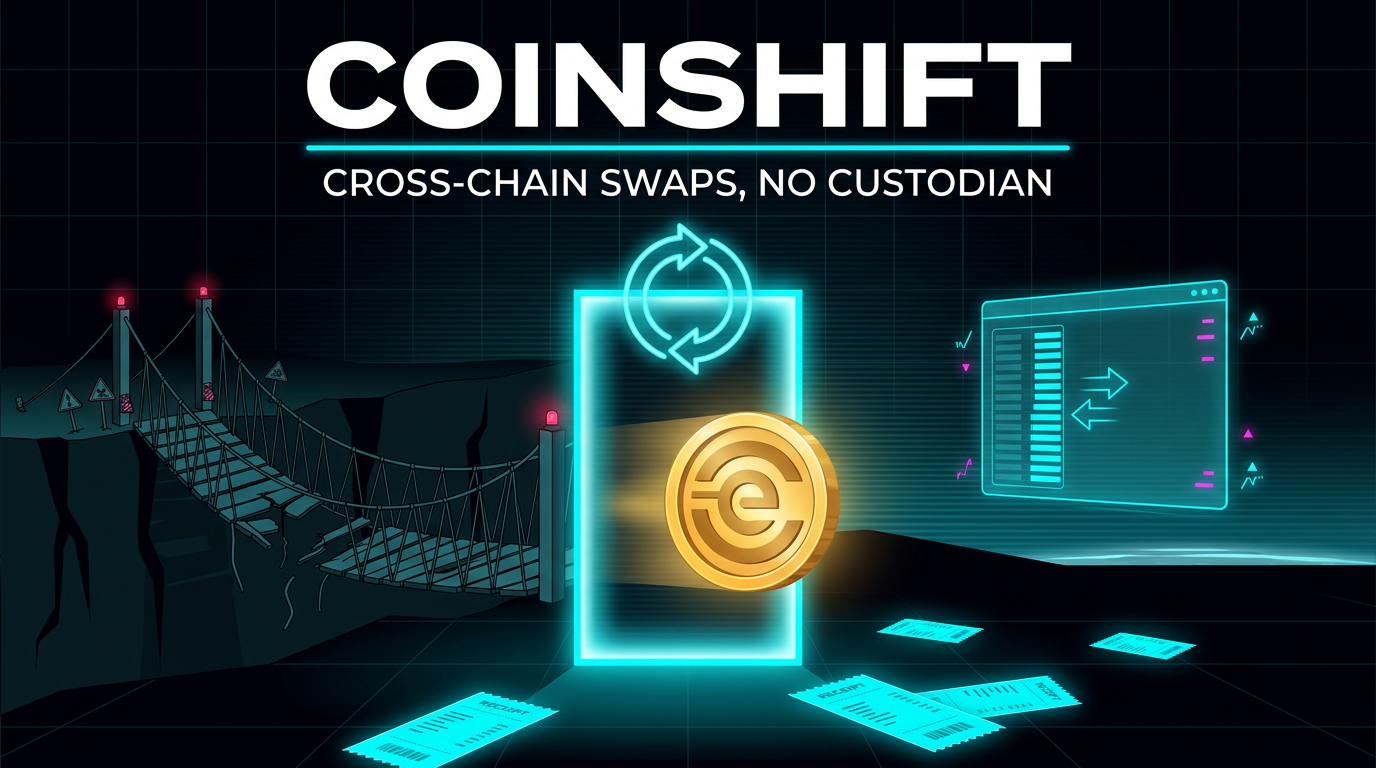
CoinShift: The Fork That Ships With Its Own Exchange
This is the seventh and final piece in our series covering the seven BIP-300 sidechains shipping with the eCash hard fork. Previous entries covered Thunder, the payments chain; zSide, the privacy chain; BitNames, the identity chain; BitAssets, the token chain; Photon, the quantum-resistant vault chain; and Truthcoin, the prediction market chain. Here we look at CoinShift, the cross-chain decentralized exchange, with code developed under the repository LayerTwo-Labs/coinshift-rs.
(Readers who followed this series from the beginning will remember an August launch date. The fork now rolls out in rehearsal stages: the practice Alpha went live on August 23rd, a Beta follows in late September, and the permanent chain arrives on Halloween, October 31st, the eighteenth birthday of the Bitcoin whitepaper. All seven sidechains are slated to be available on day 1.)
Forty-eight hours after the alpha fork went live, before the hashrate had finished doing its impression of a cardiac monitor, a community member stood up a swap site from his laptop. It took Bitcoin in and spat practice ECX out, with a constant-product curve, no accounts, and about a hundred dollars of liquidity. Within a day the implied price of a coin had whipsawed from ninety-one thousand dollars to two thousand and change, which is what happens when a trade of any size hits a pool that thin, and everyone in the chat laughed, and everyone used it anyway.
That improvised little shop is the entire case for CoinShift in miniature. When new money exists, the first thing people reach for is a venue to trade it, and the venue has always been a tollbooth: a company, a committee, a bridge multisig. CoinShift is the bet that the tollbooth can be removed, and that the removal matters more than the polish of whoever currently staffs it.
The Last Tollbooth
Every other chokepoint in this industry has a drivechain assigned to it in this series. Payments, privacy, identity, tokens, vaults, truth. But all of those chains sit on one side of a border, and at the border there is always an exchange. The question of how value crosses from one chain to another without asking permission is older than most of the people reading this article's favorite wallets, and the industry's answers to it form a kind of fossil record, each layer killed off by the same two predators: the custodian's compliance department, or the bridge hacker's exploit kit.
Walk the record. ShapeShift pioneered the no-account instant swap in 2014, became beloved precisely because you could trade without handing anyone your identity, was forced into KYC in 2018, and wound its company down into a DAO by 2021. Its successors, the ChangeNOWs and SideShifts of the world, live at the pleasure of whichever regulator is reading their logs this quarter. Even the good ones keep proving the rule: Boltz, a genuinely non-custodial swap service for Bitcoin layers, announced its indefinite shutdown this very month after months of escalating attacks. Bridges fared worse. Ronin lost over six hundred million dollars. Wormhole lost over three hundred million. Nomad lost nearly two hundred million in an afternoon that resembled a bank run performed by a crowd of strangers. Wrapped assets are IOUs with extra steps and a de-peg schedule.
The two non-custodial survivors deserve their own paragraphs, because CoinShift's pitch is aimed squarely at them.
What CoinShift Actually Is
CoinShift is a drivechain, so it inherits the machinery this series has now described six times: hashrate escrow, blind merge mining, fees paid in ECX, security borrowed from the same SHA-256 miners who secure the base layer. On top of that machinery it runs a cross-chain exchange with no custodian. Users swap assets: ECX against assets from other chains, and assets from other chains against each other, without any company holding the coins in between.
The mechanics, at the level the current codebase supports, are worth stating plainly. Movement between the sidechain and the eCash L1 uses the standard drivechain peg, the same miner-supervised deposit and withdrawal process every chain in this series shares. For external chains, CoinShift's software connects to the enforcer and to nodes of those outside networks, stores their block headers, and releases the counter-asset when both legs of a trade have confirmed on their respective chains. Bitcoin is supported first, with Bitcoin Cash and a Solana integration in progress in the public repository.
Two honest clarifications belong here rather than in the counterpoint section. First, the foreign-chain leg of a swap inherits that chain's finality assumptions, which in practice means confirmation waits and sensible size limits, not blind trust in a committee, but not magic either. Second, at launch the chain is focused on onboarding: getting value between eCash and the outside world. Sidechain-to-sidechain swaps, trading a zSide balance against a BitAssets token without touching the L1, are the natural next step, and the developers have said as much, but they are not the day-one product.
Why Not Uniswap
Uniswap is the best-known answer to "decentralized exchange," and it is genuinely good software. It is also a single-domain instrument. It trades ERC-20s against ERC-20s on Ethereum, priced in a gas token you must first acquire, on a chain whose congestion is a shared tax on every application running on it. It cannot settle Bitcoin. It cannot touch the ninety-nine percent of crypto value that does not live in the EVM. Asking Uniswap to be the venue for a Bitcoin-descended fork is like asking a stock exchange to sell you a house: wonderful institution, wrong asset class.
CoinShift's domain is the border itself. Its reason for existing is the trade Uniswap structurally cannot make.
Why Not THORChain
THORChain is the serious comparison, the one that actually does cross-chain swaps without a custodian, and the contrast is instructive because THORChain's weakness is not its engineering but its monetary base. Its security model requires validators to bond RUNE, the chain's own token, which means the cost of attacking the network is denominated in the market price of an asset whose value depends on the network's success. When that price fell, the reflexivity ran in reverse: thinner security, harder questions, painful halts. The chain carries its security budget on its own back, like a fortress built on the market capitalization of its own flag.
CoinShift carries no such token. Its security is inherited through blind merge mining from miners who are paid in ECX regardless of whether any particular swap venue prospers, and its fees flow back to the L1 the way every drivechain's fees do. There is no second coin to defend, no validator bond to collapse, no reflexivity to fear. That is the same structural argument this series made for zSide against standalone privacy coins and for BitAssets against gas-token chains. It is the drivechain thesis, applied to the exchange.
Atomic swaps, for completeness, solve the trust problem and fail the product problem: they demand compatible scripting on both chains, wallets that speak the protocol on both sides, and both parties online at the same time. Fifteen years in, they remain a tool for the patient and technical. CoinShift aims to be the always-open venue that makes that patience unnecessary.
The Fork That Ships Its Own On-Ramp
The strategic point deserves its own section, because it explains why this chain is in the launch lineup at all.
Every Bitcoin fork in history has lived or died by exchange listings. Bitcoin Cash spent weeks in limbo while exchanges decided whether to credit users, and the crediting decision was the listing decision, and the listing decision was made by companies with their own politics. A fork that cannot be traded is a fork that cannot price, and a fork that cannot price is a footnote. The eCash team has been open about lobbying exchanges, and some will list ECX in time. But the deeper answer is the one CoinShift embodies: if the exchanges decline, the chain does not need them. The venue where BTC meets ECX is part of the ecosystem itself, running on the same hashrate, paying the same miners, accountable to no listing committee.
Notice what this does to the incentives discussed elsewhere in the community, where holders have half-joked about draining exchanges' forked balances through replay mechanics. A clean, protocol-level swap venue is the honest version of that energy. Instead of punishing gatekeepers, route around them.
Who Should Use CoinShift
- Bitcoin holders who want ECX without a centralized exchange, a listing decision, or a withdrawal limit, which, in the early days of any fork, is most of the market.
- ECX holders who want out or back in, same venue, opposite direction, same absence of gatekeepers.
- Users of other chains who want exposure to the eCash ecosystem without touching a custodian; the BCH refugee and the Solana user both have a front door here.
- The ecosystem's own users, once cross-sidechain swaps mature, moving between zSide, BitAssets, and Thunder balances the way one moves between rooms in a house rather than between countries with visa requirements.
The Honest Case Against
Three objections deserve air.
First, liquidity. Exchanges are liquidity businesses, and the alpha's improvised swap shop proved both sides of that sentence: demand appeared instantly, and a hundred dollars of depth produced price swings that belonged in a slapstick reel. CoinShift will launch with real code and empty pools, and market makers do not arrive because the cryptography is elegant. The difference between the alpha anecdote and the mainnet launch is that the whole market now gets two rehearsal months to show up.
Second, the cross-chain mechanics are genuinely harder than same-chain swaps. Watching foreign chains means foreign finality, foreign reorgs, and foreign fee markets, and the honest framing is that CoinShift replaces a custodian with a set of assumptions you should understand before you size a trade. The developers' own public materials, including the CoinShift walkthrough of drivechain mechanics, are the right place to start.
Third, competition does not stand still. Intents-based aggregators are already the fashion elsewhere in crypto, and eCash community builders are openly sketching what an intents layer over the seven sidechains might look like. CoinShift at launch is a venue, not an aggregator, and the roadmap question of sidechain-to-sidechain swaps will decide whether it becomes the ecosystem's hub or merely its border crossing. Being the border crossing of a successful country is, to be clear, an excellent business. Ask Singapore.
Why CoinShift Is a Big Deal
Money got decentralized in 2009, and then the industry spent fifteen years re-centralizing every place where money meets money: the exchange, the bridge, the wrapper, the market maker with a terms-of-service. This series has covered chains for payments, privacy, identity, tokens, vaults, and truth. CoinShift covers the seam between all of them and everything else, the one venue every user of every other chain will eventually touch.
That is also why it closes the series. A fork that ships with its own exchange is a fork that has thought through the boring, decisive question of how anyone gets in and out, and it has answered that question the way this project answers all of them: without asking anyone's permission, and with the fees going to the miners. Whether the liquidity follows, as Sztorc likes to say, will be decided on the merits. For once, that phrase describes the product exactly.
Tagged: ecash coinshift dex cross chain atomic swaps thorchain uniswap bridges defi drivechain