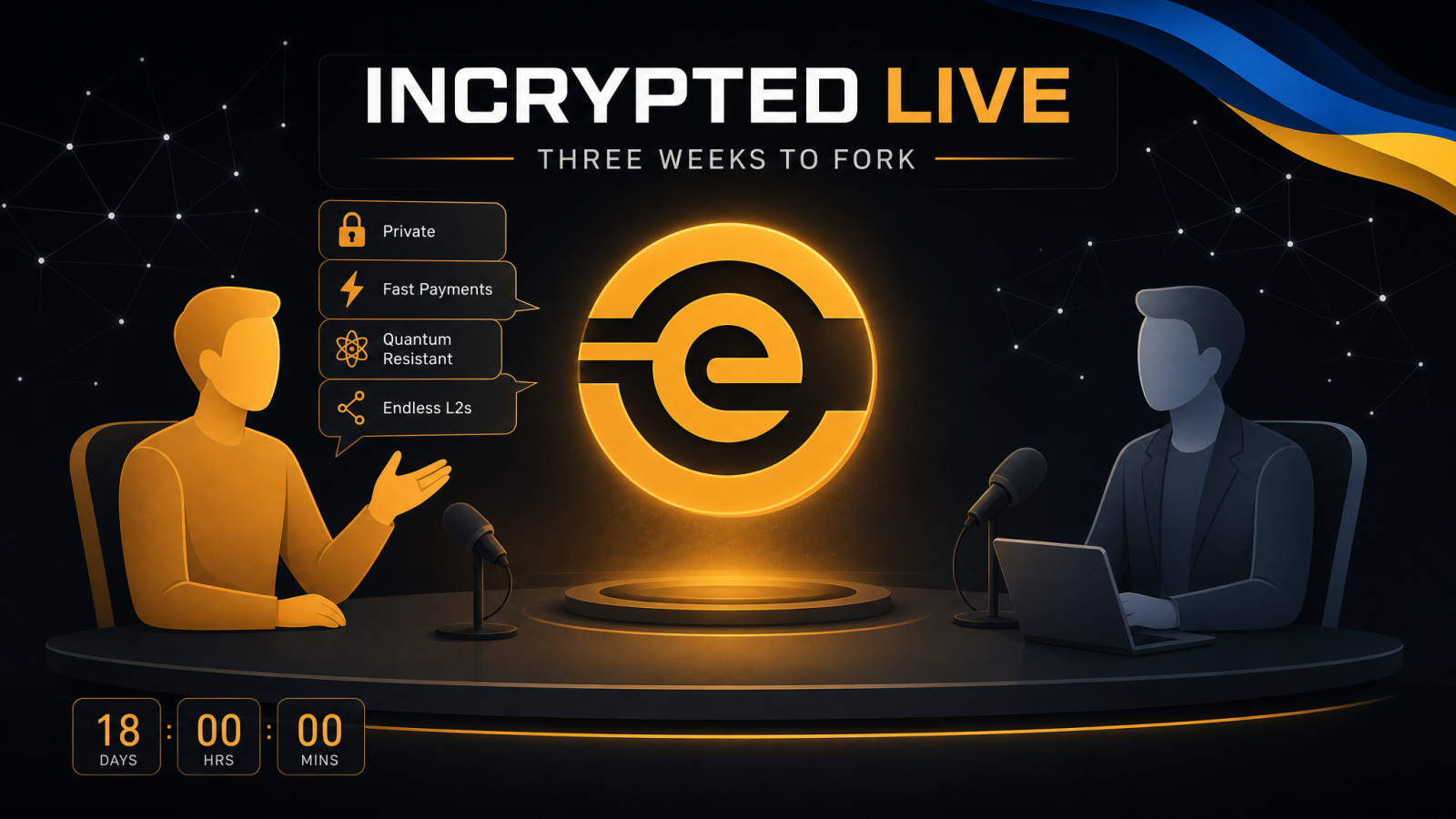
Paul Sztorc on Incrypted: Ukrainian Audiences Get the eCash Pitch, Three Weeks Before Launch
This is a summary and analysis of Paul Sztorc's August 3, 2026 appearance on Incrypted, a Ukrainian cryptocurrency media outlet, streamed live on YouTube and X. The wide-ranging ninety-minute conversation traced his path from Bitcoin skeptic to fork architect, and doubled as one of the most thorough public walkthroughs of the eCash (ECX) project to date, arriving with the hard fork less than three weeks away. The interview is availavle on YouTube and X.
Why This Interview, and Why Ukraine
Incrypted is one of the larger Ukrainian-language crypto education and media brands, and the choice of venue matters. Ukraine occupies a peculiar and instructive place in cryptocurrency's story. It is a country where digital assets stopped being a speculative abstraction and became infrastructure, a way for individuals around the world to route money directly to a nation at war when traditional rails were slow, restricted, or politically fraught.
The host nodded to this history, recalling the moment when Christine Lagarde was dismissing cryptocurrencies as "not money" even as Ukraine was receiving substantial donations in BTC and Ethereum. That tension, between institutional dismissal and grassroots utility, ran quietly beneath the whole conversation.
For a Ukrainian audience, then, the appeal of a project promising cheap, private, censorship-resistant, globally scalable money is not academic. It is the difference between a donation arriving and a donation being blocked. Sztorc, for his part, engaged warmly with his hosts, closed the interview with hopes for a swift and just end to the war, and accepted an open invitation to a future offline conference in Kyiv. The exchange was substantive, occasionally funny, and notably friendlier than the adversarial rooms Paul Sztorc has weathered elsewhere in recent months.
From Skeptic to OG
Asked the standard origin question, Paul Sztorc gave an unusually candid answer: he thought Bitcoin was nonsense at first. His initial encounter, around 2010 or 2011, came via the Free State Project's PorcFest, where libertarians were offering free Bitcoin to attendees.
"This is the silliest thing I've ever heard in my entire life," he recalled thinking. What changed his mind was not ideology but the Wired article on Silk Road. His reasoning was coldly logical. If people who wanted drugs badly enough to break laws and take risks were relying on this anonymous computer money, and it was holding up, then "it's actually working." That was more persuasive than any whitepaper.
With a background in economics, he already understood the inflation tax, the history of banking, and international payments, so the deeper appeal followed quickly. He immersed himself in the Bitcointalk forum back when a single person could still read every post, started a blog on the technology, and got his break in December 2014 when Adam Back linked to his writing during the proof-of-work versus proof-of-stake debates. From there came the conference circuit, TabConf, Scaling Bitcoin, Bitcoin++, and nearly every Bitcoin Magazine event.
The Derangements Thesis
The intellectual spine of everything Sztorc argued traces back to his essay "The Derangements of Bitcoin," a catalog of what he considers false beliefs the community clings to and refuses to correct. He does not object to institutional involvement per se.
His complaint is that "we have the wrong voices being influential." He is fine with Michael Saylor buying coins, but bristles when Saylor weighs in on ossification, or when BlackRock and the ETF issuers opine on quantum resistance, subjects on which, in his view, "they don't really know what they're talking about."
He also lamented a loss of accessibility that he frames almost sociologically. In 2011 or 2014 you could walk up to a company CEO at a conference booth or corner Barry Silbert at lunch. Today the conversation has fractured, a process he links to Dunbar's number, the notion that humans can sustain only around 150 real relationships. As Bitcoin scaled, the community splintered, and the altcoin proliferation followed the same social physics.
Drivechain, and the Blockstream Comparison
Pressed on why so many people argue with him, Paul Sztorc pointed to drivechain, his long-standing proposal for miner-secured, merge-mined sidechains. His explanation for the hostility was partly psychological and partly institutional. Drivechain, he argued, "makes a lot of stuff look worse by comparison."
He drew a pointed contrast with Blockstream, which raised roughly 21 million dollars in 2014 and another 55 million in 2015, plus hundreds of millions since, ostensibly to build sidechains, and then, in his telling, largely did not deliver on that original promise.
He returned to a story he clearly relishes, the paid Peter Todd critique. Layer Two Labs commissioned Todd, one of Bitcoin's most respected skeptics, to write against drivechain. The result, Sztorc claims, was wrong "every single sentence and paragraph," and revealed that Todd had not even visited the website, since he asserted no code existed when a graphical interface and codebase had been public for two and a half years.
The irony Sztorc drew from it was that paying for the best possible attack and getting a weak one only strengthened his conviction. He suspects other critics are simply "copying Peter's test," deferring to a critique that does not hold up.
Why Forks Are Rare, and Why Bitcoin Cash Failed
Sztorc thinks hard forks should happen far more often than they do, and blames what he calls the "Maxi cult," the psychological insistence on one team, one brand.
He walked through the history with the eye of someone who has studied it closely. Bitcoin Cash, he argued, was the only serious hard fork with a genuine vision, and it was riddled with mistakes: a bad core idea (large blocks on L1 rather than a small-block L1 with optional large-block L2s, which is precisely what drivechain does), a confusing shared name, terrible timing, and chaotic execution around SegWit2x and Amaury Séchet's launch.
Yet he was careful to credit its early market performance. Bitcoin Cash debuted around 15 percent of BTC's market cap, briefly flipped Ethereum on CoinMarketCap for a day, the origin of a well-known Vitalik Buterin tweet, and held roughly that share for its first week before slipping.
He extended the arithmetic to eCash with heavy caveats, noting that if Bitcoin is currently about five times Ethereum's size, a fork opening near 20 percent of BTC could theoretically claim the number two spot. He repeated, more than once, that he was not predicting this, only illustrating the historical range.
The eCash Rationale: A Life Raft, Cheaply Built
The core argument for forking now is cultural rather than technical. Bitcoin's problem, Sztorc insists, is not any single bug but an inability to fix bugs at all. He pointed to the absence of any soft fork since 2021, and his view that the last two, SegWit and Taproot, were misallocated toward supporting Lightning.
His solution is the CUSF, or Core Untouched Soft Fork, a QIF activator that turns on BIP 300 and 301 without altering Bitcoin Core's code, and could later add quantum-resistant signatures, OP_CAT, or OP_VAULT the same way.
His framing was relentlessly one of expected value. The fork is cheap to attempt. "If I'm wrong, all this stuff will go away and no one will really be affected that much other than that everyone got free eCash."
If he is right, it "rescued the project, the Bitcoin project." He compared the logic to mining itself, where each individual attempt is unlikely to succeed but cheap enough to be worth trying billions of times, and even reached, half-jokingly, for a "2 percent chance of ending a war" analogy before catching himself mid-sentence about AI content scanners.
The Name Question
Audience members pressed him repeatedly on the name, given that "eCash" already refers to Amaury Séchet's XEC chain, David Chaum's historic DigiCash, and the Chaumian mint projects like Cashu and Fedimint. Sztorc was unbothered.
The XEC project, he argued, is tiny and effectively dead. The domains ecash.com, ecash.org, and ecash.net were all available and cheap, which he takes as evidence the other projects were never serious about the name. He treats "eCash" as essentially generic, like "email," and noted the resonant historical detail that the first draft of Satoshi's whitepaper circulated under the filename ecash.pdf.
The Seven Sidechains
The most valuable segment for anyone tracking the project's launch readiness was the tour through the seven sidechains, five described as live and two in progress.
Thunder, the high-throughput payments chain, is the one Sztorc is proudest of. He described a performance contest last summer in which software generated an enormous transaction volume, then connected, disconnected, and reconnected blocks to time processing speed. The results, he claims, are reproducible on GitHub and exceed what Lightning can even attempt, with no liquidity or inbound-channel problems, no HTLCs, no sensitivity to L1 fee rates, and the ability to receive without being online or signing.
zSide ports Zcash's Orchard privacy technology as an L2, offering shielded addresses that hide sender, receiver, and amount, which he contrasts favorably with CoinJoin's small anonymity sets and coordinator requirements.
BitNames revives the Namecoin concept of scarce, unseizable, cryptographically owned names for decentralized identity and DNS, which Sztorc tied to real problems like phishing on darknet markets and platform deplatforming.
BitAssets handles NFTs and ERC20-style tokens, positioned as a cleaner answer to Ordinals and BRC-20, with an eye toward equity issuance and, notably, stablecoins. He confirmed a community-built USDT-style redeemable token is already being prepared so the chain need not wait for Tether itself.
Photon, the quantum-resistant chain, ships optional post-quantum signatures as a way to move the abstract quantum debate forward by giving people something concrete to test.
Truthcoin brings prediction markets, an idea Sztorc has championed since 2013 via Bitcoin Hivemind, long before Polymarket or Kalshi. He conceded it may not be fully operational at launch.
CoinShift, the most experimental, is a decentralized exchange that can require multiple L1 full nodes so it can become aware of altcoin transactions and swap between them.
Crucially, Sztorc stressed that the specific lineup matters less than the ability to add new L2s indefinitely. Even if every sidechain and every developer turned out to be bad, users could always launch a fresh L2, with coins converting at a one-to-one rate "like going to an ATM." He mentioned at least three more chains proposed by outside contributors, including an "Elements Plus" variant and a Rust-based EVM.
The Airdrop, and the Practical Advice
On mechanics, Sztorc's guidance to ordinary holders was straightforward. The single most important thing is self-custody of your BTC at the moment of the fork, since anyone holding through Coinbase, an ETF, or MicroStrategy is trusting a custodian who may pocket the airdrop, citing BlackRock's ETF language reserving the right to choose which side of a fork holders receive.
Passive holders who never move their coins can simply wait. Active users should study the coin-splitting process, which relies on an nLockTime trick that makes a transaction broadcastable instantly on ECX but not on Bitcoin for centuries, giving the two coins separate fates. A mobile wallet and splitting tool exist, though Sztorc acknowledged the friction of asking people to import private keys into unfamiliar software, and pointed to the third "dry run" practice fork and a multilingual explainer, available in English, Russian, and Polish, on the project's site.
He placed the launch "around August 23rd," citing time zones and block timing. Worth flagging for readers: the official ecash.com countdown lists activation as August 21, 2026, near block 964,000. Treat the exact day as approximate.
The Satoshi Coins: The Third Rail
The interview did not shy from the project's most controversial feature. Coins matching the Patoshi pattern, roughly 1.1 million BTC widely presumed to be Satoshi's, will not be mirrored one-to-one on eCash. Instead, Satoshi's addresses receive 600,000 ECX, and the remaining 500,000 go to the supporters and developers who built the project beforehand.
Sztorc defended this vigorously as an incentive mechanism rather than a theft, and framed it as something others should copy. His argument runs through expected value again. In a world where no one reassigns these coins, he contends, most good forks never get built, so holders would receive zero rather than 600,000.
By funding pre-launch work with coins that would otherwise sit dormant forever, the model "privatizes" the act of fixing broken networks, rewarding people proportionally to the effort they invest before launch. He was blunt that the coins are, in his view, abandoned, mined by a miner Satoshi ran only to move the network along, and that Satoshi retains no plans to touch them. He also drew the comparison to Ethereum projects airdropping tokens to Vitalik, who has sold such gifts and directed proceeds to Ukraine.
His sharpest rhetorical move was a dilemma for critics: either drivechain is a good idea, in which case one should ask why BTC is not doing it, or it is a bad idea, in which case "it's Satoshi's coins plus a bad idea, two bad ideas," and the project simply fails and harms no one.
Marketing by Subtraction
On growth, Sztorc rejected conventional marketing in favor of lowering barriers. His model is to make launching an L2 so cheap and templated that a lone developer can ship one in a single Saturday and keep all the glory as "benevolent dictator" of their own repository.
He invoked Jeremy Rubin and CTV, Vitalik and Ethereum, and Roger Ver and large blocks, all people who, he argued, tried and failed to build on Bitcoin and were forced into altcoins by Core's rigidity. eCash aims to remove that barrier entirely.
He leaned on the Tesla analogy, a wildly successful company that essentially never ran traditional ads, to argue that a great product plus organic distribution can substitute for a marketing budget, especially since crypto advertising is often banned or wasted when a single political headline tanks the market.
The hard fork itself, he suggested, is the distribution channel: every Bitcoiner now has a reason to investigate, because everyone gets free money.
Mining and the L1
On the technical foundation, Sztorc confirmed eCash uses SHA-256, identical to Bitcoin, and that the L1 is a near-exact copy of Bitcoin Core, unrenamed in the code to avoid breaking tests, with the intention of continuously merging Core's future releases.
Difficulty launches very low to attract miners. He also plugged the project's open-source mining pool, which pays out on the L2 for far more frequent settlements and could theoretically support billions of miners, and took a swipe at the opacity of existing BTC pool software and at Stratum V2, which he and a former contributor consider inadequate.
The State of the Project
Three weeks out, the picture Sztorc painted was of a project further along in engineering than in adoption, and comfortable with that gap. The software is being packaged through repeated dry runs, most sidechains are functional, the airdrop mechanics and documentation are published, and private pre-trading has reportedly ranged from 35 to 350 dollars per coin.
What remains uncertain is everything that cannot be coded: whether exchanges credit the fork, whether a critical mass of holders splits their coins, and whether the market rewards the ambition or shrugs.
Sztorc's own framing remained consistent to the end. eCash is a hedge, a life raft launched cheaply against the possibility that Bitcoin's culture is too "deranged" to save itself. If it fails, everyone got free coins and the community learned something about hard forks and drivechains.
If it succeeds, he believes it solved scaling, privacy, extensibility, and governance in one move. For an audience in Ukraine, where the practical value of unstoppable money is measured in more than theory, it was a pitch that landed on receptive ears, whatever the market ultimately decides on or around August 21.